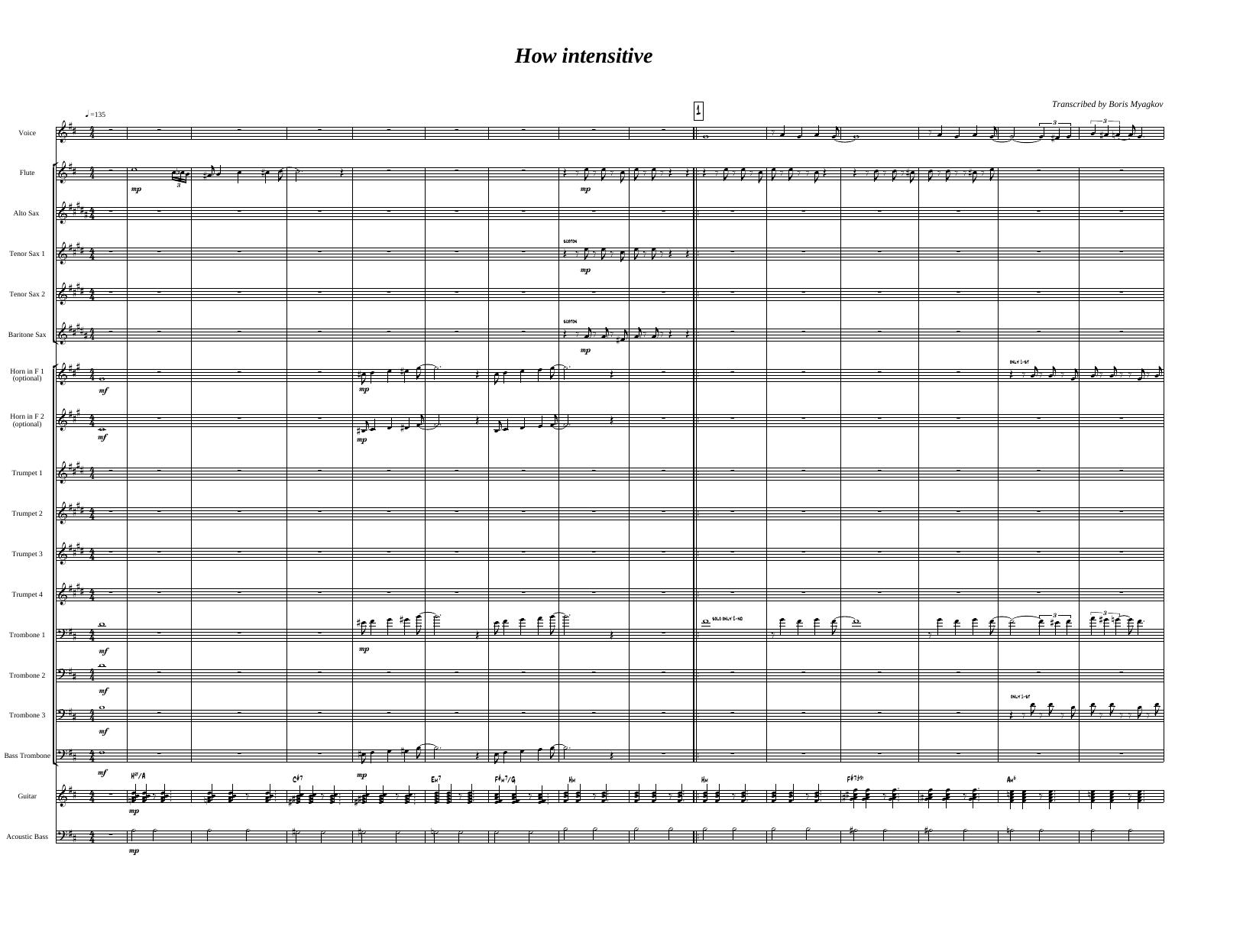
How Insensitive (B.Myagkov)
Composed by Antonio Carlos Jobim
Arranged by Boris Myagkov
- Ensemble: Big Band
- Pages: 24
- Instruments (19): Voice, Flute, Alto Sax, Tenor Sax 1, Tenor Sax 2, Baritone Sax, Horn in F 1, Horn in F 2, Trumpet 1, Trumpet 2, Trumpet 3, Trumpet 4, Trombone 1, Trombone 2, Trombone 3, Bass Trombone, Guitar, Strings, Acoustic Bass
- Difficulty: medium
- Content: Individual Parts
- Format: PDF Download (Instant)
- Price: $24.99
Antonio Carlos Jobim’s timeless bossa nova masterpiece "Insensatez," known to English-speaking audiences as "How Insensitive," stands as one of the definitive pillars of the Bossa Nova movement that swept the global jazz consciousness in the early 1960s. Drawing its melancholy harmonic foundation directly from Frédéric Chopin’s Prelude in E minor (Op. 28, No. 4), the composition bridges European romanticism with the cool, undulating rhythms of Rio de Janeiro. Immortalized by recordings from Stan Getz, João Gilberto, and Frank Sinatra, the tune has evolved from a defining 1962 Brazilian export into an essential jazz standard, prized for its descending chromatic basslines, haunting modal shifts, and an inherent dramatic tension that begs for sophisticated orchestral exploration. Boris Myagkov’s expansive big band adaptation transforms this introspective vocal vehicle into a sweeping, cinematic jazz orchestra experience. Set at a deliberate, breath-taking ballad tempo with an authentic bossa nova pulse, the chart balances lush, impressionistic chord clusters with moments of striking linear clarity. The arrangement opens with an atmospheric flute and reed introduction that establishes a misty, nocturnal mood before the vocal entry takes center stage. Myagkov utilizes the 19-piece ensemble not merely as accompaniment, but as an active contrapuntal partner, weaving transparent brass voicings and subtle woodwind counter-melodies around the lyric line. The emotional trajectory shifts from quiet resignation in the opening statements to a passionate, harmonically rich climax in the middle development section, ultimately resolving back to a tranquil, lingering cadence. Throughout the chart, the instrumental distribution highlights individual coloristic traits of the big band. The woodwind section doubles on flute and clarinets to create an airy, orchestral texture reminiscent of modern West Coast scoring, while the brass are muted and voiced in tight, gorgeous clusters that evoke the sophistication of Gil Evans or Claus Ogerman. A standout feature of Myagkov’s treatment is a lush sax soli that reharmonizes the secondary theme, challenging the section to blend with pristine intonation and flexible rubato phrasing over the steady rhythmic foundation of the rhythm section. An emotive, expressive solo space is provided for tenor saxophone, allowing the soloist to converse directly with the warm harmonic cushions of the surrounding brass. Advanced high school ensembles with mature sections, collegiate jazz orchestras, and professional big bands will find this arrangement an exceptional vehicle for developing stylistic versatility, dynamic control, and subtle ensemble listening. While the technical demands on individual players are moderate in terms of raw speed, the true challenge lies in the sophisticated rhythmic placement, long-tone control, and deep stylistic understanding required to pull off authentic bossa nova phrasing at a ballad tempo. It serves as a stunning concert centerpiece that rewards audiences with profound emotional depth and challenges musicians to prioritize beauty of sound and harmonic nuance over volume. Balancing the delicate acoustic interplay between the vocal soloist and the 19-piece big band requires rigorous dynamic restraint from the horn sections. The rhythm section must establish a hypnotic, understated bossa nova groove anchored by a subtle rimshot or brush pattern on the snare and a warm, woody acoustic bass tone that avoids heavy downbeat accents. Conductors should ensure the brass use warm, open tones or harmon mutes where indicated, strictly capping their volume at a mezzo-piano to let the vocal line breathe effortlessly over the ensemble. Pay meticulous attention to the chromatic voice-leading in the inner horn parts during the reharmonized shout passages; intonation slippage on the altered dominant chords will quickly muddy Myagkov's carefully crafted impressionistic colors. Rehearsals should begin with the rhythm and reed sections alone to lock in the delicate subdivision of the bossa pulse before layering in the sweeping brass counterlines. Q: What instruments and parts are included in this arrangement? A: This 19-instrument big band chart includes a full complement of parts consisting of Voice, Flute, Alto Saxophone, Tenor Saxophone 1, Tenor Saxophone 2, plus a complete standard big band brass and rhythm section alongside a comprehensive conductor score spanning 24 pages. Q: What is the difficulty level of this chart? A: This arrangement is graded as advanced, best suited for collegiate ensembles, advanced high school bands, and professional groups due to its sophisticated harmonic reading, demand for stylistic subtlety, and delicate dynamic control. Q: What style and historical context does this arrangement draw from? A: Rooted in the 1960s Bossa Nova movement pioneered by Antonio Carlos Jobim, this arrangement blends classic Brazilian rhythmic feels with modern, impressionistic jazz arranging traditions reminiscent of West Coast and arranger-orchestra styles. Q: What makes Boris Myagkov’s arrangement unique? A: Myagkov elevates a standard vocal vehicle into a cinematic tone poem through lush, impressionistic reharmonizations, extensive woodwind doubling, an exquisite sax soli, and an advanced contrapuntal approach that treats the 19-piece ensemble as a unified, expressive chamber orchestra. Q: What is the performance duration and tempo feel of this piece? A: The arrangement is designed as a dramatic, slow-tempo bossa nova ballad, typically clocking in around 4 to 5 minutes depending on the length of the improvised tenor saxophone solo and the conductor's preferred rubato phrasing.
Questions and answers
- What is included in the How Insensitive (B.Myagkov) PDF?
- The verified current file contains a conductor score and individual parts across 24 pages.
- How many instruments or parts are listed for How Insensitive (B.Myagkov)?
- The verified instrumentation list contains 19 entries for this Big Band arrangement.
- Who is credited for How Insensitive (B.Myagkov)?
- Composer: Antonio Carlos Jobim. Arranger: Boris Myagkov.
- What difficulty is listed for How Insensitive (B.Myagkov)?
- The verified difficulty level is medium.
- Can I preview How Insensitive (B.Myagkov) before buying?
- Yes. The product page provides a preview generated from the current PDF file.
- How is How Insensitive (B.Myagkov) delivered?
- After successful payment, the digital PDF is made available for download. The displayed price is $24.99.
Musicians Also Search For
How Insensitive Boris Myagkov PDF • How Insensitive Boris Myagkov sheet music • How Insensitive arranged by Boris Myagkov • Boris Myagkov big band charts • Boris Myagkov jazz arrangements PDF • How Insensitive Antonio Carlos Jobim sheet music • How Insensitive Antonio Carlos Jobim big band arrangements • Antonio Carlos Jobim big band charts • How Insensitive big band arrangements • How Insensitive big band PDF download • How Insensitive jazz sheet music • big band sheet music download • How Insensitive conductor score PDF • How Insensitive individual parts download • How Insensitive sheet music PDF • buy How Insensitive sheet music • download How Insensitive PDF • How Insensitive jazz charts • best Boris Myagkov big band arrangements • Antonio Carlos Jobim arranged by Boris Myagkov • How Insensitive printable sheet music • big band repertoire PDF