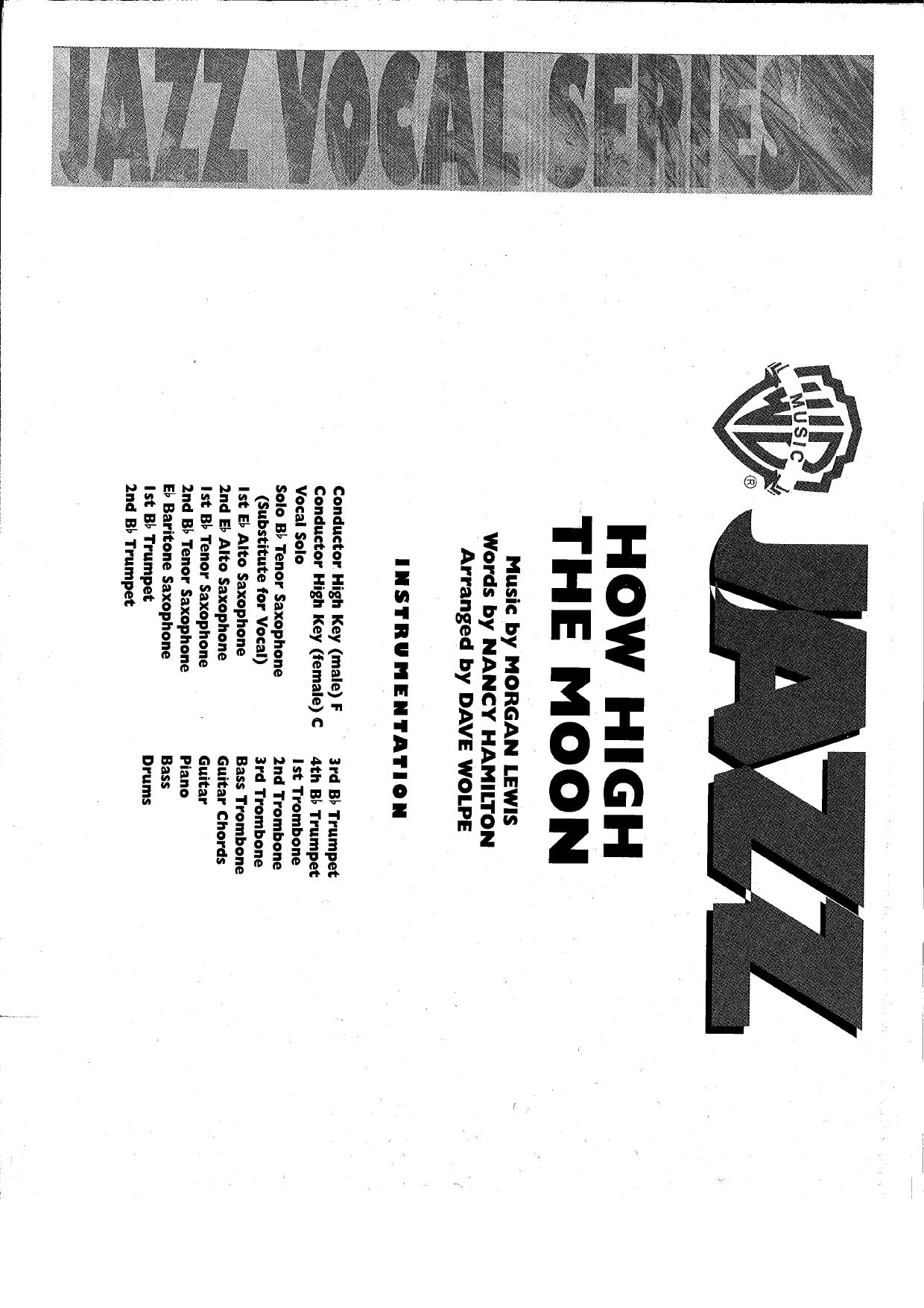
How HighTthe Moon (D.Wolpe)
Composed by Morgan Lewis
Arranged by Dave Wolpe
- Ensemble: Big Band Vocal
- Style: Bebop
- Pages: 95
- Instruments (19): Vocal Solo, Solo Bb Tenor Saxophone, 1st Eb Alto Saxophone, 2nd Eb Alto Saxophone, 1st Bb Tenor Saxophone, 2nd Bb Tenor Saxophone, Eb Baritone Saxophone, 1st Bb Trumpet, 2nd Bb Trumpet, 3rd Bb Trumpet, 4th Bb Trumpet, 1st Trombone, 2nd Trombone, 3rd Trombone, Bass Trombone, Guitar, Piano, Bass, Drums
- Difficulty: medium
- Content: Individual Parts
- Format: PDF Download (Instant)
- Price: $24.99
Morgan Lewis's "How High the Moon," composed in 1940 for the Broadway revue *Two for the Show*, quickly transcended its theatrical origins to become one of the most enduring and influential jazz standards of all time. Its distinctive AABA form, sophisticated harmonic progression (notably the I-VI-II-V turnaround in C major), and memorable melodic contour made it an immediate favorite among improvisers. The piece truly cemented its place in jazz history through iconic recordings by Ella Fitzgerald, whose virtuosic scat solos on the tune became legendary, and by bebop pioneers like Charlie Parker and Dizzy Gillespie, who frequently used its chord changes as the basis for their contrafacts, most famously Parker's "Ornithology." It represents a pivotal moment in jazz, bridging the swing era's melodic accessibility with the harmonic and rhythmic complexities that defined bebop. Dave Wolpe's arrangement of "How High the Moon" for big band and vocal soloist masterfully captures the ebullient spirit and harmonic sophistication of its bebop heritage. Set at a brisk, up-tempo swing, this chart immediately establishes an energetic, driving feel in 4/4 time. The arrangement is primarily in C major, maintaining the original's bright, optimistic character, yet Wolpe skillfully employs extended harmonies and reharmonizations that add a contemporary edge without sacrificing the tune's classic identity. The overall mood is exhilarating and virtuosic, designed to showcase both the vocalist's agility and the ensemble's precision. Wolpe's distinctive approach shines through in his meticulously crafted voicings and dynamic contrasts. The arrangement opens with a powerful, tightly voiced brass fanfare, immediately grabbing attention before the vocalist enters with the iconic melody. Soli sections for the saxophones are particularly noteworthy, featuring intricate lines that echo the bebop lexicon, demanding excellent articulation and blend. A hallmark of Wolpe's writing, the shout chorus is a true highlight here, building tension and excitement with layered brass and sax figures, culminating in a powerful climax. The arrangement provides ample space for improvisation, typically featuring a solo section for the vocalist, followed by instrumental solos (often tenor saxophone or trumpet), allowing for individual expression within the structured framework. Performing this arrangement is a rewarding challenge for advanced high school, college, community, and professional big bands. The up-tempo nature requires precise rhythmic execution from the rhythm section and crisp articulation from the horns. The brass parts feature demanding ranges and technical passages, while the saxophone soli requires a cohesive section sound. The vocal part demands a singer with strong improvisational skills and a comfortable upper range. The payoff, however, is immense: a thrilling, authentic bebop experience that showcases the band's collective prowess and leaves audiences energized. The interplay between the vocalist and the ensemble, particularly during the call-and-response sections and the driving shout chorus, creates a truly memorable musical moment. This arrangement of "How High the Moon" demands a tight, energetic performance at a brisk tempo, typically around quarter note = 220-240 BPM. The key technical challenge lies in maintaining rhythmic precision and crisp articulation, especially in the horn soli sections and the driving shout chorus. Conductors should emphasize a light, driving swing feel from the rhythm section, with particular attention to the walking bass line and the drummer's ride cymbal pattern. Brass players must focus on clean attacks and releases, ensuring accurate intonation in the often-dense voicings. Saxophone sections should rehearse their soli passages for blend and unified phrasing, aiming for a bright, cutting sound. The vocalist needs strong improvisational chops to navigate the bebop-infused changes. Rehearsal time should be dedicated to dynamic shaping, particularly building intensity into the shout chorus and ensuring clear separation between melodic lines and accompanying figures. Q: What instruments and parts are included in this arrangement? A: This arrangement is scored for a standard big band lineup: 5 saxophones (2 altos, 2 tenors, 1 baritone), 4 trumpets, 4 trombones, piano, bass, drums, and a dedicated vocal soloist part. Q: What is the difficulty level of Dave Wolpe's "How High the Moon"? A: This arrangement is rated as advanced (Grade 5), suitable for experienced high school, college, community, or professional jazz ensembles due to its up-tempo nature, technical demands, and complex harmonic language. Q: What musical style and historical context does this arrangement represent? A: This arrangement is firmly rooted in the bebop style, paying homage to the iconic jazz standard "How High the Moon" which gained prominence in the 1940s through artists like Ella Fitzgerald and Charlie Parker. Q: What makes Dave Wolpe's arrangement of "How High the Moon" unique? A: Wolpe's arrangement is distinguished by its vibrant, up-tempo swing feel, sophisticated bebop-inspired voicings, intricate saxophone soli sections, and a powerful, driving shout chorus, all designed to showcase both the vocalist and the full ensemble. Q: What is the typical performance duration and tempo for this piece? A: The typical performance duration for this arrangement is approximately 3-4 minutes, depending on the length of improvised solos. It is performed at a brisk, up-tempo swing, generally around quarter note = 220-240 BPM.
Questions and answers
- What is included in the How HighTthe Moon (D.Wolpe) PDF?
- The verified current file contains a conductor score and individual parts across 95 pages.
- How many instruments or parts are listed for How HighTthe Moon (D.Wolpe)?
- The verified instrumentation list contains 19 entries for this Big Band Vocal arrangement.
- Who is credited for How HighTthe Moon (D.Wolpe)?
- Composer: Morgan Lewis. Arranger: Dave Wolpe.
- What difficulty is listed for How HighTthe Moon (D.Wolpe)?
- The verified difficulty level is medium.
- What style is listed for How HighTthe Moon (D.Wolpe)?
- The catalog lists the style as Bebop.
- Can I preview How HighTthe Moon (D.Wolpe) before buying?
- Yes. The product page provides a preview generated from the current PDF file.
- How is How HighTthe Moon (D.Wolpe) delivered?
- After successful payment, the digital PDF is made available for download. The displayed price is $24.99.
Musicians Also Search For
How HighTthe Moon Dave Wolpe PDF • How HighTthe Moon Dave Wolpe sheet music • How HighTthe Moon arranged by Dave Wolpe • Dave Wolpe big band vocal charts • Dave Wolpe jazz arrangements PDF • How HighTthe Moon Morgan Lewis sheet music • How HighTthe Moon Morgan Lewis big band vocal arrangements • Morgan Lewis big band vocal charts • How HighTthe Moon big band vocal arrangements • How HighTthe Moon big band vocal PDF download • How HighTthe Moon jazz sheet music • big band vocal sheet music download • How HighTthe Moon conductor score PDF • How HighTthe Moon individual parts download • How HighTthe Moon sheet music PDF • How HighTthe Moon Bebop charts • Bebop big band vocal arrangements • buy How HighTthe Moon sheet music • download How HighTthe Moon PDF • How HighTthe Moon jazz charts • best Dave Wolpe big band vocal arrangements • Morgan Lewis arranged by Dave Wolpe • How HighTthe Moon printable sheet music • big band vocal repertoire PDF