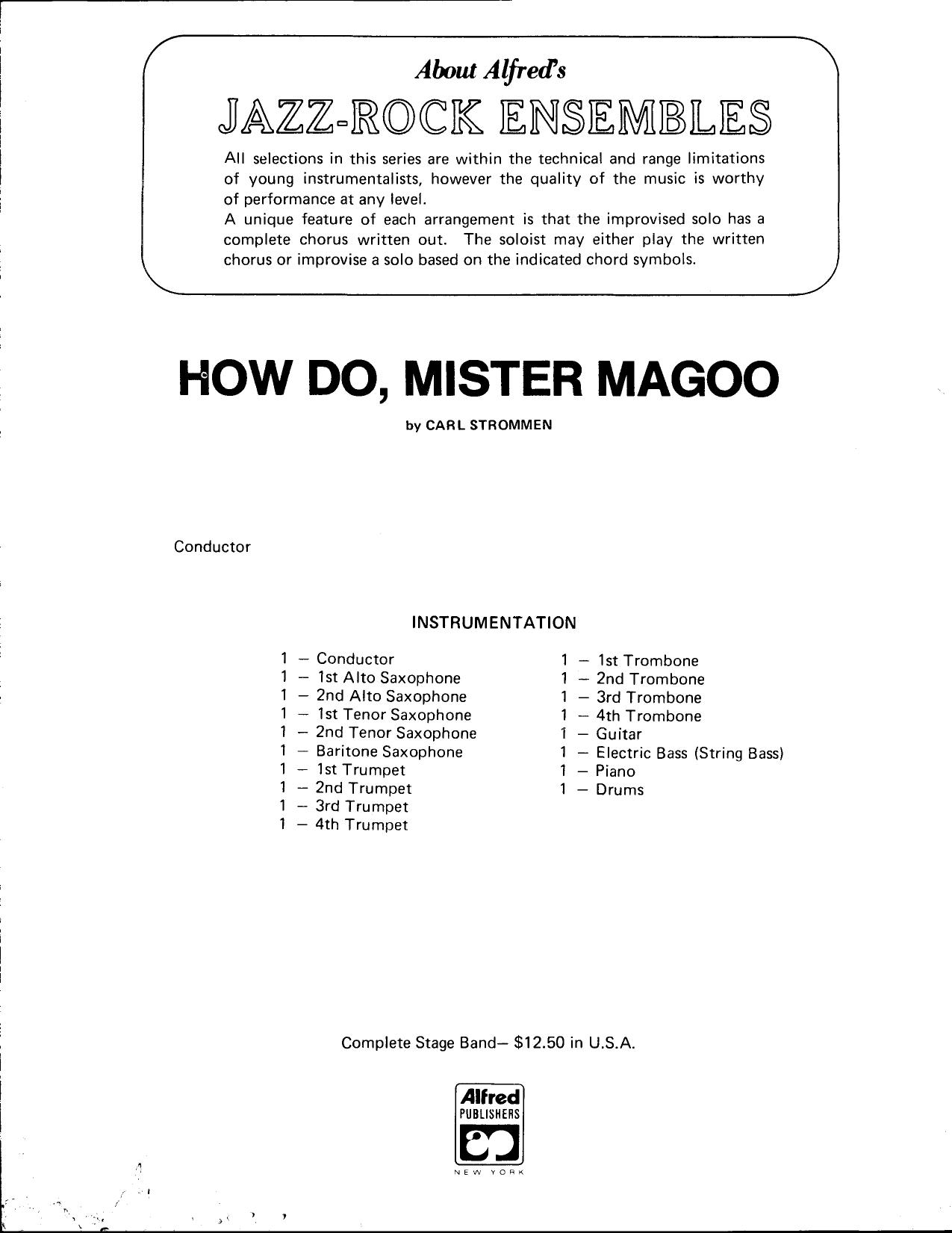
How Do, Mister Magoo (C.Strommen)
Composed by Carl Strommen
Arranged by Carl Strommen
- Ensemble: Big Band
- Pages: 36
- Instruments (18): Conductor, 1st Alto Saxophone, 2nd Alto Saxophone, 1st Tenor Saxophone, 2nd Tenor Saxophone, Baritone Saxophone, 1st Trumpet, 2nd Trumpet, 3rd Trumpet, 4th Trumpet, 1st Trombone, 2nd Trombone, 3rd Trombone, 4th Trombone, Guitar, Piano, Bass, Drums
- Difficulty: medium
- Content: Individual Parts
- Format: PDF Download (Instant)
- Price: $24.99
Carl Strommen’s dynamic big band chart "How Do, Mister Magoo" stands out as a masterclass in contemporary educational jazz writing, capturing the buoyant, witty spirit of mid-century swing while incorporating the sophisticated harmonic palette of modern jazz composition. Written by a prolific and highly respected figure in jazz education, this arrangement bridges the gap between classic swing-era drive and contemporary ensemble pedagogy. While not a historical transcription from a 1930s or 1940s territory band, Strommen’s original composition serves as a modern homage to the animated, character-driven jazz styles of composers like Neal Hefti and Sammy Nestico, offering a nostalgic yet entirely fresh narrative arc that immediately engages both performers and listeners. Built upon an infectious, driving medium-swing groove in 4/4 time, the piece radiates a playful, cinematic energy. The harmonic framework balances accessible diatonic structures with clever chromatic inflections, unexpected modal shifts, and sparkling extended chords that give the brass and reed sections a rich, sophisticated sonority. The emotional trajectory shifts delightfully from a cheeky, conversational head theme to a robust, high-energy shout chorus that demands crisp articulation and dynamic contrast. Strommen avoids predictable phrasing by weaving syncopated counter-lines throughout the ensemble, ensuring that every section—from the rhythm department to the topline horns—remains actively engaged in driving the narrative forward. Strommen’s signature arranging style shines through in the meticulous voice-leading and transparent scoring, which allows even developing ensembles to sound massive and unified. The melody is introduced by the saxophones with subtle brass punctuation before opening up into full-ensemble tutti passages. Sectional interplay is a defining hallmark of this chart; call-and-response figures trade effortlessly between the brass and reeds, punctuated by swinging plunger effects and tight rhythmic unison lines. A designated solo section provides a comfortable yet stimulating vehicle for featured improvisers, supported by a rhythmically active background-figure canvas that builds inevitable momentum toward the climatic modulation and final shout chorus. Advanced middle school, high school, and community big bands will find "How Do, Mister Magoo" to be an ideal repertoire choice for festival performances, Spring concerts, or adjudications. The chart rewards attention to detail, specifically regarding articulation uniformity (short, detached swing eighth notes versus legato phrasing) and dynamic balance. Because the technical demands are judiciously balanced with pedagogical foresight, directors can use this arrangement to teach essential jazz concepts—such as the stylistic interpretation of swing subdivisions, section blending, and stylistic contrast—without overwhelming players with excessive technical virtuosity. Success with "How Do, Mister Magoo" hinges on establishing an assertive, relaxed medium-swing tempo (around♩= 120–126). The rhythm section serves as the anchor; the drummer must maintain a steady, unhurried ride cymbal "spang-a-lang" pattern with crisp hi-hat closures on beats two and four, avoiding any tendency to rush the triplets. Horn players should carefully observe all articulated accents, ensuring that unaccented notes are appropriately de-emphasized to achieve an authentic jazz articulation. Pay close attention to the dynamic markings during the saxophone soli; the underlying rhythm section must back off dynamically to let the reed lines project clearly without forced tone production. When executing the scripted fall-offs and doits, maintain pitch center until the very end of the gesture. Rehearsal should initially isolate the syncopated background figures behind the soloist to ensure the ensemble locks in precisely with the bass line before integrating the soloist's space. Q: What instrumentation and parts are included in this publication? A: The arrangement is scored for a standard 17-piece big band instrumentation, featuring 2 alto saxophones, 2 tenor saxophones, 1 baritone saxophone, 4 trumpets, 4 trombones, and a complete rhythm section of piano, guitar, bass, and drums, along with full conductor score and individual instrumental parts spanning 36 total pages. Q: What is the difficulty level of this arrangement? A: This piece is graded as Medium (or Grade 3.5), making it exceptionally well-suited for advanced high school jazz ensembles, college lab bands, and competent community big bands looking for a rewarding, style-conscious chart. Q: What is the musical style and historical context of "How Do, Mister Magoo"? A: Composed and arranged by Carl Strommen, the piece is written in a swinging, contemporary big band style that evokes the witty character-jazz tradition of mid-20th-century Hollywood animation and classic studio jazz writing. Q: What makes this specific arrangement unique within the big band repertoire? A: Strommen’s expert pedagogical writing ensures that complex-sounding harmonies and interactive counter-melodies are accessible to developing players, allowing bands to achieve a professional, rich ensemble sound without relying on extreme technical pyrotechnics. Q: What is the performance duration and recommended tempo for this chart? A: The arrangement runs approximately 3 to 4 minutes in duration and is designed to be performed at a comfortable medium-swing tempo of approximately 120 beats per minute.
Questions and answers
- What is included in the How Do, Mister Magoo (C.Strommen) PDF?
- The verified current file contains a conductor score and individual parts across 36 pages.
- How many instruments or parts are listed for How Do, Mister Magoo (C.Strommen)?
- The verified instrumentation list contains 18 entries for this Big Band arrangement.
- Who is credited for How Do, Mister Magoo (C.Strommen)?
- Composer: Carl Strommen. Arranger: Carl Strommen.
- What difficulty is listed for How Do, Mister Magoo (C.Strommen)?
- The verified difficulty level is medium.
- Can I preview How Do, Mister Magoo (C.Strommen) before buying?
- Yes. The product page provides a preview generated from the current PDF file.
- How is How Do, Mister Magoo (C.Strommen) delivered?
- After successful payment, the digital PDF is made available for download. The displayed price is $24.99.
Musicians Also Search For
How Do, Mister Magoo Carl Strommen PDF • How Do, Mister Magoo Carl Strommen sheet music • How Do, Mister Magoo arranged by Carl Strommen • Carl Strommen big band charts • Carl Strommen jazz arrangements PDF • How Do, Mister Magoo Carl Strommen big band arrangements • How Do, Mister Magoo big band arrangements • How Do, Mister Magoo big band PDF download • How Do, Mister Magoo jazz sheet music • big band sheet music download • How Do, Mister Magoo conductor score PDF • How Do, Mister Magoo individual parts download • How Do, Mister Magoo sheet music PDF • buy How Do, Mister Magoo sheet music • download How Do, Mister Magoo PDF • How Do, Mister Magoo jazz charts • best Carl Strommen big band arrangements • How Do, Mister Magoo printable sheet music • big band repertoire PDF