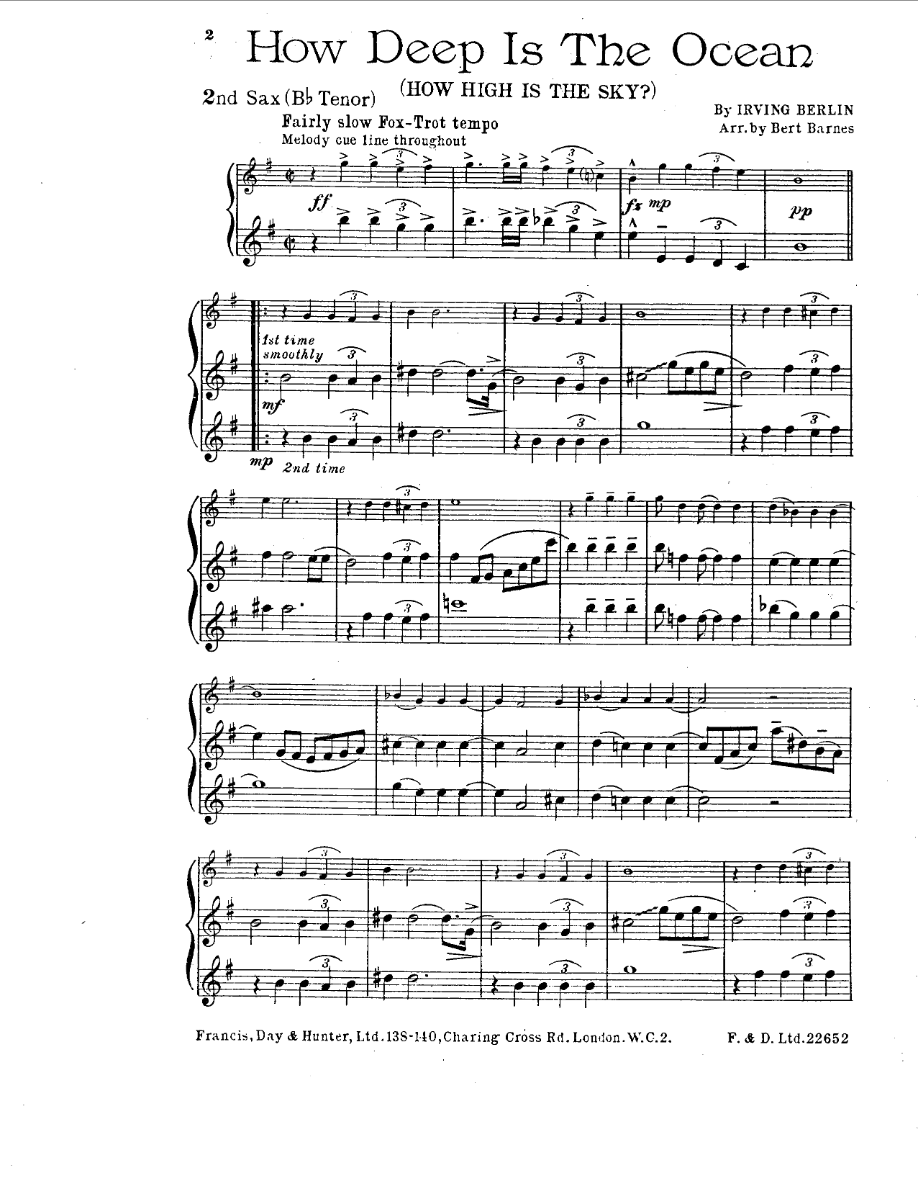
How Deep Is The Ocean (B.Barnes) sheet music preview

How Deep Is The Ocean (B.Barnes)

Composed by Irving Berlin

Arranged by B. Barnes

  • Ensemble: Big Band Dance
  • Style: Foxtrot
  • Pages: 16
  • Instruments (17): Alto Saxophone 1, Alto Saxophone 2, Tenor Saxophone 1, Tenor Saxophone 2, Baritone Saxophone, Trumpet 1, Trumpet 2, Trumpet 3, Trumpet 4, Trombone 1, Trombone 2, Trombone 3, Bass Trombone, Piano, Bass, Drums, Guitar
  • Difficulty: easy
  • Content: Individual Parts
  • Format: PDF Download (Instant)
  • Price: $24.99

Irving Berlin's timeless ballad, "How Deep Is The Ocean," emerged in 1932, a poignant reflection of the Great Depression era, yet imbued with an enduring romanticism that transcended its challenging origins. Quickly embraced by the public, it became a staple for crooners and dance bands, solidifying its status as a foundational piece in the Great American Songbook and an indispensable jazz standard. Its elegant melody and sophisticated harmonic progression made it a favorite for improvisation, ensuring its longevity through countless interpretations by jazz legends from Billie Holiday to Frank Sinatra. This particular arrangement by B. Barnes reimagines this classic as a captivating Foxtrot, transporting listeners and performers to the golden age of big band dance music while retaining the emotional depth of Berlin's original. B. Barnes's treatment of "How Deep Is The Ocean" is a masterclass in big band dance arranging, specifically tailored for the "big_band_dance" ensemble type. Eschewing a purely swing feel, Barnes meticulously crafts a medium-tempo Foxtrot groove, emphasizing a smooth, gliding rhythmic foundation perfect for ballroom dancing. The arrangement opens with a lush, harmonically rich introduction, immediately setting a sophisticated tone. Barnes's signature can be heard in the intricate voicings, which are full and warm, often employing close harmony in the saxophone section soli passages and rich brass chords that swell and recede with dynamic precision. The arrangement maintains a consistent key, allowing the melodic beauty to shine through without jarring modulations, focusing instead on harmonic color and rhythmic subtlety. The melody is primarily carried by the lead alto saxophone in the initial statements, offering a lyrical and expressive voice, often supported by the other saxophones in a beautifully blended soli. Subsequent melodic statements are passed between sections, including a powerful, yet controlled, brass soli that showcases the ensemble's blend and balance. While "How Deep Is The Ocean" is often a feature for a vocalist or soloist, Barnes's arrangement focuses on the ensemble's collective expression, presenting a fully orchestrated journey through the tune. There are no extended improvised solo sections, making it ideal for bands that prioritize tight ensemble playing and polished presentation. The technical challenges lie in achieving the precise Foxtrot feel, maintaining impeccable intonation within the dense voicings, and executing the nuanced dynamics that give the arrangement its characteristic elegance. It is a rewarding piece for its ability to evoke a bygone era of sophisticated dance halls and for the sheer satisfaction of performing a meticulously crafted big band arrangement. This arrangement is ideally suited for college-level jazz ensembles, community big bands, or semi-professional groups seeking to expand their repertoire with authentic dance band material. Its demands for blend, balance, and rhythmic precision make it an excellent teaching tool for developing ensemble cohesion, while its accessible Foxtrot tempo ensures it remains engaging for both performers and audiences. The 17-instrument orchestration (including a full saxophone section, four trumpets, four trombones, and a standard rhythm section) provides ample opportunity for a complete big band to shine, delivering a performance that is both historically informed and musically compelling. Conductors should emphasize a consistent, relaxed medium-tempo Foxtrot feel, avoiding any tendency to rush or swing the eighth notes. The rhythm section must lay down a solid, unhurried foundation, with the bass providing a steady walking line and the drums maintaining a light, driving brush or stick pattern that supports the dance rhythm. Intonation within the dense saxophone and brass voicings is paramount; encourage players to listen across sections and tune carefully, especially in sustained chords. Dynamics are crucial for shaping the arrangement's elegance; pay close attention to crescendos and diminuendos, ensuring they are smooth and controlled. There are no special techniques like plunger mutes or falls required, focusing instead on clean articulation and blend. Rehearsal time should be dedicated to perfecting the ensemble's balance, ensuring no single voice dominates the rich harmonic tapestry. Q: What instruments are included in this arrangement? A: This arrangement is scored for a full 17-instrument big band dance ensemble, including Alto Saxophone 1, Alto Saxophone 2, Tenor Saxophone 1, Tenor Saxophone 2, Baritone Saxophone, Trumpet 1-4, Trombone 1-4, Piano, Bass, Guitar, and Drums. Q: What is the difficulty level of this arrangement? A: This arrangement is suitable for college-level, community, or semi-professional big bands. Its challenges lie in achieving precise ensemble blend, intonation within rich voicings, and maintaining a consistent medium-tempo Foxtrot feel, rather than extreme technical demands for individual players. Q: What musical style and historical context does this arrangement represent? A: This arrangement presents Irving Berlin's classic "How Deep Is The Ocean" as a Foxtrot, a popular dance style from the 1930s. It embodies the sophisticated big band dance music of that era, focusing on ensemble playing rather than extended jazz improvisation. Q: What makes B. Barnes's arrangement of "How Deep Is The Ocean" unique? A: B. Barnes's unique approach transforms this ballad into a refined Foxtrot, emphasizing lush, intricate voicings and a smooth dance groove. The arrangement features melodic passages shared across sections, highlighting ensemble precision and a classic big band sound without relying on improvised solos. Q: What is the approximate performance duration or tempo of this piece? A: The arrangement is designed for a medium-tempo Foxtrot feel, typically around 110-120 BPM. The exact performance duration will depend on the chosen tempo, but it generally falls within the standard 3-4 minute range for a big band dance chart.

Musicians Also Search For

How Deep Is The Ocean B. Barnes PDFHow Deep Is The Ocean B. Barnes sheet musicHow Deep Is The Ocean arranged by B. BarnesB. Barnes big band dance chartsB. Barnes jazz arrangements PDFHow Deep Is The Ocean Irving Berlin sheet musicHow Deep Is The Ocean Irving Berlin big band dance arrangementIrving Berlin big band dance chartsHow Deep Is The Ocean big band dance arrangementHow Deep Is The Ocean big band dance PDF downloadHow Deep Is The Ocean jazz ensemble sheet musicbig band dance sheet music instant downloadHow Deep Is The Ocean individual parts downloadHow Deep Is The Ocean sheet music with partsHow Deep Is The Ocean Foxtrot chartFoxtrot big band dance arrangementsbuy How Deep Is The Ocean sheet music onlinedownload How Deep Is The Ocean PDFHow Deep Is The Ocean jazz chartbest B. Barnes big band dance arrangementsIrving Berlin songs arranged by B. BarnesHow Deep Is The Ocean printable sheet musicbig band dance repertoire PDF

All arrangements by B. Barnes All Irving Berlin sheet music