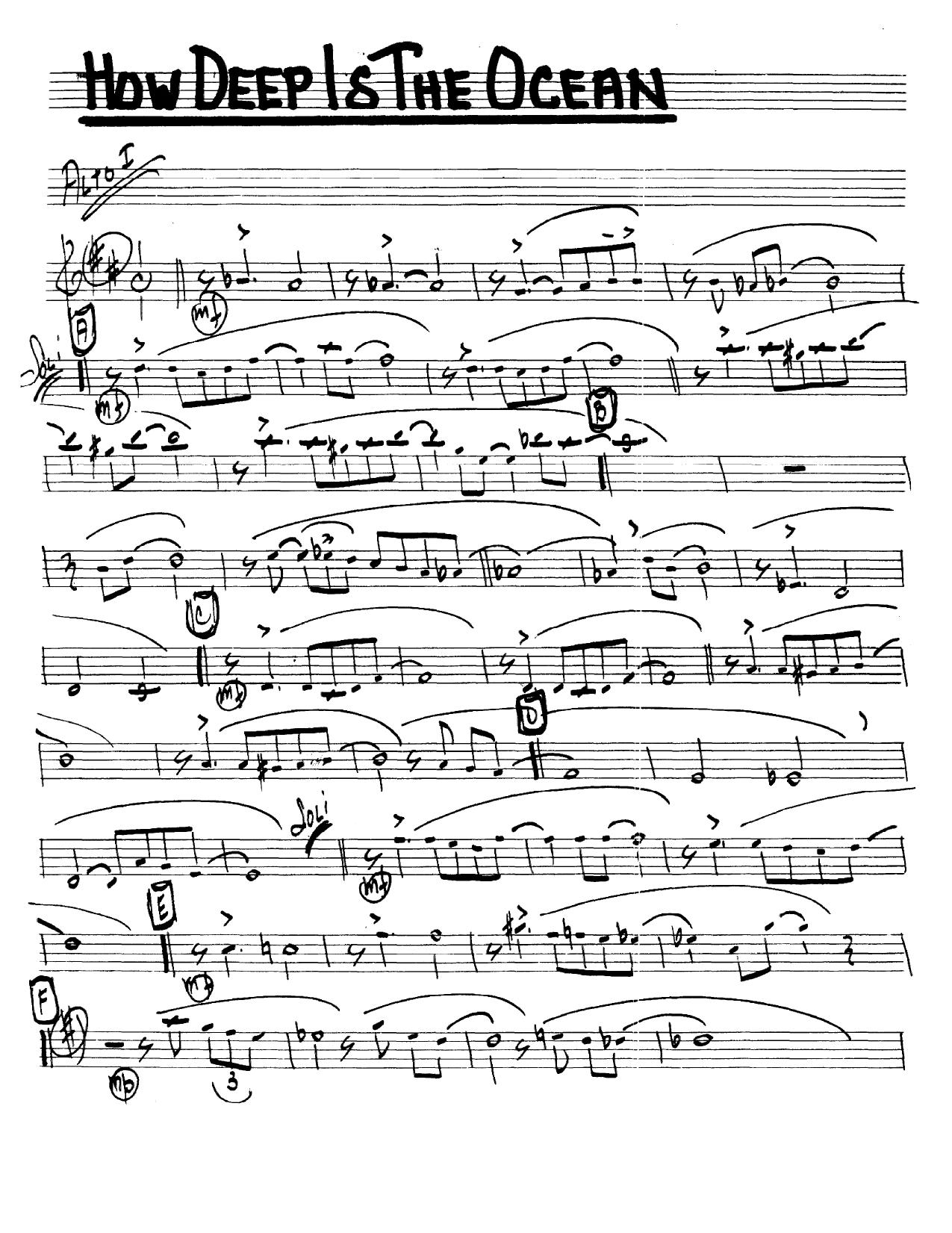
How Deep Is The Ocean
Composed by Irving Berlin
Arranged by Unknown
- Ensemble: Big Band
- Style: Jazz Standard
- Pages: 34
- Instruments (17): Alto Saxophone I, Alto Saxophone II, Tenor Saxophone I, Tenor Saxophone II, Baritone Saxophone, Trumpet I, Trumpet II, Trumpet III, Trumpet IV, Trombone I, Trombone II, Trombone III, Trombone IV, Guitar, Bass, Drums, Piano
- Difficulty: medium
- Content: Individual Parts
- Format: PDF Download (Instant)
- Price: $24.99
Irving Berlin's timeless ballad, "How Deep Is The Ocean," emerged in 1932, a poignant reflection of the Great Depression era, yet imbued with an enduring romanticism that transcended its challenging times. Penned by one of America's most prolific and beloved songwriters, the piece quickly became a staple, its melancholic yet hopeful melody resonating deeply with audiences. While Bing Crosby's 1932 recording cemented its initial popularity, it was later embraced by countless jazz luminaries, including Billie Holiday, Frank Sinatra, and Miles Davis, solidifying its status as an indispensable jazz standard. Its harmonic sophistication, characterized by a journey through rich, often unexpected chord changes, offers fertile ground for improvisation and arrangement, making it a perennial favorite for both performers and listeners. This particular big band arrangement of "How Deep Is The Ocean" presents the classic standard as a medium swing ballad, maintaining the original's introspective mood while infusing it with the lush textures and rhythmic drive characteristic of a well-crafted big band chart. The key is thoughtfully chosen to allow for both expressive melodic lines and full-bodied brass and saxophone voicings. The overall mood is one of sophisticated yearning and tender reflection, evoking the classic sounds of the mid-20th century big band era. The arrangement expertly balances the inherent lyrical beauty of Berlin's melody with the dynamic capabilities of a large ensemble, creating a rich sonic tapestry that is both emotionally resonant and musically engaging. The arranger, though unknown, demonstrates a clear understanding of big band writing conventions, employing classic techniques to elevate the piece. The melody is initially carried by the alto saxophone, offering a smooth, expressive lead, before transitioning to a full saxophone section soli that showcases intricate voicings and blend. Brass punches are strategically placed, adding emphasis without overpowering the delicate melodic lines. A notable feature is the inclusion of a featured trumpet solo, providing an opportunity for an accomplished improviser to interpret the changes with creativity and flair. The arrangement builds dynamically, culminating in a powerful, yet controlled, shout chorus that brings the ensemble to a satisfying peak before settling back into a reflective coda. This careful construction makes the piece rewarding to perform, offering each section moments to shine while contributing to a cohesive whole. This arrangement is ideally suited for college-level jazz ensembles, advanced community bands, or professional groups seeking a sophisticated and emotionally rich ballad for their repertoire. The harmonic language and rhythmic nuances require a solid understanding of jazz idiom and ensemble playing, particularly in terms of blend, balance, and dynamic control. The featured solo provides a significant challenge and opportunity for an experienced soloist. The chart's ability to convey deep emotion through its carefully constructed voicings and dynamic shifts makes it a standout addition to any big band library, promising a rewarding performance experience for both musicians and audience. Conductors should emphasize a consistent, relaxed medium swing feel from the outset, ensuring the rhythm section lays down a solid, unhurried foundation. The initial alto saxophone melody requires a warm, sustained tone and precise phrasing to convey its inherent lyricism. Pay close attention to the saxophone soli sections, focusing on tight articulation and blend to achieve a unified, rich sound. Brass entries should be crisp and supportive, never overpowering the melodic content; careful dynamic control is paramount. The featured trumpet solo offers an opportunity for expressive improvisation over the changes; encourage the soloist to explore the harmonic landscape with sensitivity. Rehearsal time should be dedicated to balancing the ensemble during the build-up to the shout chorus, ensuring clarity in all voices. Mutes, specifically cup mutes for brass, may be employed subtly in background figures to add texture, though not explicitly notated. Q: What instruments are included in this arrangement? A: This arrangement is scored for a standard big band with 9 instruments: Alto Saxophone 1, Tenor Saxophone 1, Baritone Saxophone, Trumpet 1, Trumpet 2, Trombone 1, Piano, Bass, and Drums. Q: What is the difficulty level of this arrangement? A: This arrangement is considered advanced intermediate to advanced, suitable for college-level jazz ensembles, advanced community bands, or professional groups due to its harmonic complexity, nuanced dynamics, and featured solo. Q: What is the musical style and historical context of "How Deep Is The Ocean"? A: "How Deep Is The Ocean" is a classic jazz standard, originally composed by Irving Berlin in 1932. This arrangement presents it as a medium swing ballad, evoking the sophisticated big band sound of the mid-20th century. Q: What makes this specific arrangement unique? A: This arrangement features a lyrical alto saxophone lead, intricate saxophone section solis, strategically placed brass punches, and a prominent featured trumpet solo, all contributing to a rich, emotionally resonant big band interpretation of the standard. Q: What is the typical performance duration and tempo for this piece? A: As a medium swing ballad, the performance duration typically ranges from 4 to 5 minutes, depending on the tempo chosen and the length of the featured solo. The tempo should be a relaxed medium swing, around 100-110 beats per minute.
Questions and answers
- What is included in the How Deep Is The Ocean PDF?
- The verified current file contains individual parts across 34 pages.
- How many instruments or parts are listed for How Deep Is The Ocean?
- The verified instrumentation list contains 17 entries for this Big Band arrangement.
- Who is credited for How Deep Is The Ocean?
- Composer: Irving Berlin. Arranger: Unknown.
- What difficulty is listed for How Deep Is The Ocean?
- The verified difficulty level is medium.
- What style is listed for How Deep Is The Ocean?
- The catalog lists the style as Jazz Standard.
- Can I preview How Deep Is The Ocean before buying?
- Yes. The product page provides a preview generated from the current PDF file.
- How is How Deep Is The Ocean delivered?
- After successful payment, the digital PDF is made available for download. The displayed price is $24.99.
Musicians Also Search For
How Deep Is The Ocean Unknown PDF • How Deep Is The Ocean Unknown sheet music • How Deep Is The Ocean arranged by Unknown • Unknown big band charts • Unknown jazz arrangements PDF • How Deep Is The Ocean Irving Berlin sheet music • How Deep Is The Ocean Irving Berlin big band arrangements • Irving Berlin big band charts • How Deep Is The Ocean big band arrangements • How Deep Is The Ocean big band PDF download • How Deep Is The Ocean jazz sheet music • big band sheet music download • How Deep Is The Ocean individual parts download • How Deep Is The Ocean sheet music PDF • How Deep Is The Ocean Jazz Standard charts • Jazz Standard big band arrangements • buy How Deep Is The Ocean sheet music • download How Deep Is The Ocean PDF • How Deep Is The Ocean jazz charts • best Unknown big band arrangements • Irving Berlin arranged by Unknown • How Deep Is The Ocean printable sheet music • big band repertoire PDF