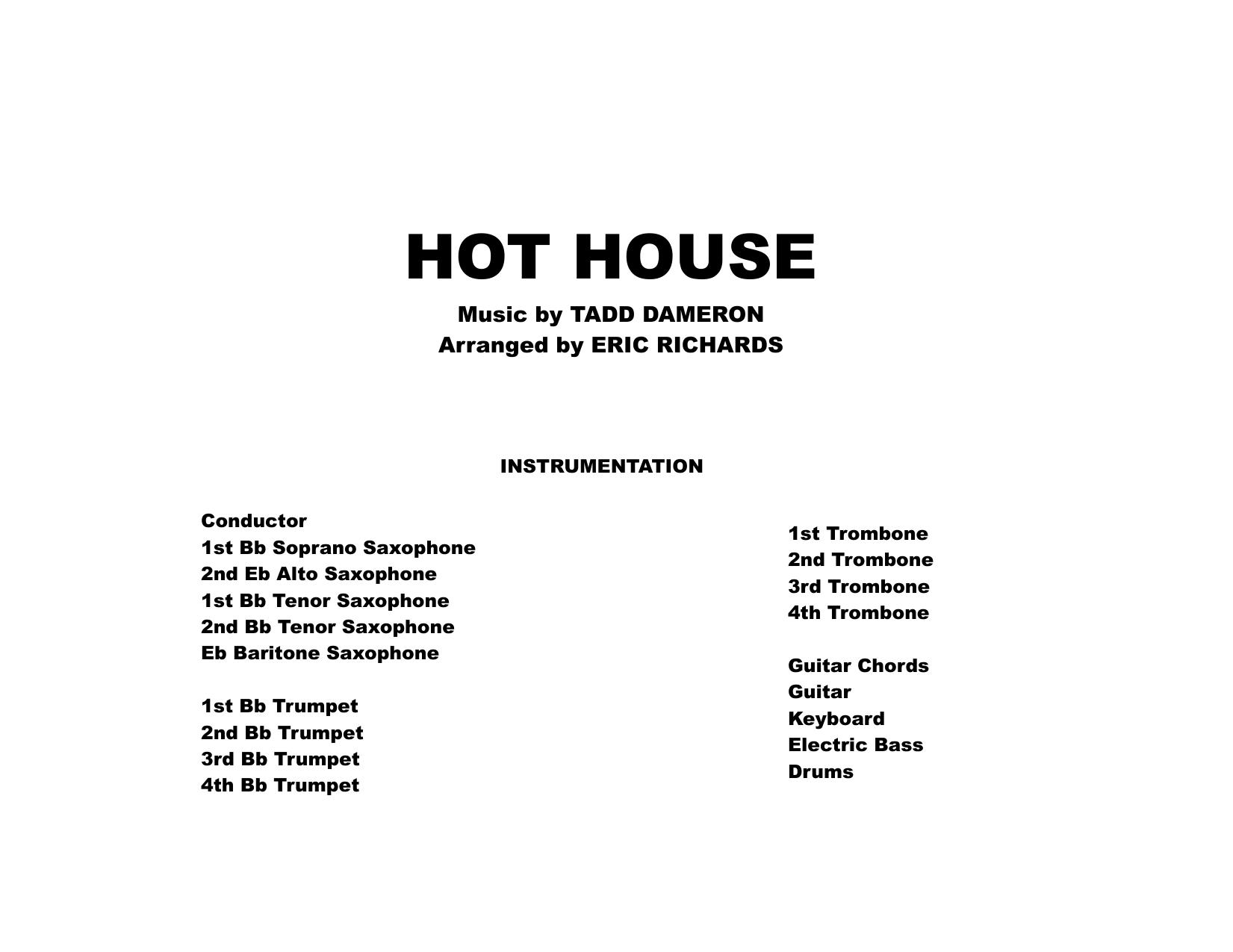
Hot House (E.Richards)
Composed by Charlie Parker
Arranged by Eric Richards
- Ensemble: Big Band
- Pages: 106
- Instruments (18): 1st Bb Soprano Sax, 1st Eb Alto Saxophone (Optional replacement for Sop. Sax 1), 2nd Eb Alto Saxophone, 1st Bb Tenor Saxophone, 2nd Bb Tenor Saxophone, Eb Baritone Saxophone, 1st Bb Trumpet, 2nd Bb Trumpet, 3rd Bb Trumpet, 4th Bb Trumpet, 1st Trombone, 2nd Trombone, Trombone III, 4th Trombone (bass), Guitar, Keyboard, Electric Bass, Drum Set
- Difficulty: advanced
- Content: Individual Parts
- Format: PDF Download (Instant)
- Price: $24.99
Bebop royalty meets contemporary big band sophistication in this dynamic adaptation of Tadd Dameron’s iconic anthem, originally made immortal by the legendary collaborations of Charlie Parker and Dizzy Gillespie. Written over the chord changes of "What Is This Thing Called Love?", "Hot House" stands as a cornerstone of the 1945 bebop revolution, prized for its angular, high-velocity head and relentless harmonic momentum. In this definitive interpretation, acclaimed composer and arranger Eric Richards harnesses the raw, pioneering energy of the original 52nd Street recording and filters it through a modern, finely crafted compositional lens, creating an electrifying showcase for advanced jazz orchestras. Driven by an unrelenting, high-octane tempo and a blistering swing feel, the arrangement explodes out of the gate with characteristic bebop urgency before expanding into wide, contemporary harmonic landscapes. Richards employs brilliant tonal coloring, pitting razor-sharp sax solis against roaring, brass-heavy counterlines that highlight the advanced capabilities of a 17-piece modern big band. The iconic melody is traded deftly between sections, demanding exceptional articulation, nimble finger technique, and absolute precision. As the chart builds toward its explosive, multi-tiered shout chorus, tension mounts through ingenious modulations and dense, extended chord voicings that push the ensemble to dynamic extremes without ever losing the grease and swing of the bebop idiom. Solo opportunities are a central focal point of this chart, providing ample space for featured improvisers—traditionally on alto saxophone and trumpet—to stretch out over rhythm-changes-adjacent modal shifts and rapid-fire changes. The underlying rhythm section is treated as an active, conversational partner rather than a mere timekeeping unit, with the drum chair requiring crisp ride-cymbal definition, driving comping, and interactive trade-offs with the horns. The sheer density of the writing, spanning 106 pages of comprehensive full-score and part materials, ensures that every section remains thoroughly engaged from the first downbeat to the final crashing chord. Advanced high school, collegiate, and professional jazz ensembles will find this chart to be an exhilarating centerpiece for festival performance or concert programming. It demands mature section playing, immaculate intonation on complex modern extensions, and stamina, yet it rewards the performers with an authentic, adrenaline-fueled jazz experience that consistently electrifies audiences. Richards has successfully bridged the historical gap between 1940s bebop innovation and twenty-first-century big band power, resulting in a mandatory addition to the advanced contemporary repertoire. Navigating Eric Richards' high-octane adaptation of "Hot House" requires meticulous attention to articulation, endurance, and rhythmic pocket. At a brisk, traditional bebop tempo, the primary technical challenge lies in the execution of rapid eighth-note lines; the entire ensemble must articulate with a light, forward-moving tongue, ensuring that the swing eighths remain even and unhurried despite the velocity. Conductors should spend early rehearsals working with the rhythm section in isolation. The piano and guitar should avoid heavy, clunky comping, opting instead for sparse, rhythmic stabs that complement the walking bassline without cluttering the harmonic texture. Horn players must balance their dynamics carefully during dense tutti passages to let internal countermelodies pierce through the wall of sound. Pay close attention to dynamic contrast—subdued, whispering ensemble passages must snap instantly into roaring, full-volume shout choruses with zero lag in projection or pitch center. No special plunger mutes or unorthodox extended techniques are required, allowing the ensemble to focus entirely on pure, acoustic power, precise intonation, and authentic bebop phrasing. Q: What instruments and parts are included in this arrangement? A: This 17-instrument big band chart includes a full complement: 1st Bb Soprano Saxophone, 2nd Eb Alto Saxophone, 1st Bb Tenor Saxophone, 2nd Bb Tenor Saxophone, Eb Baritone Saxophone, four trumpets, four trombones, guitar, piano, bass, drums, and a comprehensive 106-page conductor score. Q: What is the difficulty level of this Eric Richards arrangement? A: This arrangement is graded as advanced (Level 5/6), making it best suited for collegiate, advanced high school, community, and professional jazz orchestras equipped with strong soloists and seasoned section players. Q: What is the historical background of the musical style? A: The piece is based on Tadd Dameron’s legendary bebop standard, famously recorded in 1945 by Charlie Parker and Dizzy Gillespie over the harmonic framework of "What Is This Thing Called Love?". Q: What makes this specific arrangement by Eric Richards unique? A: Richards successfully bridges historical bebop vocabulary with modern big band architecture, utilizing dense extended harmonies, dynamic sectional counterpoint, and a roaring shout chorus that elevates the original small-group tune into a massive orchestral statement. Q: What is the performance duration and tempo feel of the chart? A: The arrangement is set at a blistering, up-tempo bebop swing feel with a performance duration typically ranging between 4 to 5 minutes, depending on the length of the improvised solos.
Questions and answers
- What is included in the Hot House (E.Richards) PDF?
- The verified current file contains a conductor score and individual parts across 106 pages.
- How many instruments or parts are listed for Hot House (E.Richards)?
- The verified instrumentation list contains 18 entries for this Big Band arrangement.
- Who is credited for Hot House (E.Richards)?
- Composer: Charlie Parker. Arranger: Eric Richards.
- What difficulty is listed for Hot House (E.Richards)?
- The verified difficulty level is advanced.
- Can I preview Hot House (E.Richards) before buying?
- Yes. The product page provides a preview generated from the current PDF file.
- How is Hot House (E.Richards) delivered?
- After successful payment, the digital PDF is made available for download. The displayed price is $24.99.
Musicians Also Search For
Hot House Eric Richards PDF • Hot House Eric Richards sheet music • Hot House arranged by Eric Richards • Eric Richards big band charts • Eric Richards jazz arrangements PDF • Hot House Charlie Parker sheet music • Hot House Charlie Parker big band arrangements • Charlie Parker big band charts • Hot House big band arrangements • Hot House big band PDF download • Hot House jazz sheet music • big band sheet music download • Hot House conductor score PDF • Hot House individual parts download • Hot House sheet music PDF • buy Hot House sheet music • download Hot House PDF • Hot House jazz charts • best Eric Richards big band arrangements • Charlie Parker arranged by Eric Richards • Hot House printable sheet music • big band repertoire PDF