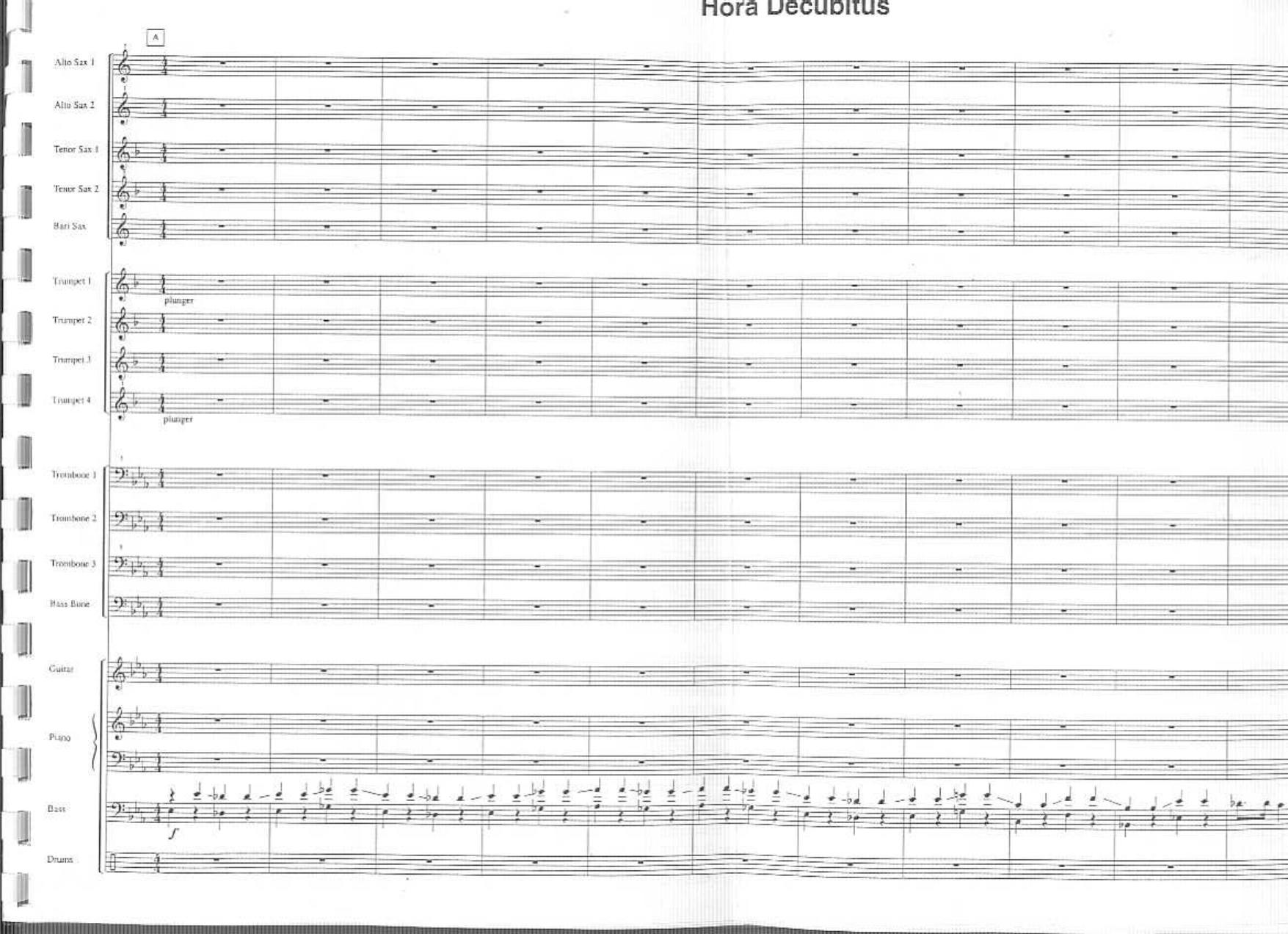
Hora Decubitus (C.Mingus) sheet music preview

Hora Decubitus (C.Mingus)

Composed by Charles Mingus

Arranged by Charles Mingus

  • Ensemble: Big Band
  • Pages: 81
  • Instruments (17): Alto Sax 1, Alto Sax 2, Tenor Sax 1, Tenor Sax 2, Bari Sax, Trumpet 1, Trumpet 2, Trumpet 3, Trumpet 4, Trombone 1, Trombone 2, Trombone 3, Bass Bone, Guitar, Piano, Bass, Drums
  • Difficulty: advanced
  • Content: Individual Parts
  • Format: PDF Download (Instant)
  • Price: $24.99

Originally recorded for the seminal 1963 Impulse! album *Mingus Mingus Mingus Mingus Mingus*, "Hora Decubitus" stands as one of Charles Mingus’s most ferocious and structurally ingenious compositions. The title, translated roughly from Latin as "the hour of going to bed," belies the relentless, high-octane energy of the music, which fuses the raw, blues-drenched urgency of the-sanctified church with the polyphonic complexity of early New Orleans jazz and hard bop. Mingus originally crafted this piece as a modern twelve-bar blues vehicle that builds in intensity through overlapping ostinatos and driving counterpoint, creating a dense wall of sound that pushes the boundaries of traditional big band writing. Propelled by an aggressive, driving medium-up swing tempo in 4/4, the mood is dark, defiant, and relentlessly building. The piece opens with a signature menacing riff that cascades through the ensemble, instantly establishing a gritty, hypnotic groove. Mingus utilizes shifting textures where the rhythm section lays down an uncompromising, churning foundation, allowing the horns to weave intricate, interlocking counter-melodies. The emotional trajectory shifts from a simmering, low-end rumble into an ecstatic, fever-pitch climax characterized by roaring collective improvisations and relentless cross-rhythms that evoke the kinetic spirit of a late-night New York jazz club. Written by Mingus himself, this definitive arrangement captures his legendary compositional voice—one that demands absolute commitment, ferocious articulation, and deep rhythmic integration from every player on the bandstand. Scored dynamically for a robust 7-instrument ensemble (featuring Alto Saxophone, Tenor Saxophone, Trumpet, Trombone, and a rhythm section anchored by Piano), the chart achieves the sonic weight and textural density of a full-sized 17-piece big band. Mingus achieves this through ingenious voicing, utilizing tight, dissonant harmonies in the horns and stride-infused, percussive punctuations in the piano to fill out the sonic spectrum. The arrangement brilliantly balances tightly orchestrated shout choruses with wide-open spaces for intense, blues-soaked soloing. Navigating this 81-page masterwork requires exceptional stamina, sharp intonation, and a profound understanding of post-bop phrasing, making it ideally suited for advanced collegiate ensembles, professional contemporary jazz orchestras, and ambitious community big bands looking to challenge their technical limits. The horns share the heavy lifting of the thematic material, requiring seamless blend and aggressive articulation on the recurring blues riffs. Featured solo sections provide ample opportunity for a standout tenor saxophonist or trumpeter to stretch out over the turbulent blues changes. Performing "Hora Decubitus" offers a deeply rewarding masterclass in ensemble dynamics, teaching musicians how to balance individual expressive freedom with the rigid, driving discipline required to execute Mingus's monumental vision. Unlocking the visceral power of "Hora Decubitus" begins with mastering the underlying rhythmic drive; the tempo must feel urgent yet completely relaxed at its core, avoiding any tendency to rush during dynamic crescendos. The primary technical challenge lies in the execution of the overlapping contrapuntal lines, which demand pristine articulation and precise balance so that inner voices remain audible against the roaring rhythm section. Horn players should utilize a robust, vocalized tone, leaning into minor-third bends, guttural growls, and sharp accents to emulate the early jazz roots embedded within the modern harmonies. Pianists must approach the comping with a percussive, aggressive touch, drawing inspiration from Mingus’s own relentless keyboard attack rather than traditional comping models. Rehearsal should initially isolate the interlocking ostinato figures at a slower tempo before gradually pushing toward the target performance speed. Conductors should emphasize breath support and physical stamina across all sections, ensuring the ensemble maintains a heavy, blues-inflected swing right up to the final, thunderous chord. Q: What instruments and parts are included in this arrangement? A: This arrangement is scored for a 7-instrument ensemble featuring Alto Saxophone, Tenor Saxophone, Trumpet, Trombone, Piano, and a comprehensive rhythm section spanning an extensive 81-page master score and parts collection. Q: What is the difficulty level of this chart? A: This piece is tailored for advanced high school, collegiate, and professional ensembles due to its demanding contrapuntal lines, fast tempos, and requirement for advanced post-bop stylistic awareness. Q: What is the historical background and style of the music? A: Written by Charles Mingus and famously recorded on his 1963 album *Mingus Mingus Mingus Mingus Mingus*, the piece is a high-energy, modern twelve-bar blues that bridges early New Orleans counterpoint with hard bop intensity. Q: What makes this specific arrangement unique? A: Across its 81 pages, the chart manages to condense the thunderous, dense sonic weight of a full 17-piece big band into a tight 7-instrument framework through ingenious voicing and interlocking ostinatos. Q: What is the performance duration and tempo feel? A: The arrangement is built around an aggressive, driving medium-up swing feel in 4/4 time, typically clocking in at around 4 to 5 minutes of high-intensity performance.

Questions and answers

What is included in the Hora Decubitus (C.Mingus) PDF?
The verified current file contains a conductor score and individual parts across 81 pages.
How many instruments or parts are listed for Hora Decubitus (C.Mingus)?
The verified instrumentation list contains 17 entries for this Big Band arrangement.
Who is credited for Hora Decubitus (C.Mingus)?
Composer: Charles Mingus. Arranger: Charles Mingus.
What difficulty is listed for Hora Decubitus (C.Mingus)?
The verified difficulty level is advanced.
Can I preview Hora Decubitus (C.Mingus) before buying?
Yes. The product page provides a preview generated from the current PDF file.
How is Hora Decubitus (C.Mingus) delivered?
After successful payment, the digital PDF is made available for download. The displayed price is $24.99.

Musicians Also Search For

Hora Decubitus Charles Mingus PDFHora Decubitus Charles Mingus sheet musicHora Decubitus arranged by Charles MingusCharles Mingus big band chartsCharles Mingus jazz arrangements PDFHora Decubitus Charles Mingus big band arrangementsHora Decubitus big band arrangementsHora Decubitus big band PDF downloadHora Decubitus jazz sheet musicbig band sheet music downloadHora Decubitus conductor score PDFHora Decubitus individual parts downloadHora Decubitus sheet music PDFbuy Hora Decubitus sheet musicdownload Hora Decubitus PDFHora Decubitus jazz chartsbest Charles Mingus big band arrangementsHora Decubitus printable sheet musicbig band repertoire PDF

All arrangements by Charles Mingus All Charles Mingus sheet music