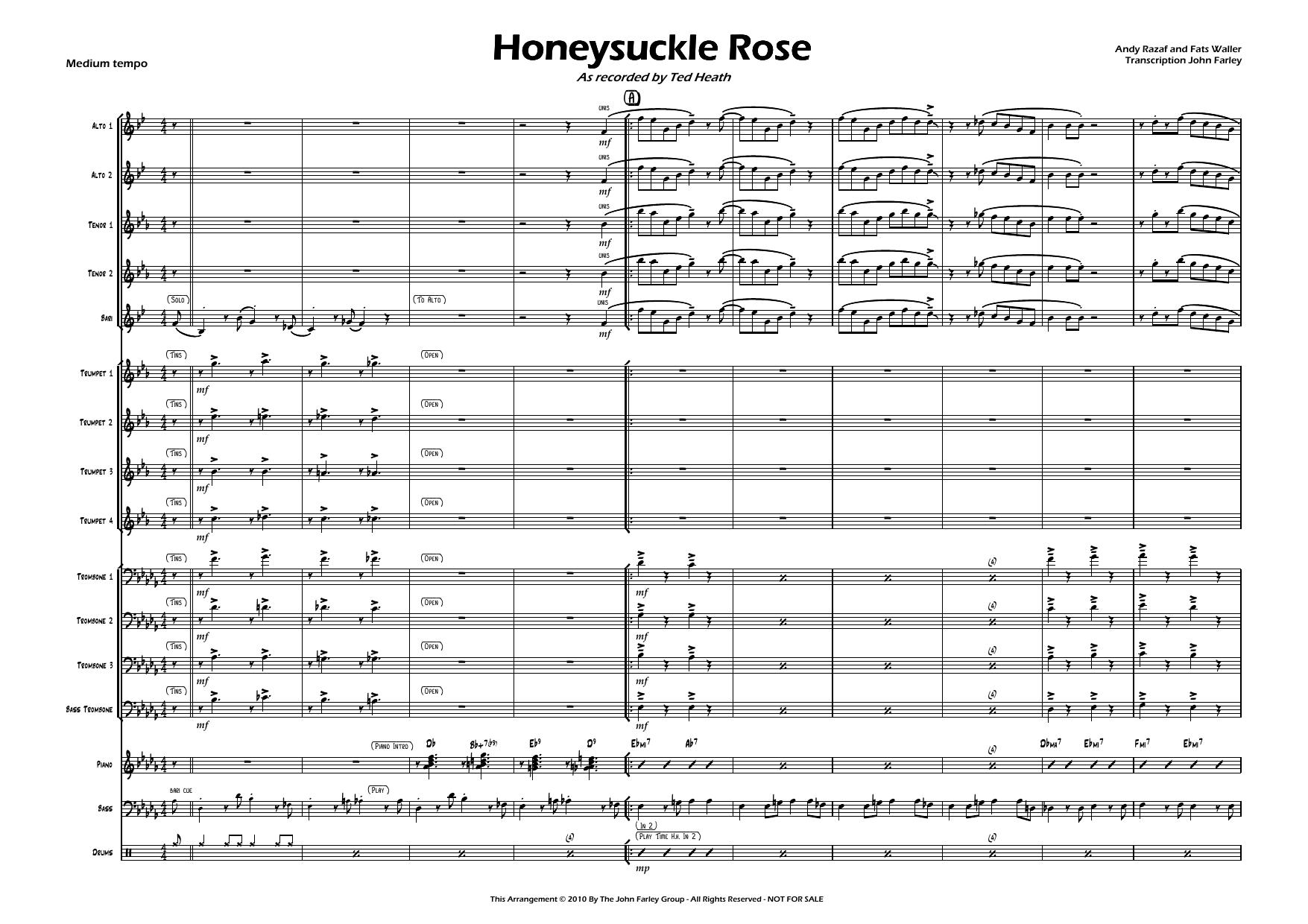
Honeysuckle Rose (J.Farley)
Composed by Fats Waller
Arranged by John Farley
- Ensemble: Big Band
- Pages: 36
- Instruments (17): Alto Saxophone 1, Alto Saxophone 2, Tenor Saxophone 1, Tenor Saxophone 2, Baritone Saxophone, Trumpet 1, Trumpet 2, Trumpet 3, Trumpet 4, Trombone 1, Trombone 2, Trombone 3, Bass Trombone, Guitar, Piano, Bass, Drums
- Difficulty: medium
- Content: Individual Parts
- Format: PDF Download (Instant)
- Price: $24.99
Fats Waller, alongside lyricist Andy Razaf, immortalized "Honeysuckle Rose" in 1929, cementing its status as one of the most enduring and infectious contributions to the Great American Songbook. Rooted in the stride piano tradition and the ebullient energy of the late-1920s Harlem jazz scene, the composition rapidly evolved from a Tin Pan Alley tune into an essential vehicle for jazz improvisation. Countless luminaries—from Benny Goodman and Django Reinhardt to Count Basie and Ella Fitzgerald—have reinterpreted its cyclical, rhythmically deceptive chord progression. The piece remains a litmus test for swing-era fluency, balancing playful melodic curves with a sophisticated harmonic blueprint that invites both joyous romps and sophisticated modal explorations. John Farley’s dynamic adaptation captures the effervescent spirit of the original while reimagining its textures for a flexible, contemporary seven-piece big band ensemble. Driven by an infectious medium-up swing groove set at roughly 172 BPM, the arrangement radiates warmth, wit, and irrepressible momentum. Farley opens the chart with a sparkling, conversational head statement where the alto saxophone and trumpet trade crisp counterpoint over a stride-inflected piano comping pattern. The mood shifts effortlessly from buoyant and cheeky to driving and intense, culminating in a compact, high-octane shout chorus that utilizes tight horn interjections and rhythmic displacement to maximize the sonic footprint of the reduced instrumentation. Tailored specifically for a 7-instrument ensemble featuring Alto Saxophone, Tenor Saxophone, Trumpet, Trombone, Piano, and rhythm section support, this 36-page publication distributes the weight of the arrangement evenly across all voices. Farley crafts interlocking horn solis that evoke the rich harmonic stacking of a full 17-piece orchestra without sacrificing the transparency required of a smaller band. Solos are open-ended over standard form changes for the trumpet and tenor saxophone, allowing featured improvisers plenty of space to stretch out. Technical demands lean toward intermediate-to-advanced proficiency, particularly regarding clean articulation at faster tempos and the execution of syncopated swing eighth-notes that bridge traditional swing with modern bop phrasing. Advanced high school ensembles, collegiate jazz combos with horn sections, and professional community big bands will find this chart an exceptionally rewarding centerpiece for concert programs or festival adjudications. The clever economy of scoring means every player has an active, engaging part that contributes directly to the texture, avoiding the thinness that often plagues reduced-instrumentation big band charts. Performers will especially relish the clever modulation into the final chorus, a signature Farley touch that elevates the energy level right before the final punchy resolution. Achieving an authentic performance of this arrangement requires a disciplined approach to swing subdivisions and dynamic contrast. The tempo should remain locked at a steady, driving medium-up swing (approx. 172 BPM); avoid rushing the A-sections, as rhythmic stability is vital for the syncopated brass and reed figures. Horn players must focus on uniform articulation, treating short notes with crisp, dry staccatos and accentuation on the upbeat-driven measures to highlight Farley's intricate counter-melodies. The rhythm section serves as the anchor: the pianist should emulate a modernized stride feel—keeping the left hand light and buoyant rather than heavy-handed—while the bass and drums maintain a forward-leaning, feather-bass swing pulse. Pay close attention to dynamic markings during the muted brass interludes to ensure the melodic lines project cleanly above the accompaniment. Rehearsal should begin slowly, isolating the interlocking soli sections at 130 BPM before gradually working up to performance speed to ensure precise intonation and stylistic cohesion across the horn front line. Q: What specific instruments and parts are included in this publication? A: This 36-page arrangement is scored for a 7-instrument ensemble comprising Alto Saxophone, Tenor Saxophone, Trumpet, Trombone, Piano, Bass, and Drums. Q: What is the difficulty level of this arrangement? A: It is designed for intermediate-to-advanced musicians, making it ideal for skilled high school groups, collegiate jazz ensembles, and professional community big bands. Q: What is the historical style and background of the piece? A: Written by Fats Waller in 1929, this arrangement honors the traditional Harlem stride and swing eras while incorporating contemporary jazz-band voicing and harmonic twists. Q: What makes John Farley’s arrangement unique? A: Farley successfully condenses the lush, massive sound of a full big band into a tight seven-instrument format, utilizing clever counterpoint, rich horn solis, and an energetic shout chorus. Q: What is the approximate performance duration and tempo? A: The chart is set at a medium-up swing tempo of approximately 172 BPM and runs for roughly 3.5 to 4 minutes depending on solo choruses.
Questions and answers
- What is included in the Honeysuckle Rose (J.Farley) PDF?
- The verified current file contains a conductor score and individual parts across 36 pages.
- How many instruments or parts are listed for Honeysuckle Rose (J.Farley)?
- The verified instrumentation list contains 17 entries for this Big Band arrangement.
- Who is credited for Honeysuckle Rose (J.Farley)?
- Composer: Fats Waller. Arranger: John Farley.
- What difficulty is listed for Honeysuckle Rose (J.Farley)?
- The verified difficulty level is medium.
- Can I preview Honeysuckle Rose (J.Farley) before buying?
- Yes. The product page provides a preview generated from the current PDF file.
- How is Honeysuckle Rose (J.Farley) delivered?
- After successful payment, the digital PDF is made available for download. The displayed price is $24.99.
Musicians Also Search For
Honeysuckle Rose John Farley PDF • Honeysuckle Rose John Farley sheet music • Honeysuckle Rose arranged by John Farley • John Farley big band charts • John Farley jazz arrangements PDF • Honeysuckle Rose Fats Waller sheet music • Honeysuckle Rose Fats Waller big band arrangements • Fats Waller big band charts • Honeysuckle Rose big band arrangements • Honeysuckle Rose big band PDF download • Honeysuckle Rose jazz sheet music • big band sheet music download • Honeysuckle Rose conductor score PDF • Honeysuckle Rose individual parts download • Honeysuckle Rose sheet music PDF • buy Honeysuckle Rose sheet music • download Honeysuckle Rose PDF • Honeysuckle Rose jazz charts • best John Farley big band arrangements • Fats Waller arranged by John Farley • Honeysuckle Rose printable sheet music • big band repertoire PDF