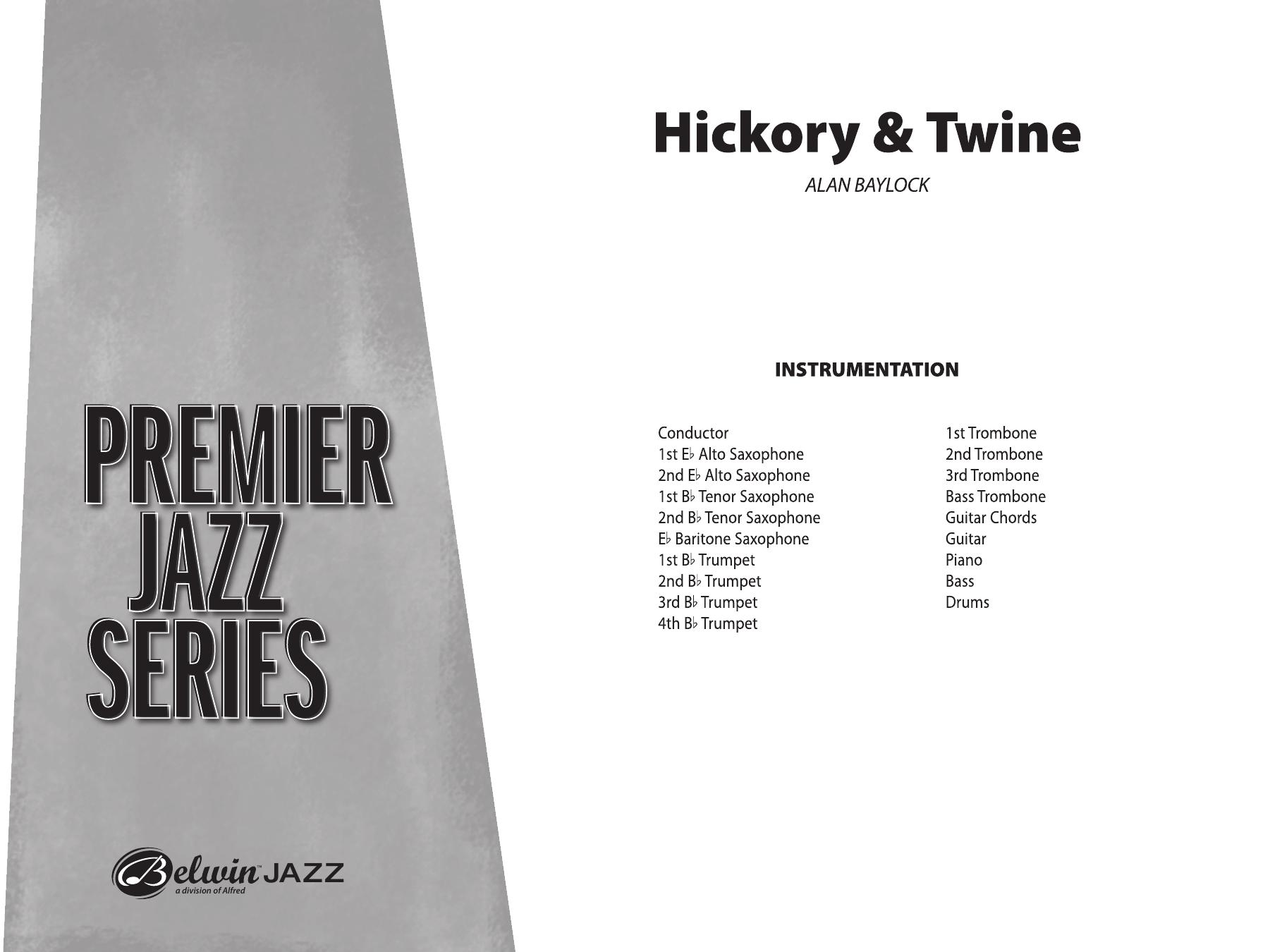
Hickory & Twine (A.Baylock)
Composed by Alan Baylock
Arranged by Alan Baylock
- Ensemble: Big Band
- Style: Jazz Standard
- Pages: 100
- Instruments (18): Conductor, 1st Eb Alto Saxophone, 2nd Eb Alto Saxophone, 1st Bb Tenor Saxophone, 2nd Bb Tenor Saxophone, Eb Baritone Saxophone, 1st Bb Trumpet, 2nd Bb Trumpet, 3rd Bb Trumpet, 4th Bb Trumpet, 1st Trombone, 2nd Trombone, 3rd Trombone, Bass Trombone, Guitar, Piano, Bass, Drums
- Difficulty: advanced
- Content: Individual Parts
- Format: PDF Download (Instant)
- Price: $24.99
"Hickory & Twine," an original composition by Alan Baylock, stands as a testament to contemporary big band writing, firmly rooted in the tradition of the jazz standard while pushing its boundaries. Unlike a historical standard, this piece is a modern classic, penned by one of today's most respected jazz composers and arrangers. It embodies the vibrant spirit and sophisticated harmonic language characteristic of modern big band repertoire, designed to showcase a band's musicality and individual soloists. Baylock's compositions often draw from the rich tapestry of jazz history, blending elements of post-bop, swing, and contemporary orchestral jazz, making "Hickory & Twine" a prime example of a piece that feels both fresh and timeless. Musically, "Hickory & Twine" unfolds as a medium-up swing chart, typically performed around 160-180 BPM, establishing an infectious, driving groove from the outset. The piece is generally set in a bright, accessible key, allowing for comfortable execution across the ensemble. Its mood is one of sophisticated energy and joyful swing, evoking the classic big band era but filtered through a modern lens. Baylock masterfully employs a dynamic range, moving from tightly voiced ensemble passages to expansive, open textures. The piece's character is defined by its melodic clarity, rhythmic precision, and harmonic richness, providing a rewarding experience for both performers and listeners. It’s a piece that truly swings, encouraging a relaxed yet precise rhythmic feel from the rhythm section and horns alike. Alan Baylock's arrangement of his own composition showcases his signature approach to big band writing: meticulously crafted voicings, intelligent use of counterpoint, and powerful shout choruses that build to exhilarating climaxes. The melody is initially presented by the saxophone section in a tightly knit soli, often featuring a blend of unison lines and rich harmonic support, before being echoed or developed by the brass. There are ample opportunities for featured solos, typically for tenor saxophone and trumpet, allowing individual band members to shine over the driving rhythm section. Baylock's charts are known for their logical progression and effective use of dynamics, often incorporating subtle rhythmic displacements and unexpected harmonic turns that keep the music engaging. The technical challenges lie primarily in maintaining rhythmic precision at tempo, navigating the intricate ensemble figures, and executing the dynamic contrasts with conviction. The rewarding aspect is the sheer joy of performing a well-crafted, swinging chart that truly comes alive with a committed ensemble. This arrangement is ideally suited for advanced high school, collegiate, community, and professional big bands. Its demands on ensemble blend, rhythmic accuracy, and dynamic control make it an excellent teaching tool for developing musicians, while its sophisticated musicality ensures it remains engaging for seasoned professionals. The clarity of the notation and the thoughtful orchestration allow bands to achieve a polished sound with dedicated rehearsal, making it a valuable addition to any big band's repertoire for concerts, festivals, or competitive performances. "Hickory & Twine" thrives on a consistent, medium-up swing feel, ideally around 160-180 BPM. Emphasize a relaxed yet precise rhythmic approach, particularly in the rhythm section, ensuring the quarter note pulses with a buoyant energy. Key technical challenges include maintaining rhythmic unison in the saxophone solis and brass figures, which often feature syncopated lines requiring diligent practice with a metronome. Encourage brass players to articulate with clarity and precision, especially in the shout choruses, while saxophones should strive for a smooth, blended sound in their section work. Dynamic contrasts are crucial; practice transitioning smoothly between soft, intricate passages and powerful, full-ensemble sections. There are no specific extended techniques like plungers or doits indicated, but encourage expressive phrasing and appropriate jazz inflections (falls, scoops) where stylistically appropriate. Rehearsal should focus on solidifying the groove, balancing the voicings, and ensuring soloists are well-supported by the ensemble. Q: What instruments and parts are included in the "Hickory & Twine" arrangement? A: This is a standard 17-piece big band arrangement, including Alto Saxophone 1, Alto Saxophone 2, Tenor Saxophone 1, Tenor Saxophone 2, Baritone Saxophone, Trumpet 1, Trumpet 2, Trumpet 3, Trumpet 4, Trombone 1, Trombone 2, Trombone 3, Trombone 4, Piano, Bass, Drums, and Guitar. Q: What is the difficulty level of "Hickory & Twine" and for what ensembles is it suitable? A: This arrangement is rated as advanced high school, collegiate, community, or professional level. It requires strong ensemble playing, rhythmic precision, and capable soloists, making it suitable for bands with solid fundamental skills. Q: What is the musical style and historical context of "Hickory & Twine"? A: "Hickory & Twine" is an original composition by Alan Baylock, written in the contemporary big band jazz style. While not a historical standard, it embodies the sophisticated harmonic and rhythmic language of modern jazz, drawing inspiration from the rich tradition of medium-up swing charts. Q: What makes Alan Baylock's arrangement of "Hickory & Twine" unique? A: Baylock's arrangement showcases his signature blend of intricate voicings, dynamic contrasts, and powerful shout choruses. It features well-crafted ensemble passages, engaging melodic development, and ample space for improvisation, characteristic of his highly regarded compositional style. Q: What is the typical performance duration and tempo for "Hickory & Twine"? A: While variable based on solos, a typical performance of "Hickory & Twine" is approximately 4-6 minutes. It is intended to be performed at a medium-up swing tempo, generally ranging from 160 to 180 beats per minute.
Questions and answers
- What is included in the Hickory & Twine (A.Baylock) PDF?
- The verified current file contains a conductor score and individual parts across 100 pages.
- How many instruments or parts are listed for Hickory & Twine (A.Baylock)?
- The verified instrumentation list contains 18 entries for this Big Band arrangement.
- Who is credited for Hickory & Twine (A.Baylock)?
- Composer: Alan Baylock. Arranger: Alan Baylock.
- What difficulty is listed for Hickory & Twine (A.Baylock)?
- The verified difficulty level is advanced.
- What style is listed for Hickory & Twine (A.Baylock)?
- The catalog lists the style as Jazz Standard.
- Can I preview Hickory & Twine (A.Baylock) before buying?
- Yes. The product page provides a preview generated from the current PDF file.
- How is Hickory & Twine (A.Baylock) delivered?
- After successful payment, the digital PDF is made available for download. The displayed price is $24.99.
Musicians Also Search For
Hickory & Twine Alan Baylock PDF • Hickory & Twine Alan Baylock sheet music • Hickory & Twine arranged by Alan Baylock • Alan Baylock big band charts • Alan Baylock jazz arrangements PDF • Hickory & Twine Alan Baylock big band arrangements • Hickory & Twine big band arrangements • Hickory & Twine big band PDF download • Hickory & Twine jazz sheet music • big band sheet music download • Hickory & Twine conductor score PDF • Hickory & Twine individual parts download • Hickory & Twine sheet music PDF • Hickory & Twine Jazz Standard charts • Jazz Standard big band arrangements • buy Hickory & Twine sheet music • download Hickory & Twine PDF • Hickory & Twine jazz charts • best Alan Baylock big band arrangements • Hickory & Twine printable sheet music • big band repertoire PDF