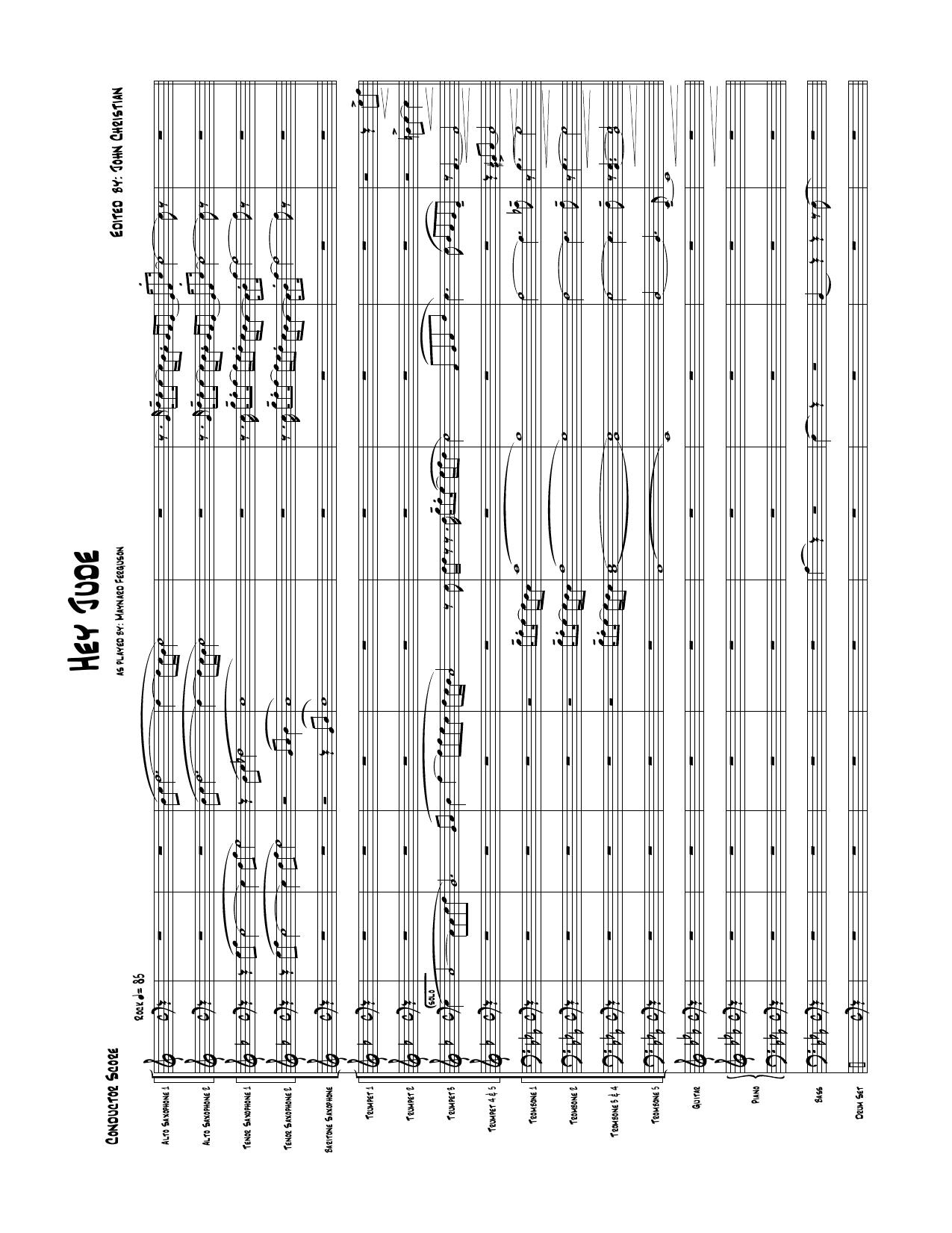
Hey Jude J.Christian.M.Ferguson (J.169)
Composed by John Lennon, Paul McCartney
Arranged by JOHN CHRISTIAN BIG BAND (Parts & Score) 169
- Ensemble: Big Band
- Pages: 47
- Instruments (17): Alto Saxophone 1, Alto Saxophone 2, Tenor Saxophone 1, Tenor Saxophone 2, Baritone Saxophone, Trumpet 1, Trumpet 2, Trumpet 3, Trumpet 4 & 5, Trombone 1, Trombone 2, Trombone 3 & 4, Trombone 5, Guitar, Piano, Bass, Drum Set
- Difficulty: medium
- Content: Individual Parts
- Format: PDF Download (Instant)
- Price: $24.99
Originally unveiled to the world in 1968 by The Beatles, "Hey Jude" stands as one of the towering songwriting achievements of the twentieth century. Penned by Paul McCartney (credited to Lennon-McCartney), the anthem evolved from a comforting message to Julian Lennon into a global phenomenon defined by its iconic, communal "Na-na-na-na" coda. While firmly rooted in the British Invasion pop canon, the song’s expansive AABA form, soaring melodic contour, and undeniable emotional resonance have long made it fertile ground for jazz reinterpretation. Great jazz artists across the decades have recognized that its cyclical harmony and dramatic crescendo naturally lend themselves to expressive instrumental adaptation, bridging the gap between familiar pop hooks and sophisticated jazz improvisation. In the hands of the JOHN CHRISTIAN BIG BAND, this chart reimagines the classic as a sweeping, dynamically rich contemporary jazz orchestral statement. Moving away from a straightforward ballad treatment, the arrangement establishes a spacious, modern medium-tempo groove that gradually builds in texture and intensity. The mood shifts seamlessly from introspective, lush harmonic exposition to an uplifting, high-energy climax. Extended chord voicings in the brass add a sophisticated, contemporary color, while subtle reharmonizations beneath the familiar melody introduce a sophisticated harmonic depth that keeps both performers and listeners thoroughly engaged. The arrangement opens by distributing the instantly recognizable theme across various instrumental choirs, allowing the woodwinds and muted brass to establish a rich, conversational texture before the full ensemble enters. A standout saxophone soli section showcases the reed section's blend, navigating intricate bebop-infused lines that breathe new life into McCartney's original vocal phrasing. As the chart progresses toward its grand shout chorus, the dynamic energy surges, propelled by driving swing rhythms and punctuating brass stabs that mimic the communal fervor of the original outro. Solo opportunities are strategically integrated, providing featured improvisers ample space to build narrative solos over a supportive, harmonically rich rhythm section background. Tailored specifically for advanced collegiate, community, and professional big bands, this 47-page publication demands a high degree of section cohesion and dynamic control. While the technical demands on individual players are manageable for seasoned musicians, the true challenge—and reward—lies in achieving a unified ensemble sound during the subtle rubato stretches and the powerful, driving tutti passages. Conceived with meticulous attention to detail by the arranger, this definitive edition equips jazz orchestras with a surefire concert closer or festival centerpiece that honors a timeless melody while exploring fresh, modern big band horizons. Successfully realizing this chart requires a careful balance of lyrical sensitivity and driving rhythmic momentum. The tempo should remain steady yet elastic, avoiding a rigid click-track feel to allow the iconic melody to breathe organically in the opening phrases. Conductors should pay close attention to the dynamic arc; the early sections rely heavily on transparent textures and delicate sub-tone playing from the saxophone section, making dynamic contrast essential before reaching the massive shout chorus. Brass players should utilize subtle cup or harmon mutes where indicated to create warm, vocal-like timbres that complement the woodwinds. In the rhythm section, the drummer should drive the ensemble with a crisp, interactive ride cymbal pattern that mirrors the gradual thickening of the texture, transitioning from a loose, open feel to a forceful, locked-in swing groove by the climax. Rehearsals should initially isolate the tricky rhythmic unisons between the low brass and baritone saxophone to ensure absolute precision on the syncopated figures. Q: What specific instruments and parts are included in this arrangement? A: This complete 17-instrument big band package features a full standard complement including Alto Saxophone 1 & 2, Tenor Saxophone 1 & 2, Baritone Saxophone, plus full brass and rhythm sections, accompanied by a comprehensive 47-page conductor score. Q: What is the difficulty level of this chart? A: This arrangement is graded as advanced, making it best suited for college, community, and professional big bands that possess strong section independence and seasoned soloists. Q: How does this arrangement treat the original Lennon-McCartney composition? A: It transforms the 1968 Beatles pop anthem into a sophisticated contemporary jazz vehicle, utilizing extended harmonies, a rich saxophone soli, and a powerful, building shout chorus reminiscent of the song's famous coda. Q: What makes this specific JOHN CHRISTIAN BIG BAND edition unique? A: It features distinctive, modern harmonic voicings and a masterfully paced narrative arc that builds from an intimate, lush ballad-esque opening into a soaring, high-energy festival-style climax. Q: What is the recommended performance tempo and duration for this piece? A: The arrangement is set at a expressive, modern medium tempo with a flexible groove, allowing for a performance duration of approximately 5 to 6 minutes depending on the length of the open improvised solos.
Questions and answers
- What is included in the Hey Jude J.Christian.M.Ferguson (J.169) PDF?
- The verified current file contains a conductor score and individual parts across 47 pages.
- How many instruments or parts are listed for Hey Jude J.Christian.M.Ferguson (J.169)?
- The verified instrumentation list contains 17 entries for this Big Band arrangement.
- Who is credited for Hey Jude J.Christian.M.Ferguson (J.169)?
- Composer: John Lennon, Paul McCartney. Arranger: JOHN CHRISTIAN BIG BAND (Parts & Score) 169.
- What difficulty is listed for Hey Jude J.Christian.M.Ferguson (J.169)?
- The verified difficulty level is medium.
- Can I preview Hey Jude J.Christian.M.Ferguson (J.169) before buying?
- Yes. The product page provides a preview generated from the current PDF file.
- How is Hey Jude J.Christian.M.Ferguson (J.169) delivered?
- After successful payment, the digital PDF is made available for download. The displayed price is $24.99.
Musicians Also Search For
Hey Jude J.Christian.M.Ferguson JOHN CHRISTIAN BIG BAND (Parts & Score) 169 PDF • Hey Jude J.Christian.M.Ferguson JOHN CHRISTIAN BIG BAND (Parts & Score) 169 sheet music • Hey Jude J.Christian.M.Ferguson arranged by JOHN CHRISTIAN BIG BAND (Parts & Score) 169 • JOHN CHRISTIAN BIG BAND (Parts & Score) 169 big band charts • JOHN CHRISTIAN BIG BAND (Parts & Score) 169 jazz arrangements PDF • Hey Jude J.Christian.M.Ferguson John Lennon, Paul McCartney sheet music • Hey Jude J.Christian.M.Ferguson John Lennon, Paul McCartney big band arrangements • John Lennon, Paul McCartney big band charts • Hey Jude J.Christian.M.Ferguson big band arrangements • Hey Jude J.Christian.M.Ferguson big band PDF download • Hey Jude J.Christian.M.Ferguson jazz sheet music • big band sheet music download • Hey Jude J.Christian.M.Ferguson conductor score PDF • Hey Jude J.Christian.M.Ferguson individual parts download • Hey Jude J.Christian.M.Ferguson sheet music PDF • buy Hey Jude J.Christian.M.Ferguson sheet music • download Hey Jude J.Christian.M.Ferguson PDF • Hey Jude J.Christian.M.Ferguson jazz charts • best JOHN CHRISTIAN BIG BAND (Parts & Score) 169 big band arrangements • John Lennon, Paul McCartney arranged by JOHN CHRISTIAN BIG BAND (Parts & Score) 169 • Hey Jude J.Christian.M.Ferguson printable sheet music • big band repertoire PDF