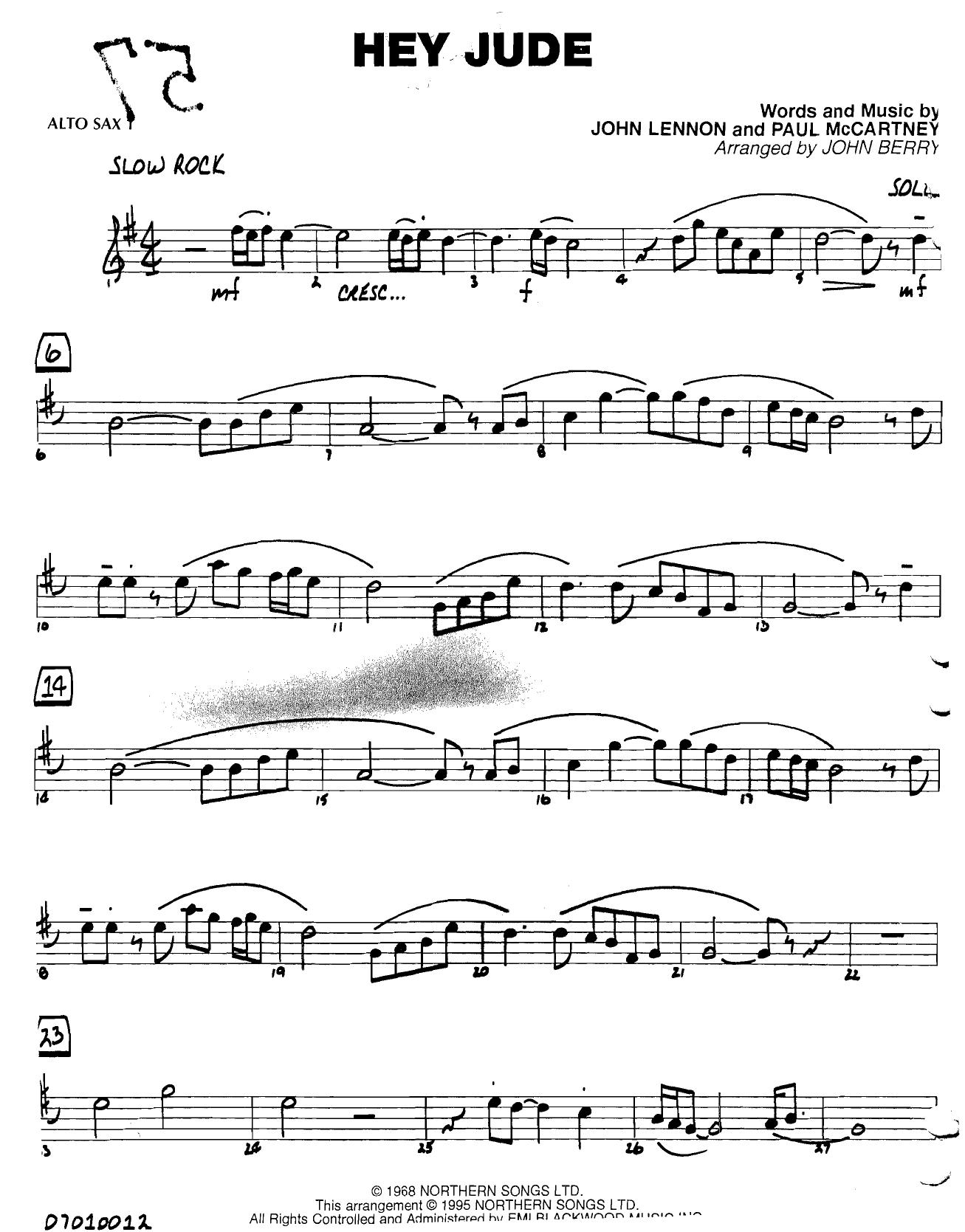
Hey Jude (J.Berry)
Composed by John Lennon
Arranged by John Berry
- Ensemble: Big Band
- Pages: 36
- Instruments (17): Alto Sax 1, Alto Sax 2, Tenor Sax 1, Tenor Sax 2, Baritone Sax, Trumpet 1, Trumpet 2, Trumpet 3, Trumpet 4, Trombone 1, Trombone 2, Trombone 3, Trombone 4, Piano, Bass, Drums, Guitar
- Difficulty: medium
- Content: Individual Parts
- Format: PDF Download (Instant)
- Price: $24.99
Originally penned by John Lennon and credited to Lennon–McCartney, the iconic 1968 Beatles anthem transcended its pop origins to become a deeply ingrained part of the global musical consciousness. While conceived as a ballad of comfort for Julian Lennon during his parents' divorce, the song’s soaring, gospel-like outro and monumental melodic arc lend themselves brilliantly to the expansive harmonic palette of the jazz big band. John Berry’s masterful treatment takes this timeless melodic framework and reframes it through a sophisticated contemporary jazz lens, transforming a classic sing-along into a dynamic, texturally rich instrumental showcase that respects the emotional weight of the source material while exploring fresh harmonic territory. Built around a steady, driving groove rather than a strict traditional swing feel, the arrangement opens with an inviting, atmospheric intro that gradually builds in density and warmth. Berry utilizes lush, modern horn voicings to capture the melancholic yet hopeful essence of the original melody, passing thematic material fluidly between the trumpet and saxophone sections. As the chart unfolds, it moves through a series of artfully crafted modulations and dynamic shifts, culminating in a powerful, building shout chorus reminiscent of the song’s famous "Na-na-na-na" fade-out. This climax does not rely on sheer volume alone, but rather on interlocking countermelodies, rich chord extensions, and rhythmic interplay across the entire 17-piece ensemble, creating an atmosphere of collective jubilation. Performance-wise, the arrangement demands strong section cohesion and expressive phrasing, particularly in maintaining a smooth, lyrical flow during slower or rubato transitions before locking into the groove. Solo opportunities are provided to highlight standout improvisers within the saxophone or trumpet ranks, supported by subtle, harmonically rich background figures from the brass. The rhythm section plays a pivotal role in driving the tune forward, requiring a sensitive yet steady drummer who can navigate the gradual swell of energy from an intimate opening to a roaring, anthemic climax. The use of dynamic contrast is essential; players must exercise restraint in the early choruses to allow the arrangement’s architectural crescendo to pack its full emotional wallop. Advanced high school ensembles with strong section leaders, as well as collegiate and professional community big bands, will find this chart to be an exceptionally rewarding addition to their libraries. It offers a masterclass in building dramatic tension across a performance while providing familiar, crowd-pleasing thematic material that audiences instantly connect with. Directors looking to program a piece that bridges the gap between accessible pop history and sophisticated jazz arranging will discover that Berry’s chart hits the ideal sweet spot of musical depth and audience appeal. Conductors should approach John Berry’s setting of "Hey Jude" with a strong emphasis on lyrical phrasing and architectural pacing. The primary tempo should maintain a comfortable, unhurried groove that allows the iconic melody to breathe without dragging. The most common technical challenge lies in balancing the dense, extended chord voicings during the middle development sections; directors must ensure that the inner voices of the saxophone and trombone sections do not bury the primary melodic line. Rhythm section players need to treat the accompaniment with stylistic flexibility. The piano and guitar should utilize sophisticated, rootless modal voicings to complement Berry's modern harmonies, avoiding heavy comping during the exposed intro. The drummer should focus on a steady, vocal-like ride cymbal pulse, eschewing overly aggressive heavy swing in favor of a supportive, contemporary pop-jazz feel that builds organically toward the climax. Encourage the brass section to use controlled releases on longer notes, utilizing subtle falls only where marked to preserve the dignity of the anthem-like melody. Regular sectional rehearsals focusing on intonation within the dense chord clusters will pay massive dividends during the performance. Q: What instruments and parts are included in this big band arrangement? A: The chart is scored for a standard 17-instrument big band lineup, consisting of 5 saxophones (2 altos, 2 tenors, 1 baritone), 4 trumpets, 4 trombones, and a 4-piece rhythm section (piano, bass, drums, and optional guitar). Full conductor scores and individual parts are fully articulated. Q: What is the difficulty level of this arrangement? A: This arrangement is graded as medium-advanced, making it ideal for skilled high school jazz ensembles, collegiate groups, and professional community big bands with strong section players and confident soloists. Q: How does this arrangement treat the musical style and historical context of the original song? A: John Berry takes the legendary 1968 Beatles pop anthem and recontextualizes it into a sophisticated, contemporary jazz setting that transitions from an intimate, lyrical opening into a powerful, harmonically rich shout chorus. Q: What makes this particular John Berry arrangement unique? A: Its unique strength lies in how it captures the monumental emotional arc of the original vocal outro, translating the famous sing-along climax into an intricate, interlocking big band shout chorus filled with modern harmonic extensions. Q: What is the performance duration and tempo feel of the piece? A: The arrangement runs approximately 4 to 5 minutes in length and features a steady, driving modern medium groove rather than a traditional swing feel, prioritizing lyrical flow and dynamic build over rapid tempos.
Questions and answers
- What is included in the Hey Jude (J.Berry) PDF?
- The verified current file contains individual parts across 36 pages.
- How many instruments or parts are listed for Hey Jude (J.Berry)?
- The verified instrumentation list contains 17 entries for this Big Band arrangement.
- Who is credited for Hey Jude (J.Berry)?
- Composer: John Lennon. Arranger: John Berry.
- What difficulty is listed for Hey Jude (J.Berry)?
- The verified difficulty level is medium.
- Can I preview Hey Jude (J.Berry) before buying?
- Yes. The product page provides a preview generated from the current PDF file.
- How is Hey Jude (J.Berry) delivered?
- After successful payment, the digital PDF is made available for download. The displayed price is $24.99.
Musicians Also Search For
Hey Jude John Berry PDF • Hey Jude John Berry sheet music • Hey Jude arranged by John Berry • John Berry big band charts • John Berry jazz arrangements PDF • Hey Jude John Lennon sheet music • Hey Jude John Lennon big band arrangements • John Lennon big band charts • Hey Jude big band arrangements • Hey Jude big band PDF download • Hey Jude jazz sheet music • big band sheet music download • Hey Jude individual parts download • Hey Jude sheet music PDF • buy Hey Jude sheet music • download Hey Jude PDF • Hey Jude jazz charts • best John Berry big band arrangements • John Lennon arranged by John Berry • Hey Jude printable sheet music • big band repertoire PDF