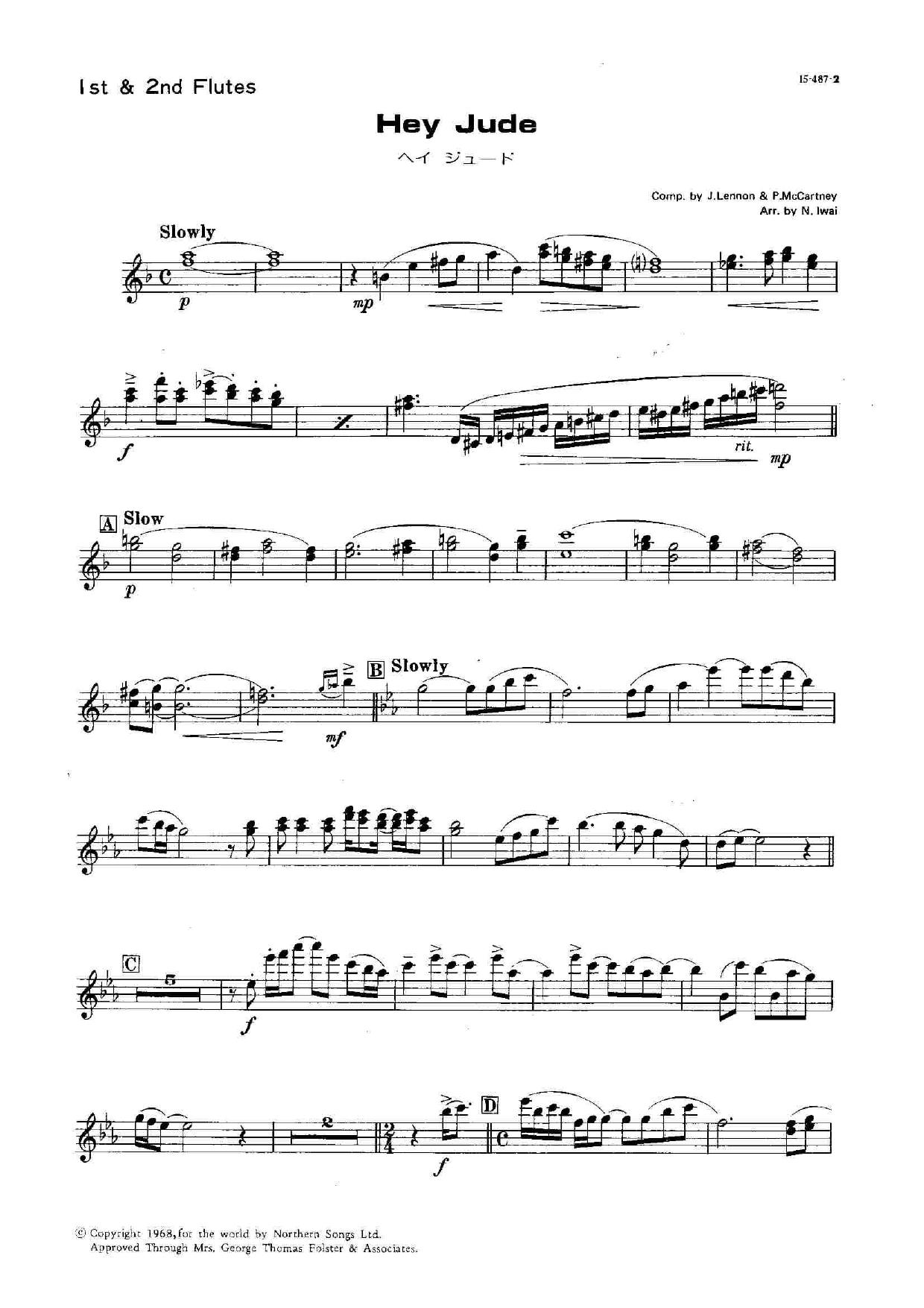
Hey Jude (N.Iwai) sheet music preview

Hey Jude (N.Iwai)

Composed by John Lennon

Arranged by N.Iwai

  • Ensemble: Concert Band
  • Style: Jazz Standard
  • Pages: 31
  • Instruments (28): 1st Flute, 2nd Flute, 1st Clarinet in Bb, 2nd Clarinet in Bb, 3rd Clarinet in Bb, 1st Horn in F, 2nd Horn in F, Bassoon, Oboe, Clarinet in Eb, 1st Alto Saxophone in Eb, 2nd Alto Saxophone in Eb, Tenor Saxophone in Bb, Baritone Saxophone in Eb, 1st Trumpet in Bb, 2nd Trumpet in Bb, 3rd Trumpet in Bb, Timpani, Euphonium in Bb, Bass in C, 1st Trombone, 2nd Trombone, Bass Trombone, Electric Bass Guitar, Percussions, Glockenspiel, Vibraphone, Drums
  • Difficulty: medium
  • Content: Individual Parts
  • Format: PDF Download (Instant)
  • Price: $22.99

Originally penned by John Lennon and credited to the legendary Lennon–McCartney songwriting partnership, "Hey Jude" emerged in 1968 as a monumental anthem of comfort and perseverance. While rooted in the classic British pop-rock idiom of the late Beatles era, the song's sweeping melodic arc, soaring harmonic progression, and iconic communal fade-out have long made it an irresistible vehicle for jazz interpretation. Its rich chord changes and timeless emotional resonance translate seamlessly into the jazz idiom, bridging the gap between nostalgic balladry and expansive, uplifting ensemble expression. Transforming this ubiquitous pop standard into a sophisticated concert band arrangement, Naohiro Iwai infuses the score with a lush, contemporary jazz-pop sensibility characterized by rich, extended harmonies and vibrant tonal colors. The arrangement opens with an evocative, atmospheric introduction before settling into a flowing, buoyant groove that balances a relaxed swing feel with contemporary ballad phrasing. The mood shifts masterfully from introspective lyricism to triumphant, full-ensemble climaxes, evoking a deep sense of communal celebration and emotional release that stays true to the spirit of the original anthem while exploring a thoroughly refreshed instrumental palette. Iwai’s distinctive arranging style shines through in the clever distribution of thematic material across the entire concert band. Woodwinds frequently carry the initial fragile statements of the melody with delicate scoring, gradually handing off the motifs to a warm, resonant brass choir. Rather than relying on a traditional bebop shout chorus, Iwai builds tension through cascading countermelodies, rich chordal suspensions, and a gradual expansion of dynamic volume that leads into a powerful, harmonically dense climax. The arrangement demands careful attention to balance and intonation, particularly when navigating the shifting inner voices and lush modulations that elevate the harmonic landscape. Advanced high school, collegiate, and community concert bands will find this 31-page publication an exceptionally rewarding addition to their repertoire. The technical challenges lie primarily in maintaining a smooth, legato phrasing style across wide dynamic ranges and executing precise ensemble cohesion during transitional rubato moments. Percussion plays a subtle yet vital role in driving the underlying groove without overpowering the delicate melodic textures. Offering a sublime blend of familiar nostalgia and sophisticated concert jazz writing, this arrangement provides an ideal showcase for ensembles looking to engage audiences with a universally beloved melody delivered through an artistic, jazz-inspired lens. Conductors should approach Naohiro Iwai’s concert band setting of "Hey Jude" with a strong emphasis on lyrical phrasing and tonal warmth. The tempo should maintain a steady, flowing pulse that allows the swing-infused eighth notes to breathe naturally without feeling rushed. Balance is a primary technical challenge; because the scoring utilizes dense, contemporary jazz harmonies and rich inner-voice counterlines, accompanimental sections must actively listen under the soloistic woodwind and brass melodies. Pay close attention to dynamic markings in the low brass and low reeds, ensuring that pedal points support the harmonic structure rather than muddying the texture. Rehearsal should focus initially on sectional intonation during the sustained chordal passages, particularly around the modulatory shifts. Percussionists should avoid heavy-handed backbeats, opting instead for a crisp, supportive cymbal and snare texture that complements the jazz ballad style. Encourage the ensemble to capture the vocal quality of the original melody, treating every sustained note with intentional shape and direction toward the final triumphant refrain. Q: What instruments and parts are included in this publication? A: This 31-page publication features a comprehensive conductor score alongside fully integrated parts for a standard full concert band instrumentation, including woodwinds, brass, and a complete percussion section tailored for a jazz-infused concert band setting. Q: What is the difficulty level of this arrangement? A: This piece is best suited for advanced high school, collegiate, and proficient community concert bands that are comfortable navigating rich extended harmonies, shifting dynamic levels, and sophisticated melodic phrasing. Q: How does this arrangement fit into the jazz standard and pop-rock traditions? A: While originating as a legendary 1968 Beatles pop anthem written by John Lennon, this arrangement reimagines the iconic tune through the lens of a sophisticated contemporary jazz standard, blending classic lyrical themes with lush, modern harmonic voicings. Q: What makes Naohiro Iwai's treatment unique? A: Iwai's arrangement stands out through its inventive redistribution of the melody across diverse instrumental choirs, utilizing smooth counterlines, delicate woodwind scoring, and expansive harmonic progressions rather than a standard big band shout chorus. Q: What is the recommended tempo and performance duration for this piece? A: The arrangement is set at a moderate, flowing tempo that emphasizes a relaxed groove and expressive ballad style, resulting in a performance duration of approximately 4 to 5 minutes depending on the conductor's chosen rubato phrasing.

Questions and answers

What is included in the Hey Jude (N.Iwai) PDF?
The verified current file contains individual parts across 31 pages.
How many instruments or parts are listed for Hey Jude (N.Iwai)?
The verified instrumentation list contains 28 entries for this Concert Band arrangement.
Who is credited for Hey Jude (N.Iwai)?
Composer: John Lennon. Arranger: N.Iwai.
What difficulty is listed for Hey Jude (N.Iwai)?
The verified difficulty level is medium.
What style is listed for Hey Jude (N.Iwai)?
The catalog lists the style as Jazz Standard.
Can I preview Hey Jude (N.Iwai) before buying?
Yes. The product page provides a preview generated from the current PDF file.
How is Hey Jude (N.Iwai) delivered?
After successful payment, the digital PDF is made available for download. The displayed price is $22.99.

Musicians Also Search For

Hey Jude N.Iwai PDFHey Jude N.Iwai sheet musicHey Jude arranged by N.IwaiN.Iwai concert band chartsN.Iwai jazz arrangements PDFHey Jude John Lennon sheet musicHey Jude John Lennon concert band arrangementsJohn Lennon concert band chartsHey Jude concert band arrangementsHey Jude concert band PDF downloadHey Jude jazz sheet musicconcert band sheet music downloadHey Jude individual parts downloadHey Jude sheet music PDFHey Jude Jazz Standard chartsJazz Standard concert band arrangementsbuy Hey Jude sheet musicdownload Hey Jude PDFHey Jude jazz chartsbest N.Iwai concert band arrangementsJohn Lennon arranged by N.IwaiHey Jude printable sheet musicconcert band repertoire PDF

All arrangements by N.Iwai All John Lennon sheet music