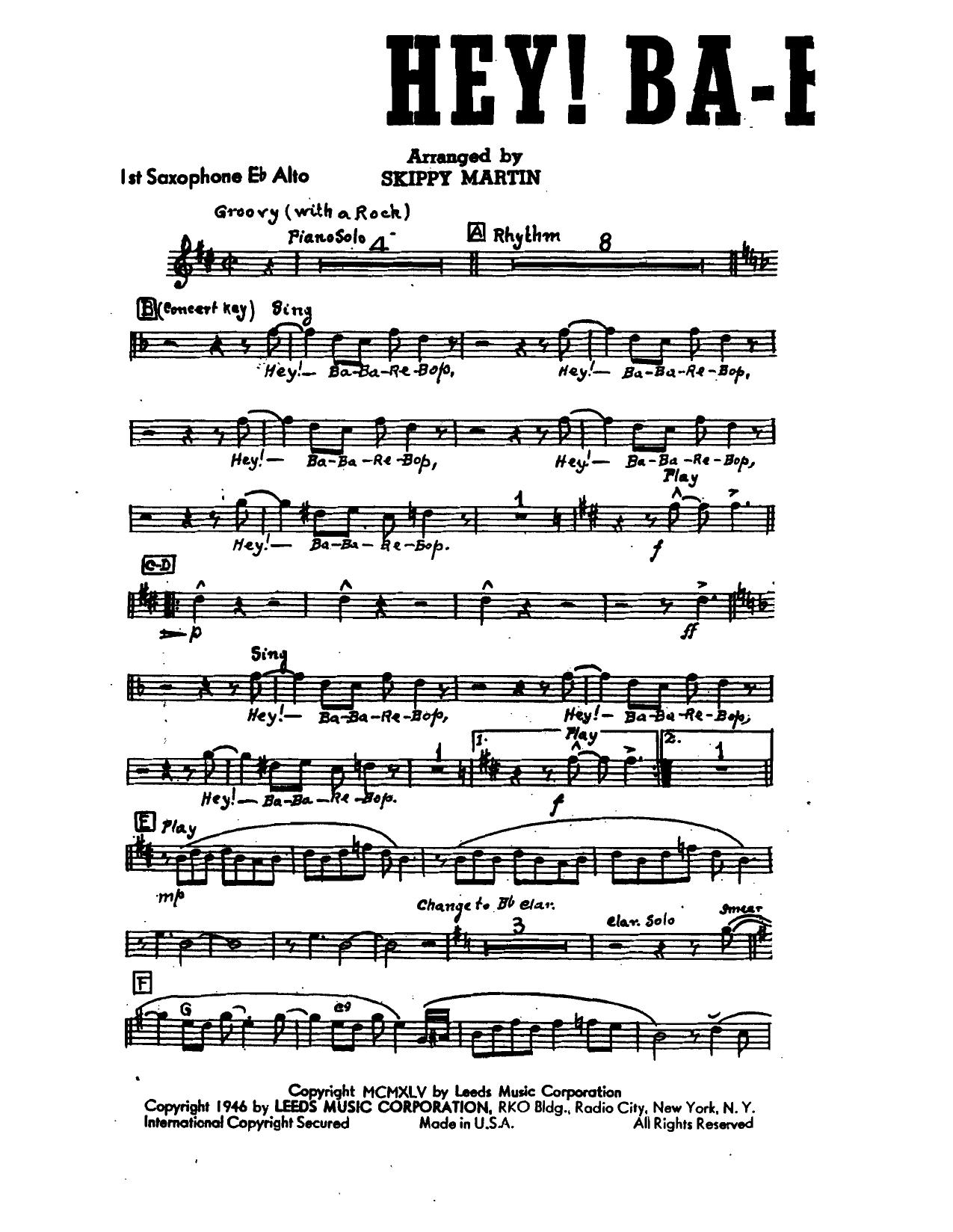
Hey Ba Ba Re Bop (S.Martin)
Composed by Lionel Hampton
Arranged by S.Martin
- Ensemble: Big Band
- Style: Jazz Standard
- Pages: 24
- Instruments (10): 1st Saxophone Eb Alto, 3rd Saxophone Eb Alto, 2nd Saxophone Bb Tenor, 4th Saxophone Bb Tenor, 1st Trumpet in Bb, 2nd Trumpet in Bb, 1st Trombone, 2nd Trombone, Guitar, Bass
- Difficulty: medium
- Content: Individual Parts
- Format: PDF Download (Instant)
- Price: $24.99
"Hey! Ba-Ba-Re-Bop," originally recorded by Lionel Hampton and His Orchestra in 1946, stands as a quintessential jazz standard that encapsulates the vibrant energy of the post-swing, pre-bebop era, often referred to as jump blues or early rhythm and blues. This iconic tune, credited to Hampton and his drummer Curley Hamner, was a significant chart-topper, reaching number one on the R&B Juke Box chart for sixteen non-consecutive weeks and number nine on the national pop charts. Its infectious call-and-response structure and use of nonsense syllables were influenced by earlier R&B hits like Helen Humes' "Be-Baba-Leba" and Jim Wynn's "Ee-Bobaliba," establishing it as a bridge between swing and the nascent rock and roll sound. Lionel Hampton, a pioneering jazz vibraphonist, percussionist, and bandleader, made the piece famous with his dynamic performances, characterized by his trademark showmanship and ability to blend sophisticated jazz with irresistible dance rhythms. The song's enduring popularity lies in its joyous, high-energy spirit and its role in defining the sound of a pivotal moment in American music history. This arrangement by S.Martin meticulously captures the electrifying, up-tempo swing feel of the original, set in the bright key of B-flat major. It evokes a mood of unrestrained exhilaration and playful abandon, perfect for igniting any performance. S.Martin’s distinctive approach is evident in the vibrant voicings that showcase the full power of the big band. Expect tightly-knit soli sections in the saxophone and brass choirs, punctuated by powerful shout choruses that build intensity throughout the piece. The arrangement features intricate ensemble figures and dynamic contrasts, maintaining the authentic character of the jump blues style while offering fresh, contemporary nuances. S.Martin is known for crafting arrangements that respect the original's integrity while adding layers of harmonic richness and rhythmic drive, ensuring both authenticity and modern appeal. The arrangement features the melody carried primarily by the trumpet section, often in unison or tight harmonies, with strong counter-melodies from the saxophones. There are ample opportunities for featured solos, typically in the trumpet and tenor saxophone, allowing improvisers to channel the high-octane spirit of the era. Technical challenges include fast articulation, precise ensemble playing in the intricate soli passages, and maintaining a consistent, driving swing eighth-note feel at a brisk tempo. The rewarding aspect of performing this chart lies in its sheer energy and audience engagement; the call-and-response sections and powerful ensemble hits are designed to be both challenging and incredibly fun to execute. This arrangement is ideally suited for college-level big bands, advanced high school ensembles, and community jazz orchestras looking for a vibrant, historically significant, and technically engaging piece that will undoubtedly energize any concert or dance floor. This arrangement demands a brisk, driving up-tempo swing feel, ideally around quarter note = 200-220 BPM, to capture the infectious energy of the original. Conductors should emphasize a strong, consistent pulse from the rhythm section, particularly the walking bass line and the drummer's ride cymbal pattern, which should be light yet propulsive. Key technical challenges include the rapid articulation in the brass and saxophone soli sections, requiring meticulous rehearsal to achieve clarity and precision. Trumpet players will need strong high-note endurance for the lead parts and shout chorus peaks. Encourage brass players to utilize plunger mutes where indicated, paying close attention to dynamic shaping and release points for maximum effect. Rehearsal tips include isolating fast rhythmic figures and practicing them slowly with a metronome, gradually increasing tempo. Focus on dynamic contrasts, ensuring that the ensemble can move seamlessly between powerful fortissimos and nuanced mezzo-fortes to highlight the arrangement's exciting contours. **Q: What instruments are included in this arrangement?** A: This arrangement is scored for a standard big band with 10 instruments, including Alto Saxophone 1, Alto Saxophone 3, Tenor Saxophone 2, Trumpet 1, and Trumpet 2, among others. The full complement typically includes a saxophone section, a brass section (trumpets and trombones), and a rhythm section (piano, bass, drums, guitar). **Q: What is the difficulty level of this arrangement?** A: This arrangement is considered advanced intermediate to advanced (Grade 4-5). It presents challenging rhythms, extended ranges for brass, and intricate ensemble passages, making it suitable for experienced high school, college, or community jazz ensembles. **Q: What is the musical style and historical context of "Hey Ba Ba Re Bop"?** A: "Hey Ba Ba Re Bop" is a jazz standard from the jump blues and early rhythm and blues era of the mid-1940s. It was popularized by Lionel Hampton and his Orchestra in 1946, known for its up-tempo swing, call-and-response vocals, and energetic, dance-oriented feel. **Q: What makes S.Martin's arrangement of "Hey Ba Ba Re Bop" unique?** A: S.Martin's arrangement distinguishes itself through its authentic preservation of the original's high-energy swing feel, coupled with sophisticated voicings, dynamic soli sections, and powerful shout choruses. It offers a fresh yet respectful interpretation that highlights the big band's full capabilities. **Q: What is the typical performance duration or tempo for this piece?** A: This arrangement is designed to be performed at a brisk, up-tempo swing, ideally ranging from quarter note = 200-220 BPM. The exact duration will depend on the number and length of improvised solos, but typically falls within the 3-5 minute range.
Questions and answers
- What is included in the Hey Ba Ba Re Bop (S.Martin) PDF?
- The verified current file contains individual parts across 24 pages.
- How many instruments or parts are listed for Hey Ba Ba Re Bop (S.Martin)?
- The verified instrumentation list contains 10 entries for this Big Band arrangement.
- Who is credited for Hey Ba Ba Re Bop (S.Martin)?
- Composer: Lionel Hampton. Arranger: S.Martin.
- What difficulty is listed for Hey Ba Ba Re Bop (S.Martin)?
- The verified difficulty level is medium.
- What style is listed for Hey Ba Ba Re Bop (S.Martin)?
- The catalog lists the style as Jazz Standard.
- Can I preview Hey Ba Ba Re Bop (S.Martin) before buying?
- Yes. The product page provides a preview generated from the current PDF file.
- How is Hey Ba Ba Re Bop (S.Martin) delivered?
- After successful payment, the digital PDF is made available for download. The displayed price is $24.99.
Musicians Also Search For
Hey Ba Ba Re Bop S.Martin PDF • Hey Ba Ba Re Bop S.Martin sheet music • Hey Ba Ba Re Bop arranged by S.Martin • S.Martin big band charts • S.Martin jazz arrangements PDF • Hey Ba Ba Re Bop Lionel Hampton sheet music • Hey Ba Ba Re Bop Lionel Hampton big band arrangements • Lionel Hampton big band charts • Hey Ba Ba Re Bop big band arrangements • Hey Ba Ba Re Bop big band PDF download • Hey Ba Ba Re Bop jazz sheet music • big band sheet music download • Hey Ba Ba Re Bop individual parts download • Hey Ba Ba Re Bop sheet music PDF • Hey Ba Ba Re Bop Jazz Standard charts • Jazz Standard big band arrangements • buy Hey Ba Ba Re Bop sheet music • download Hey Ba Ba Re Bop PDF • Hey Ba Ba Re Bop jazz charts • best S.Martin big band arrangements • Lionel Hampton arranged by S.Martin • Hey Ba Ba Re Bop printable sheet music • big band repertoire PDF