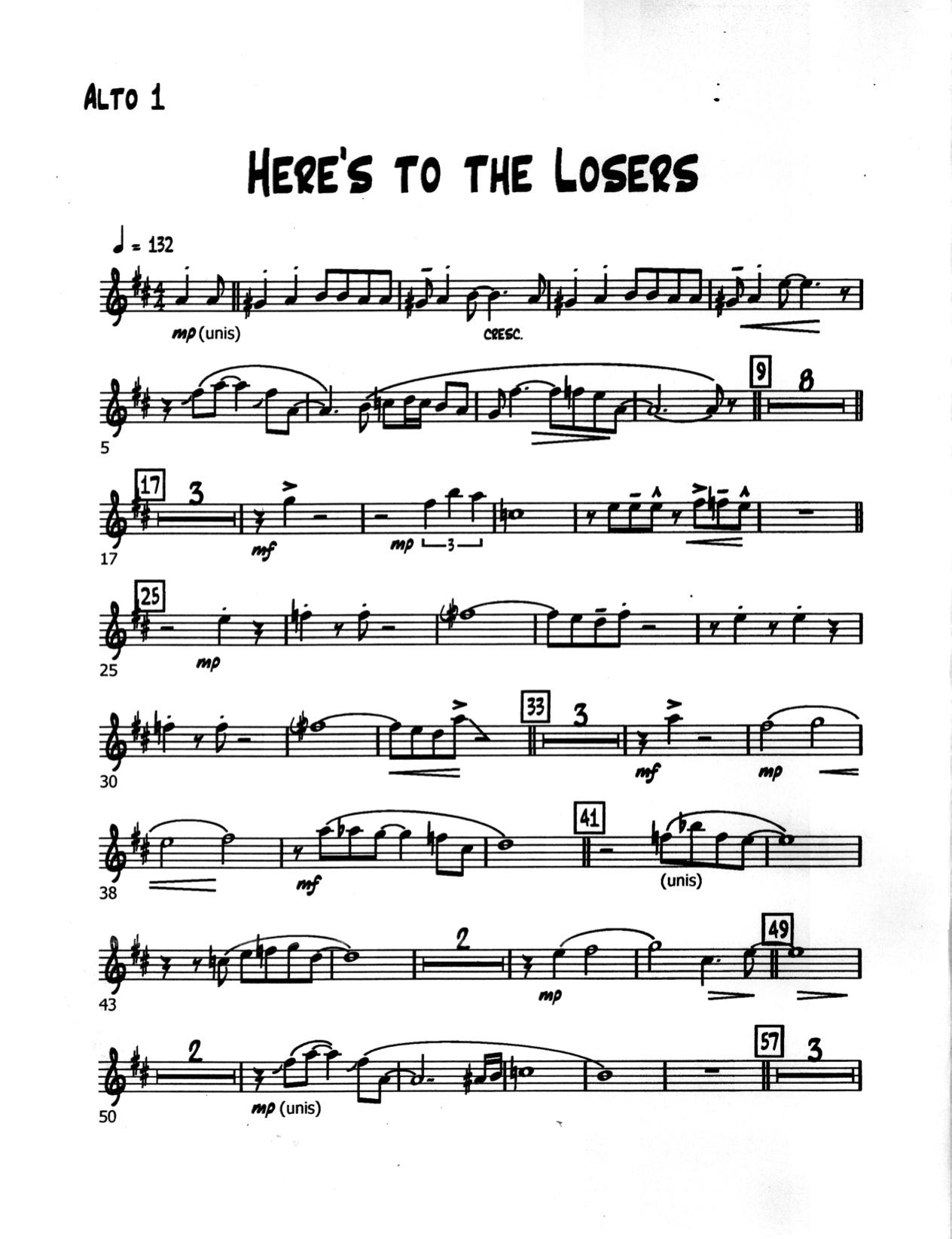
Here's To The Losers (M.Paich)
Composed by Jimmy Van Heusen
Arranged by Frank Sinatra & Nelson Riddle
- Ensemble: Big Band
- Pages: 35
- Instruments (17): Alto 1, Alto 2, Tenor 1, Tenor 2, Bari, Trumpet 1, Trumpet 2, Trumpet 3, Trumpet 4, Trombone 1, Trombone 2, Trombone 3, Trombone 4, Piano, Bass, Drums, Voice
- Difficulty: medium
- Content: Individual Parts
- Format: PDF Download (Instant)
- Price: $24.99
"Here's To The Losers," penned by the legendary songwriting team of Jimmy Van Heusen and Sammy Cahn, occupies a unique, bittersweet corner of the mid-century American songbook. Originally recorded in the early 1960s, this saloon-style anthem captures the poignant, self-deprecating bravado characteristic of Frank Sinatra’s classic Capitol and Reprise concept albums. While lesser-known than heavyweights like "One for My Baby," this tune shares that same smoky, late-night philosophical weight, celebrating the resilient underdogs who lose with grace. It represents the quintessential 1960s vocal jazz aesthetic where cinematic arrangement meets saloon introspection, making it a sophisticated choice for modern jazz ensembles looking to evoke authentic mid-century atmosphere. Marty Paich’s legendary West Coast cool arrangement—closely associated with the sophisticated string and brass textures he crafted for Sinatra and other vocalists—brings an intimate, chamber-jazz sensibility to the big band format. Set at a lazy, melancholic medium-swing tempo in a comfortable, horn-friendly key, the chart exudes a smoky, world-weary mood balanced by sly, winking optimism. Paich avoids heavy, bombastic brass writing in favor of transparent, West Coast voicings, utilizing muted trumpets, warm trombone counterlines, and rich saxophone harmonies that mimic a much larger ensemble. The emotional trajectory shifts seamlessly from introspective verses to a gently swelling chorus that wears its heart proudly on its sleeve. The 35-page score is meticulously crafted for a 10-piece instrumental ensemble (featuring Alto Saxophone, Tenor Saxophone, Baritone Saxophone, Trumpet, Trombone, and a robust rhythm section foundation). The woodwinds carry much of the lyrical weight, frequently weaving intricate countermelodies around the vocal line or instrumental lead, while the brass provides punchy, restrained accents rather than overpowering walls of sound. Instead of a blazing, high-note shout chorus, Paich constructs a subtle, dynamic development section that builds tension through clever harmonic shifts and interwoven lines before settling back into the weary, affectionate refrain. Technical demands center less on raw velocity and more on immaculate intonation, breath control, and stylistic nuance; maintaining a consistent, relaxed behind-the-beat swing feel is essential to capturing the arrangement's signature swagger. Advanced high school, collegiate, and professional jazz ensembles will find this chart an exceptional vehicle for developing stylistic maturity and micro-dynamic control. Because the arrangement relies heavily on transparency and sophisticated chord extensions rather than sheer volume, it exposes the weaknesses of an immature section while rewarding groups that excel at blend, balance, and understated swing. It serves as an ideal centerpiece for a vocal-backed set or an inspired instrumental feature, offering audiences a refreshing departure from high-octane up-tempo burners while demanding the highest caliber of musical sophistication. Marty Paich’s arrangement demands absolute precision in phrasing and dynamic restraint. The primary technical challenge lies in maintaining a deeply relaxed, laid-back medium-swing feel without letting the tempo drag or the rhythm section rush. Conductors should pay close attention to the balance between the saxophones and brass; the voicings are tight and transparent, meaning any overblowing by an individual player will distort the rich chordal colors. Trumpet and trombone sections should utilize cup or harmon mutes where indicated to achieve that authentic, intimate 1960s lounge texture. Articulation must be clean and lightweight—avoid heavy tongue attacks on the quarter-note pulses. Rehearsals should begin with the rhythm section establishing a steady, unhurried groove before horns are layered in. Focus heavily on the dynamic swells in the transition passages; the emotional impact of this chart relies entirely on seamless transitions from whisper-soft introspection to warm, resonant climaxes. Q: What instruments and parts are included in this arrangement? A: The 35-page score features a 10-instrument core lineup consisting of Alto Saxophone, Tenor Saxophone, Baritone Saxophone, Trumpet, Trombone, and a complete rhythm section. Q: What is the difficulty level of this chart? A: This arrangement is best suited for advanced high school, collegiate, and professional jazz ensembles due to its heavy reliance on precise intonation, subtle dynamic control, and West Coast harmonic reading. Q: What is the historical style and context of the piece? A: Written by Jimmy Van Heusen and arranged in the signature West Coast cool style associated with Marty Paich and Frank Sinatra, it represents the sophisticated, saloon-style vocal jazz of the early 1960s. Q: What makes this specific arrangement unique? A: Unlike typical high-energy big band charts, this arrangement favors transparent chamber-jazz voicings, intricate woodwind counterlines, and a moody, laid-back aesthetic over bombastic shout choruses. Q: What is the performance tempo and duration? A: The piece is set at a lazy, relaxed medium-swing tempo (approx. 104-112 BPM) and typically runs around 3.5 to 4 minutes depending on the chosen phrasing and rubato elements.
Questions and answers
- What is included in the Here's To The Losers (M.Paich) PDF?
- The verified current file contains individual parts across 35 pages.
- How many instruments or parts are listed for Here's To The Losers (M.Paich)?
- The verified instrumentation list contains 17 entries for this Big Band arrangement.
- Who is credited for Here's To The Losers (M.Paich)?
- Composer: Jimmy Van Heusen. Arranger: Frank Sinatra & Nelson Riddle.
- What difficulty is listed for Here's To The Losers (M.Paich)?
- The verified difficulty level is medium.
- Can I preview Here's To The Losers (M.Paich) before buying?
- Yes. The product page provides a preview generated from the current PDF file.
- How is Here's To The Losers (M.Paich) delivered?
- After successful payment, the digital PDF is made available for download. The displayed price is $24.99.
Musicians Also Search For
Here's To The Losers Frank Sinatra & Nelson Riddle PDF • Here's To The Losers Frank Sinatra & Nelson Riddle sheet music • Here's To The Losers arranged by Frank Sinatra & Nelson Riddle • Frank Sinatra & Nelson Riddle big band charts • Frank Sinatra & Nelson Riddle jazz arrangements PDF • Here's To The Losers Jimmy Van Heusen sheet music • Here's To The Losers Jimmy Van Heusen big band arrangements • Jimmy Van Heusen big band charts • Here's To The Losers big band arrangements • Here's To The Losers big band PDF download • Here's To The Losers jazz sheet music • big band sheet music download • Here's To The Losers individual parts download • Here's To The Losers sheet music PDF • buy Here's To The Losers sheet music • download Here's To The Losers PDF • Here's To The Losers jazz charts • best Frank Sinatra & Nelson Riddle big band arrangements • Jimmy Van Heusen arranged by Frank Sinatra & Nelson Riddle • Here's To The Losers printable sheet music • big band repertoire PDF