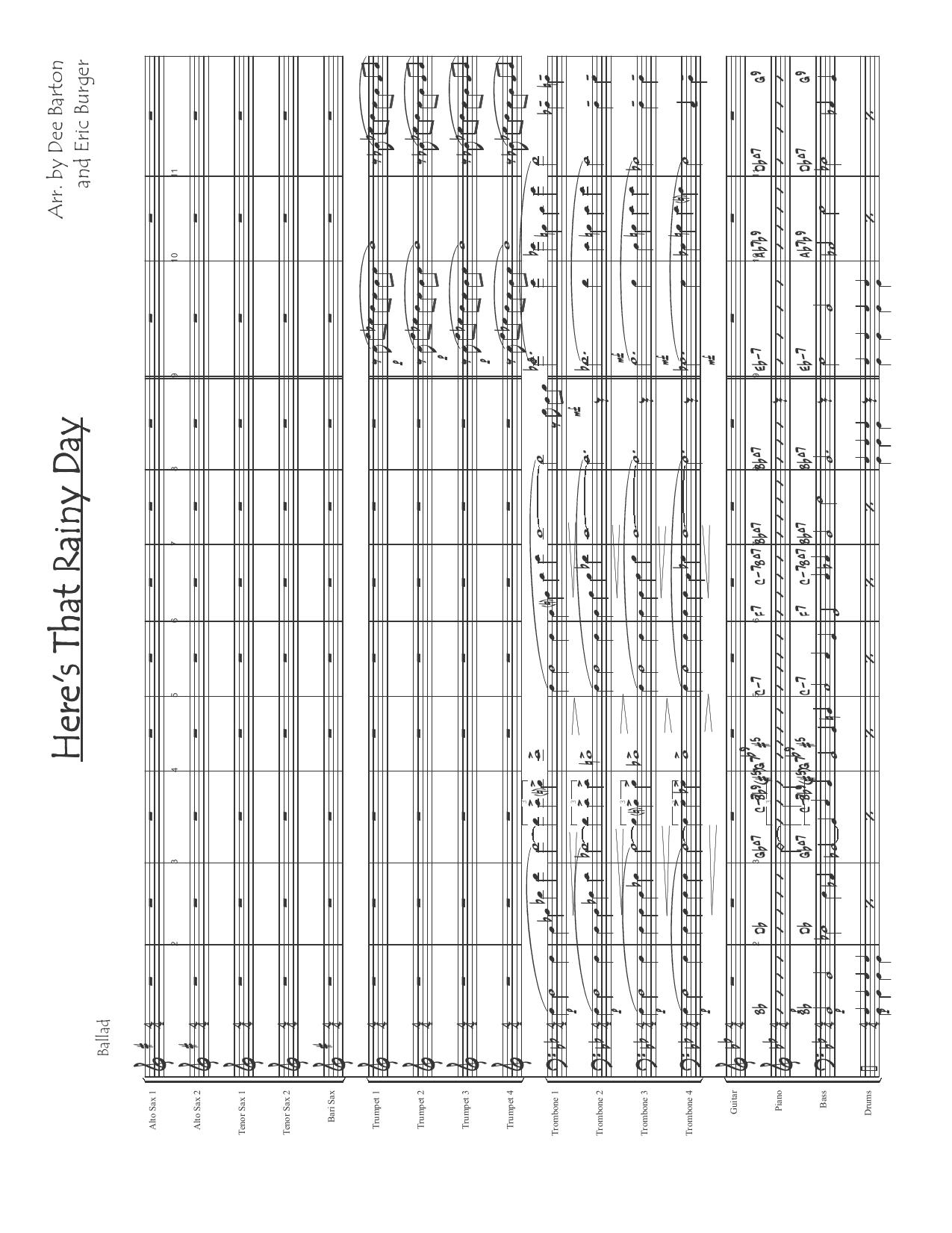
Here's That Rainy Day (D.Barton & E.Burger) sheet music preview

Here's That Rainy Day (D.Barton & E.Burger)

Composed by Jimmy Van Heusen

Arranged by Dee Barton

  • Ensemble: Big Band
  • Pages: 25
  • Instruments (17): Alto Sax 1, Alto Sax 2, Tenor Sax 1, Tenor Sax 2, Bari Sax, Trumpet 1, Trumpet 2, Trumpet 3, Trumpet 4, Trombone 1, Trombone 2, Trombone 3, Trombone 4, Guitar, Piano, Bass, Drums
  • Difficulty: medium
  • Content: Individual Parts
  • Format: PDF Download (Instant)
  • Price: $24.99

Jimmy Van Heusen and Johnny Burke introduced "Here's That Rainy Day" in the 1953 Broadway musical *Carnival in Flanders*, but the tune truly ascended into the pantheon of jazz immortality through definitive interpretations by Frank Sinatra, Bill Evans, and Stan Getz. Characterized by its melancholic yet comforting melody and sophisticated harmonic progression, this timeless standard has long served as a litmus test for a jazz artist’s ability to balance vulnerability with harmonic depth. Within the big band tradition, ballad and reflective treatments require an ensemble to possess extraordinary breath control, immaculate intonation, and a mature sense of rubato and internal pulse. Dee Barton’s masterful arrangement transforms the familiar standard into a lush, cinematic vehicle for contemporary jazz orchestra. Conceived as a reflective ballad with an underlying, gentle rhythmic pulse, the chart opens with atmospheric, modern voicings that immediately establish a moody, introspective landscape. Barton utilizes dense, extended chord structures in the brass and rich woodwind doublings to create a glowing warmth, steering clear of clichés while honoring the emotional integrity of Van Heusen’s original melody. The arrangement balances fragile, exposed solo statements with sweeping, full-ensemble swells that evoke the West Coast cool school combined with a modern harmonic palette. Throughout the 25-page score, the melodic weight shifts intelligently across the ensemble, featuring poignant lines for the alto and tenor saxophones that demand lyrical phrasing and expressive vibrato control. The arrangement builds organically toward a deeply emotional climax before dissolving back into a quiet, haunting denouement, showcasing Barton’s signature knack for dramatic pacing and dynamic contrast. While there are no blistering up-tempo shout choruses, the technical demands lie in the realm of subtle control: maintaining pitch center across extreme dynamic shifts, executing precise sub-tone blending in the sax section, and balancing the inner voices of complex chord clusters. Advanced collegiate, community, and professional jazz orchestras will find this chart to be an exceptionally rewarding addition to a concert repertoire. It provides a sophisticated alternative to high-energy burners, allowing an ensemble to display its collective maturity, tonal beauty, and expressive range. Directors looking to program a substantial, emotionally resonant work that challenges the band's listening skills and stylistic sensitivity will discover that Barton's setting is an essential masterclass in big band ballad playing. Navigating Dee Barton’s arrangement requires a meticulous approach to balance and intonation, particularly when the ensemble sustains thick, modern tertian and quartal harmonies at soft dynamics. The conductor should establish a flexible, breathing tempo feel that avoids a rigid grid-like subdivision, allowing the rubato-like phrasing of the soloists to breathe naturally over the understated rhythm section accompaniment. Saxophones must focus on a warm, homogeneous sub-tone sound in the lower registers, while the brass need exceptional control to play muted and open passages without forcing the tone. Rehearsal time should be heavily invested in tuning the inner voices of the chord clusters during the transitional interludes. Encourage the lead trumpet and alto sax to listen deeply across sections to unify vibrato speed and phrasing contours. Pay close attention to the subtle dynamic swells indicated in the score; these are the primary drivers of the arrangement's emotional narrative and must be executed with absolute uniformity across all sections. Q: What instruments and parts are included in this arrangement? A: The 25-page score and parts set is scored for an 8-instrument core ensemble format featuring Alto Saxophone, Tenor Saxophone, Baritone Saxophone, Trumpet, Trombone, and standard rhythm section integration. Q: What is the difficulty level of this chart? A: This arrangement is rated as advanced, primarily due to the sophisticated harmonic vocabulary, requirement for pristine intonation on sustained open-horn voicings, and the demand for mature ballad phrasing. Q: What is the historical and stylistic context of this piece? A: Based on Jimmy Van Heusen's 1953 standard, this arrangement reinterprets the classic tune through a sophisticated, West Coast-influenced modern jazz big band lens, emphasizing lush textures and emotional depth. Q: What makes Dee Barton’s treatment unique compared to other big band versions? A: Barton avoids standard predictable ballad formulas by incorporating rich, extended harmonic voicings, cinematic dynamic contouring, and seamless transitions between exposed solo moments and full-ensemble color washes. Q: What is the performance tempo and duration of the piece? A: The arrangement is set as a slow, expressive ballad with an elastic, breathing pulse, typically clocking in around 4 to 5 minutes depending on the rubato choices of the conductor and featured soloists.

Questions and answers

What is included in the Here's That Rainy Day (D.Barton & E.Burger) PDF?
The verified current file contains a conductor score and individual parts across 25 pages.
How many instruments or parts are listed for Here's That Rainy Day (D.Barton & E.Burger)?
The verified instrumentation list contains 17 entries for this Big Band arrangement.
Who is credited for Here's That Rainy Day (D.Barton & E.Burger)?
Composer: Jimmy Van Heusen. Arranger: Dee Barton.
What difficulty is listed for Here's That Rainy Day (D.Barton & E.Burger)?
The verified difficulty level is medium.
Can I preview Here's That Rainy Day (D.Barton & E.Burger) before buying?
Yes. The product page provides a preview generated from the current PDF file.
How is Here's That Rainy Day (D.Barton & E.Burger) delivered?
After successful payment, the digital PDF is made available for download. The displayed price is $24.99.

Musicians Also Search For

Here's That Rainy Day Dee Barton PDFHere's That Rainy Day Dee Barton sheet musicHere's That Rainy Day arranged by Dee BartonDee Barton big band chartsDee Barton jazz arrangements PDFHere's That Rainy Day Jimmy Van Heusen sheet musicHere's That Rainy Day Jimmy Van Heusen big band arrangementsJimmy Van Heusen big band chartsHere's That Rainy Day big band arrangementsHere's That Rainy Day big band PDF downloadHere's That Rainy Day jazz sheet musicbig band sheet music downloadHere's That Rainy Day conductor score PDFHere's That Rainy Day individual parts downloadHere's That Rainy Day sheet music PDFbuy Here's That Rainy Day sheet musicdownload Here's That Rainy Day PDFHere's That Rainy Day jazz chartsbest Dee Barton big band arrangementsJimmy Van Heusen arranged by Dee BartonHere's That Rainy Day printable sheet musicbig band repertoire PDF

All arrangements by Dee Barton All Jimmy Van Heusen sheet music