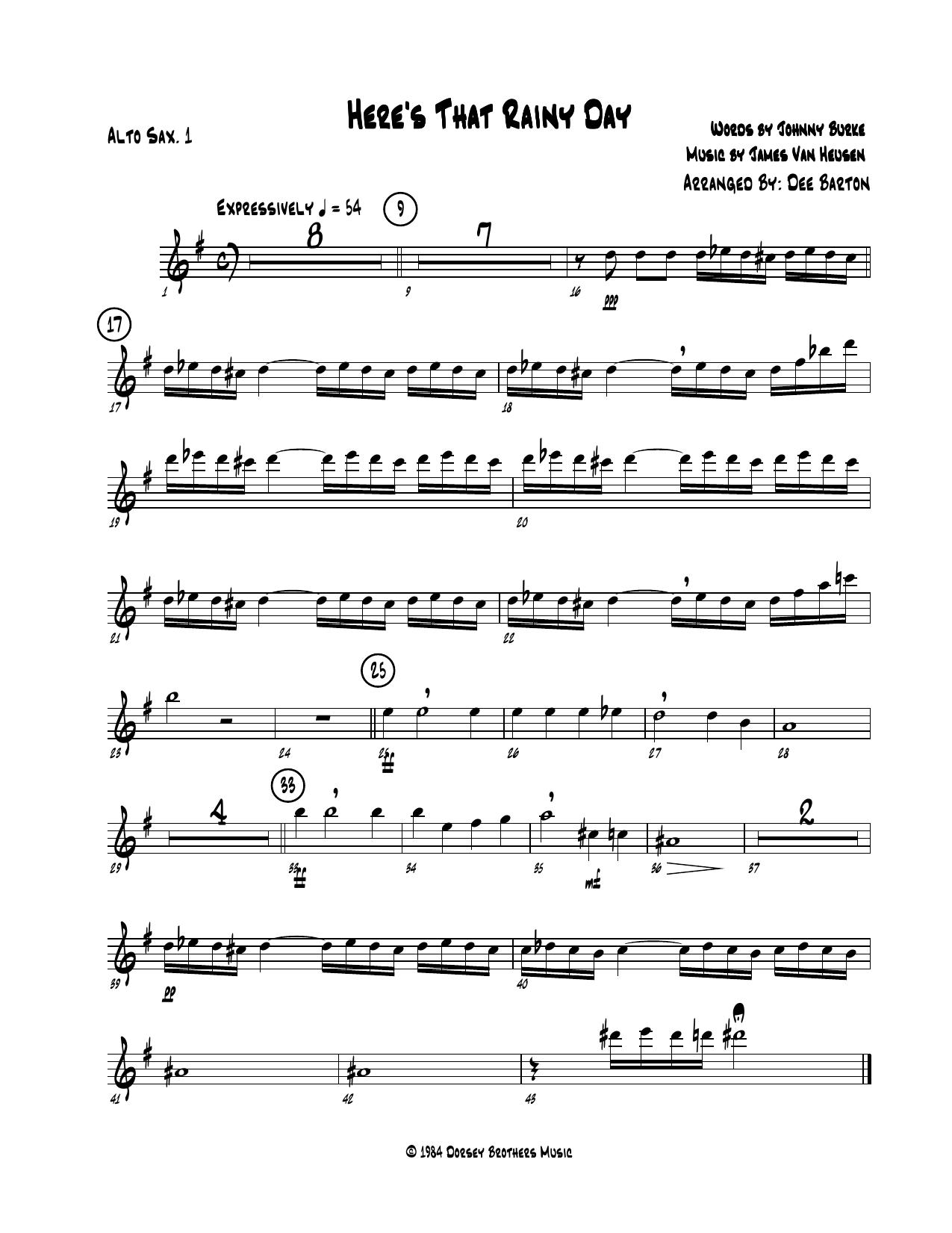
Here's That Rainy Day (D.Barton)
Composed by Jimmy Van Heusen
Arranged by Dee Barton
- Ensemble: Big Band
- Pages: 21
- Instruments (21): Alto Sax 1, Alto Sax 2, Tenor Sax 1, Tenor Sax 2, Baritone Sax, Opt. Tenor Sax (Substitute for Alto Sax 2), Opt. Baritone Sax (Substitute for Tenor Sax 2), Trumpet 1, Trumpet 2, Trumpet 3, Trumpet 4, Trumpet 5, Trombone 1, Trombone 2, Trombone 3, Trombone 4, Tuba (Trombone 5), Piano, Guitar, String Bass, Drums
- Difficulty: medium
- Content: Individual Parts
- Format: PDF Download (Instant)
- Price: $24.99
Jimmy Van Heusen and Johnny Burke introduced "Here's That Rainy Day" in the 1953 Broadway musical *Carnival in Flanders*, but the composition truly ascended into the pantheon of jazz royalty through definitive interpretations by Frank Sinatra, Chet Baker, and the Stan Kenton Orchestra. As a jazz standard, the tune is celebrated for its sophisticated, bittersweet harmonic progression, characterized by its iconic modal shifts and melancholic chromaticism. It represents the pinnacle of mid-century American popular song craftsmanship, offering a rich framework that invites deeply expressive, introspective harmonic exploration by jazz improvisers and arrangers alike. Dee Barton’s masterful big band adaptation reimagines this classic standard as a lush, deeply reflective ballad driven by a slow, rubato-infused pulse that eventually settles into a spacious, modern swing feel. The arrangement is cast in a moody, resonant key center that maximizes the warmth of the saxophone section and the melancholic depth of the low brass. The overall mood shifts seamlessly from hushed, delicate fragility to towering, cinematic climaxes. Barton avoids a straightforward melody statement, instead utilizing dense, West Coast-inflected chord voicings that create a shimmering, impressionistic harmonic texture reminiscent of the innovative writing found in advanced contemporary jazz composition. The arrangement opens with an atmospheric introduction led by the piano and atmospheric brass pads before the alto saxophone section carries the primary melodic statement in a tightly woven, harmonized soli. Barton builds tension gradually through subtle counterpoint in the inner voices and rolling drum cadences, leading to an open solo section—tailored for a lead tenor saxophone or flugelhorn—that floats effortlessly over a sophisticated harmonic background. The climax of the chart features a breathtaking shout chorus that expands the dynamic spectrum to a commanding forte, showcasing rich brass pyramids and cascading woodwind lines before dissolving back into the haunting, quiet introspection of the opening thematic material. Advanced collegiate, community, and professional jazz ensembles will find this chart an exceptionally rewarding centerpiece for a concert program. While the technical demands on individual players are moderate in terms of sheer speed, the arrangement requires extraordinary ensemble maturity, precise intonation, dynamic control, and a sophisticated grasp of harmonic pacing. It serves as an ideal vehicle for showcasing a band's collective tonal beauty, phrasing sensitivity, and emotional depth. Executing Dee Barton’s setting of "Here's That Rainy Day" successfully requires meticulous attention to dynamic contrast and intonation, particularly within the sustained, dense harmonic structures of the brass section. The conductor should approach the tempo with flexibility, utilizing a relaxed, breathing ballad feel (around quarter note = 66-72 BPM) that avoids feeling rigid or metronomic. A primary technical challenge lies in maintaining a warm, centered tone during the extremely quiet passages in the introduction and coda; players must avoid pinching their sound when playing softly in the upper registers. Saxophone sections should focus on seamless blend during the soli statements, matching vibrato widths closely. Brass players should utilize cup or harmon mutes where indicated to achieve the desired West Coast color, ensuring that muted lines project without forcing the tone. During rehearsal, isolate the chord clusters in the lower brass and saxophones to tune the major sevenths and extended alterations carefully, as the emotional impact of Barton’s arrangement hinges entirely on the exact purity of these harmonic voicings. Q: What instruments and parts are included in this arrangement? A: This chart is scored for a standard 21-instrument big band lineup, consisting of Alto Saxophone 1, Alto Saxophone 2, Tenor Saxophone 1, Tenor Saxophone 2, Baritone Saxophone, 4 Trumpets, 4 Trombones, Bass Trombone, Guitar, Piano, Bass, Drums, and auxiliary percussion parts across a 21-page master score and set of parts. Q: What is the difficulty level of this Dee Barton arrangement? A: This arrangement is graded as advanced, best suited for collegiate, advanced high school, community, and professional jazz ensembles due to its demanding dynamic control, intricate harmonic reading, and requirement for mature ensemble blend. Q: What is the historical context and musical style of this piece? A: Rooted in Jimmy Van Heusen’s 1953 standard, this chart is framed in a sophisticated, modern West Coast jazz ballad style that emphasizes lush harmonic voicings, subtle metric shifts, and deep emotional expression. Q: What makes this specific arrangement by Dee Barton unique? A: Barton’s treatment stands out for its impressionistic re-harmonizations, atmospheric use of space, delicate woodwind soli passages, and a cinematic, soaring shout chorus that transforms a familiar standard into a monumental concert feature. Q: What is the performance duration and recommended tempo for this chart? A: The performance duration is approximately 4 to 5 minutes, depending on the length of the open improvised solo sections, performed at a relaxed, flowing ballad tempo around 68 beats per minute.
Questions and answers
- What is included in the Here's That Rainy Day (D.Barton) PDF?
- The verified current file contains individual parts across 21 pages.
- How many instruments or parts are listed for Here's That Rainy Day (D.Barton)?
- The verified instrumentation list contains 21 entries for this Big Band arrangement.
- Who is credited for Here's That Rainy Day (D.Barton)?
- Composer: Jimmy Van Heusen. Arranger: Dee Barton.
- What difficulty is listed for Here's That Rainy Day (D.Barton)?
- The verified difficulty level is medium.
- Can I preview Here's That Rainy Day (D.Barton) before buying?
- Yes. The product page provides a preview generated from the current PDF file.
- How is Here's That Rainy Day (D.Barton) delivered?
- After successful payment, the digital PDF is made available for download. The displayed price is $24.99.
Musicians Also Search For
Here's That Rainy Day Dee Barton PDF • Here's That Rainy Day Dee Barton sheet music • Here's That Rainy Day arranged by Dee Barton • Dee Barton big band charts • Dee Barton jazz arrangements PDF • Here's That Rainy Day Jimmy Van Heusen sheet music • Here's That Rainy Day Jimmy Van Heusen big band arrangements • Jimmy Van Heusen big band charts • Here's That Rainy Day big band arrangements • Here's That Rainy Day big band PDF download • Here's That Rainy Day jazz sheet music • big band sheet music download • Here's That Rainy Day individual parts download • Here's That Rainy Day sheet music PDF • buy Here's That Rainy Day sheet music • download Here's That Rainy Day PDF • Here's That Rainy Day jazz charts • best Dee Barton big band arrangements • Jimmy Van Heusen arranged by Dee Barton • Here's That Rainy Day printable sheet music • big band repertoire PDF