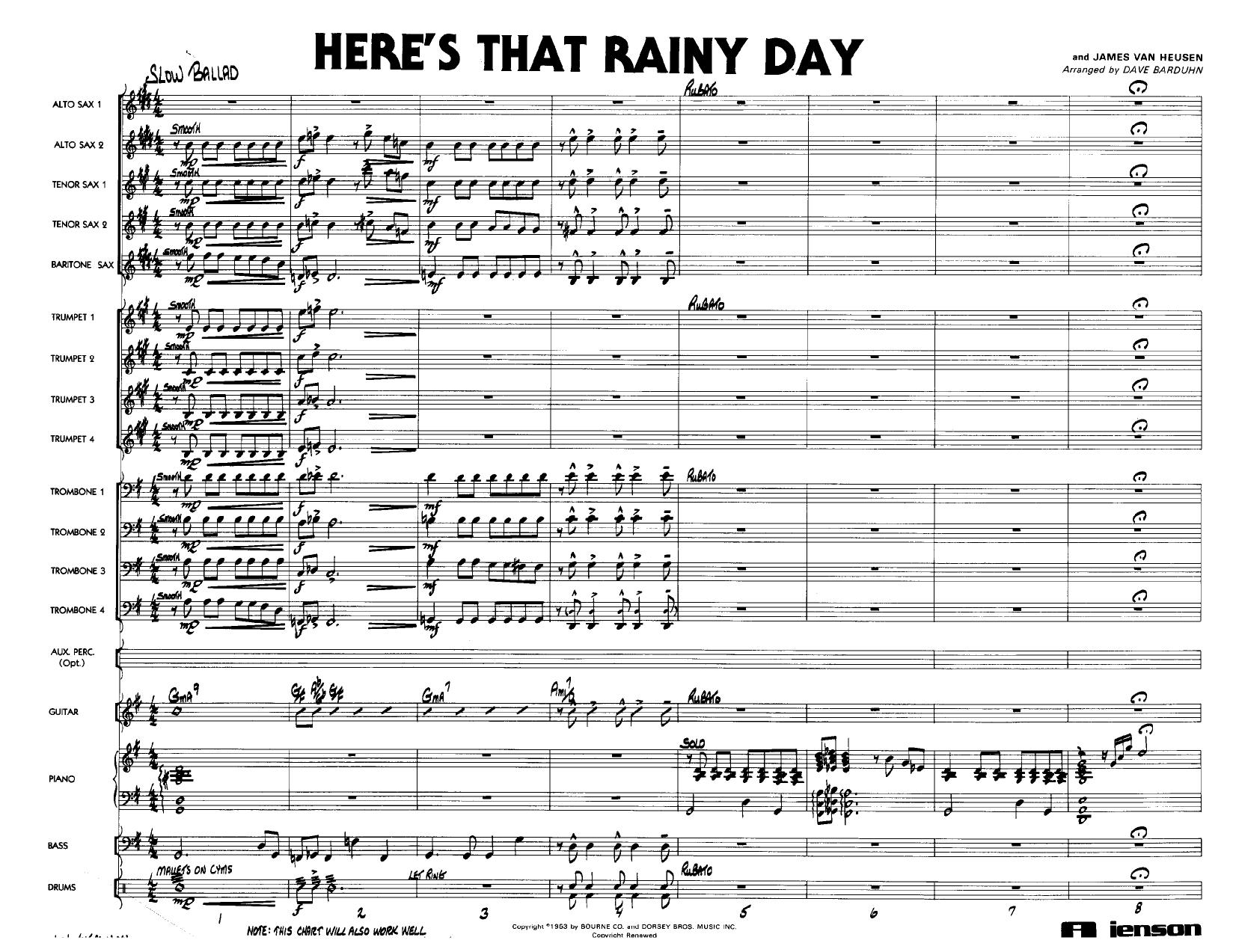
Here's That Rainy Day (D.Barduhn) sheet music preview

Here's That Rainy Day (D.Barduhn)

Composed by Jimmy Van Heusen

Arranged by Dave Barduhn

  • Ensemble: Big Band
  • Pages: 32
  • Instruments (17): Alto Sax 1, Alto Sax 2, Tenor Sax 1, Tenor Sax 2, Baritone Sax, Trumpet 1, Trumpet 2, Trumpet 3, Trumpet 4, Trombone 1, Trombone 2, Trombone 3, Trombone 4, Guitar, Piano, Bass, Drums
  • Difficulty: medium
  • Content: Individual Parts
  • Format: PDF Download (Instant)
  • Price: $24.99

Jimmy Van Heusen and Johnny Burke crafted "Here's That Rainy Day" for the 1953 Broadway musical *Carnival in Flanders*, but the tune immortalized itself in the jazz canon through definitive interpretations by Frank Sinatra, Bill Evans, and Wes Montgomery. Operating within the rich tradition of the Great American Songbook, this melancholic masterpiece has evolved from a theatrical ballad into an essential vehicle for jazz harmonic exploration. Its sophisticated chord changes and lingering, bittersweet melody offer a masterclass in emotional resonance, capturing a poignant blend of melancholy and reflective optimism that defines mid-century vocal and instrumental jazz. Dave Barduhn’s masterful big band adaptation reimagines Van Heusen’s classic as a lush, expressive ballad centered around a flowing, contemporary swing feel. The arrangement unfolds in a comfortable, relaxed tempo that prioritizes rich textural layering over dense rhythmic complexity, allowing the ensemble to explore deep, modern extended harmonies. The mood shifts seamlessly from intimate, breathy woodwind voicings to sweeping, cinematic crescendos. Barduhn avoids static scoring by treating the 18-piece big band as a dynamic, breathing organism, utilizing subtle rubato pacing and rolling dynamic swells to evoke the gentle, relentless passage of a rainy afternoon. A signature of Barduhn’s writing style is his immaculate treatment of the saxophone soli and transparent brass voicing, both of which are prominently featured here. The arrangement opens with a delicate, atmospheric introduction before handing the primary melodic statements to the lead alto saxophone and flugelhorn sections, framed by warm, impressionistic background figures from the reeds. While designed to highlight a featured soloist—ideally an alto saxophonist or vocalist—the chart maintains high engagement across all chairs through intricate inner-voice movement. Technical demands center less on raw velocity and much more on blend, intonation, and breath support, requiring mature control over dynamic extremes, subtle vibrato usage, and seamless ensemble phrasing during exposed chordal passages. Advanced high school ensembles, collegiate jazz orchestras, and professional community big bands will find this arrangement an exceptional vehicle for developing stylistic maturity and tonal cohesion. Because the chart relies heavily on listening across sections and maintaining a transparent, lush soundscape, it serves as a rigorous yet rewarding study in modern ballad playing. Directors will appreciate how the chart pushes an ensemble to elevate its collective musicality, transforming a familiar standard into a breathtaking, emotionally resonant centerpiece for any formal concert program. Conductors should approach this chart with a primary focus on horizontal phrasing and elastic, breathing time rather than a strict metronomic pulse. Establish a relaxed, expressive tempo around ballad-swing parameters, ensuring the rhythm section maintains an ultra-subtle, feather-light triplet feel on the ride cymbal without ever rushing the forward momentum. Pianists and guitarists must voice chord extensions carefully, avoiding heavy lower-register clutter to preserve the transparency of Barduhn’s sophisticated upper-structure triads. Technically, the greatest challenge lies in maintaining pristine intonation during prolonged, exposed dynamic swells and soft passages. Horn players should utilize minimal vibrato at the start of sustained notes, letting it warm up naturally. Ensure the brass mutes, where utilized, are balanced strictly against the acoustic volume of the rhythm section. Rehearsals should isolate the dynamic transitions, particularly the key modulation points, practicing them under tempo to achieve a unified, effortless blend across the entire 18-piece ensemble. Q: What instruments and parts are included in this 32-page big band arrangement? A: The chart is scored for a standard 18-piece big band instrumentation, featuring Alto Saxophone 1 & 2, Tenor Saxophone 1 & 2, Baritone Saxophone, 4 Trumpets (with flugelhorn doubles recommended), 4 Trombones, Guitar, Piano, Bass, and Drums. Q: What is the difficulty level of Dave Barduhn's arrangement of "Here's That Rainy Day"? A: This arrangement is rated at an advanced intermediate to advanced level (Grade 4-5), making it ideal for skilled high school, collegiate, and professional jazz ensembles focusing on ballad interpretation and blend. Q: What is the historical style and musical context of this piece? A: Originally composed by Jimmy Van Heusen for a 1953 Broadway production, this arrangement places the tune firmly in the contemporary jazz ballad tradition, echoing the sophisticated harmonic styling popularized by legendary vocal and instrumental jazz icons. Q: What makes this specific arrangement by Dave Barduhn unique? A: Barduhn distinguishes his chart through lush, modern extended harmonies, transparent section voicings, and a flowing, cinematic approach that avoids predictable ballad clichés in favor of rich, impressionistic textures. Q: What is the approximate performance duration and tempo feel of this arrangement? A: The arrangement runs approximately 4 to 5 minutes and is performed at a relaxed, expressive ballad tempo with an underlying, subtle swing feel.

Questions and answers

What is included in the Here's That Rainy Day (D.Barduhn) PDF?
The verified current file contains a conductor score and individual parts across 32 pages.
How many instruments or parts are listed for Here's That Rainy Day (D.Barduhn)?
The verified instrumentation list contains 17 entries for this Big Band arrangement.
Who is credited for Here's That Rainy Day (D.Barduhn)?
Composer: Jimmy Van Heusen. Arranger: Dave Barduhn.
What difficulty is listed for Here's That Rainy Day (D.Barduhn)?
The verified difficulty level is medium.
Can I preview Here's That Rainy Day (D.Barduhn) before buying?
Yes. The product page provides a preview generated from the current PDF file.
How is Here's That Rainy Day (D.Barduhn) delivered?
After successful payment, the digital PDF is made available for download. The displayed price is $24.99.

Musicians Also Search For

Here's That Rainy Day Dave Barduhn PDFHere's That Rainy Day Dave Barduhn sheet musicHere's That Rainy Day arranged by Dave BarduhnDave Barduhn big band chartsDave Barduhn jazz arrangements PDFHere's That Rainy Day Jimmy Van Heusen sheet musicHere's That Rainy Day Jimmy Van Heusen big band arrangementsJimmy Van Heusen big band chartsHere's That Rainy Day big band arrangementsHere's That Rainy Day big band PDF downloadHere's That Rainy Day jazz sheet musicbig band sheet music downloadHere's That Rainy Day conductor score PDFHere's That Rainy Day individual parts downloadHere's That Rainy Day sheet music PDFbuy Here's That Rainy Day sheet musicdownload Here's That Rainy Day PDFHere's That Rainy Day jazz chartsbest Dave Barduhn big band arrangementsJimmy Van Heusen arranged by Dave BarduhnHere's That Rainy Day printable sheet musicbig band repertoire PDF

All arrangements by Dave Barduhn All Jimmy Van Heusen sheet music