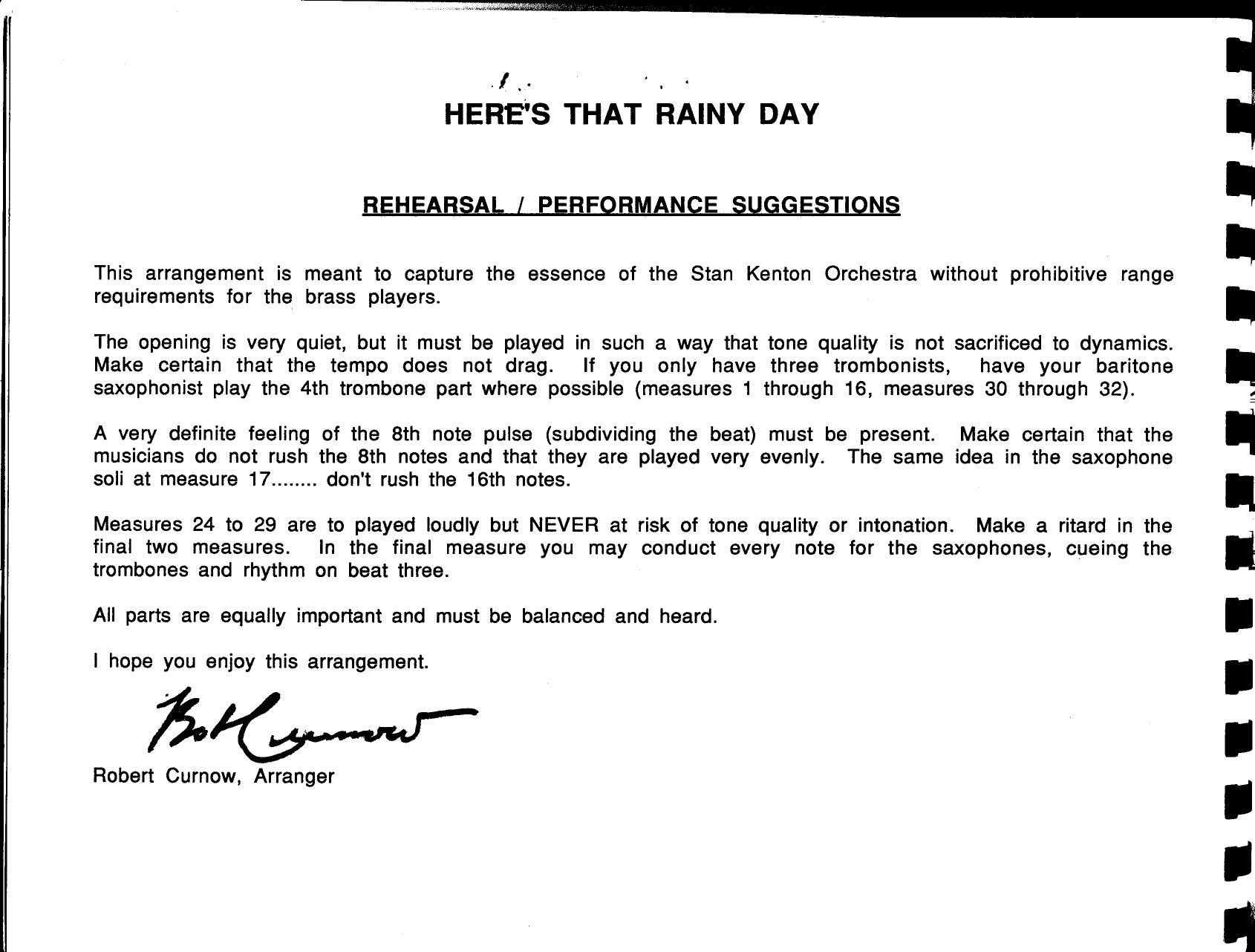
Here's That Rainy Day (B.Curnow)
Composed by Jimmy Van Heusen
Arranged by Bob Curnow
- Ensemble: Big Band
- Pages: 35
- Instruments (17): Alto Saxophone 1, Alto Saxophone 2, Tenor Saxophone 1, Tenor Saxophone 2, Baritone Saxophone, Trumpet 1, Trumpet 2, Trumpet 3, Trumpet 4, Trombone 1, Trombone 2, Trombone 3, Trombone 4, Piano, Guitar, Bass, Drums
- Difficulty: medium
- Content: Individual Parts
- Format: PDF Download (Instant)
- Price: $24.99
Composed by Jimmy Van Heusen with lyrics by Johnny Burke, "Here's That Rainy Day" originated in the 1953 Broadway musical *Carnival in Flanders* and swiftly transcended its theatrical roots to become one of the most revered entries in the Great American Songbook. Immortalized by jazz icons ranging from Frank Sinatra and Bill Evans to Wes Montgomery, the composition is celebrated for its bittersweet harmonic progression and poignant melodic contour. Its unique blend of melancholy and lyrical elegance has cemented its status as a quintessential jazz ballad, inviting interpreters to explore deep emotional landscapes through sophisticated chord substitutions and rubato phrasing. Master arranger Bob Curnow approaches this timeless standard with the lush, sophisticated harmonic vocabulary and rich textural layering that characterize the finest traditions of contemporary big band writing. Rather than relying on a straightforward head-arrangement format, Curnow re-imagines the piece as an expansive canvas of modern orchestral jazz. The arrangement opens with a pensive, atmospheric introduction that gradually unfolds into a flowing medium-ballad tempo feel. Curnow utilizes extended chord voicings, subtle chromatic shifts, and dense horn-section interleaving to create a warm, enveloping sonic palette reminiscent of the finest West Coast jazz traditions, ensuring that every section of the ensemble contributes to the overarching emotional narrative. Throughout the chart, responsibility for the thematic material shifts fluidly between sections, highlighting the rich timbral contrast available within a standard 17-piece big band instrumentation. The woodwinds and muted brass often carry the primary melody lines with delicate phrasing, while carefully constructed soli sections showcase the cohesive blend of the saxophone and brass choirs. Dynamic peaks are handled with meticulous structural pacing, building naturally toward expressive climaxes without sacrificing the intimate, reflective character of the source material. Solo opportunities are thoughtfully integrated, allowing featured performers space to improvise within a supportive, harmonically rich background texture that reacts dynamically to the soloist's phrasing. Advanced high school, collegiate, and professional jazz ensembles will find this arrangement an exceptional vehicle for developing nuanced ensemble balance, intonation, and stylistic maturity. Because the chart relies heavily on controlled dynamics, rubato transitions, and precise blend rather than sheer velocity, it provides an invaluable masterclass in ensemble listening and ballad interpretation. Conductor and players alike will discover profound artistic rewards in navigating Curnow's intricate counterpoint and sophisticated harmonic resolutions, making it a standout selection for festival performances and formal concert programs. Navigating this arrangement successfully requires an exceptional commitment to blend, balance, and lyrical phrasing from every section of the ensemble. - **Tempo and Feel:** Maintain a steady, flowing medium-ballad groove. Avoid rushing the rubato sections at phrase transitions; let the time breathe organically while maintaining an internal pulse. - **Intonation and Voicing:** Curnow’s dense, extended harmonies demand meticulous tuning within the sections. Thirds and sevenths must be locked in, and interior voices in the saxophones and trombones need to project clearly without masking the lead melody. - **Articulations and Mutes:** Pay close attention to marked dynamic swells and fades. Where mutes are specified for brass, ensure uniformity of equipment within the section to maintain a cohesive timbre. - **Rehearsal Strategy:** Isolate the chordal interludes and rehearse them slowly at half-tempo to ensure the ensemble hears the root movements and upper extensions clearly before attempting full dynamics. Q: What instruments and parts are included in this arrangement? A: The package includes a complete 35-page conductor score and 17 individual instrument parts: two alto saxophones, two tenor saxophones, baritone saxophone, four trumpets, four trombones, bass trombone, piano, guitar, bass, and drums. Q: What is the difficulty level of this chart? A: This arrangement is graded as medium-advanced, making it ideal for accomplished high school bands, university ensembles, and professional community big bands looking to refine their ballad playing. Q: What is the musical style and historical background of the piece? A: It is a jazz ballad based on Jimmy Van Heusen’s classic 1953 standard, reimagined through Bob Curnow's contemporary big band writing style, which emphasizes lush harmonies and dynamic textural contrast. Q: What makes Bob Curnow’s arrangement unique compared to other versions of this standard? A: Curnow utilizes sophisticated extended voicings, intricate counterpoint, and innovative sectional interleaving that draw upon the rich heritage of West Coast modern big band arranging, elevating a familiar melody into an orchestral showcase. Q: What is the performance duration and tempo framework of the piece? A: While performance time varies based on chosen soloist choruses and rubato pacing, the chart operates primarily within a relaxed, flowing medium-ballad tempo framework lasting approximately four to six minutes.
Questions and answers
- What is included in the Here's That Rainy Day (B.Curnow) PDF?
- The verified current file contains a conductor score and individual parts across 35 pages.
- How many instruments or parts are listed for Here's That Rainy Day (B.Curnow)?
- The verified instrumentation list contains 17 entries for this Big Band arrangement.
- Who is credited for Here's That Rainy Day (B.Curnow)?
- Composer: Jimmy Van Heusen. Arranger: Bob Curnow.
- What difficulty is listed for Here's That Rainy Day (B.Curnow)?
- The verified difficulty level is medium.
- Can I preview Here's That Rainy Day (B.Curnow) before buying?
- Yes. The product page provides a preview generated from the current PDF file.
- How is Here's That Rainy Day (B.Curnow) delivered?
- After successful payment, the digital PDF is made available for download. The displayed price is $24.99.
Musicians Also Search For
Here's That Rainy Day Bob Curnow PDF • Here's That Rainy Day Bob Curnow sheet music • Here's That Rainy Day arranged by Bob Curnow • Bob Curnow big band charts • Bob Curnow jazz arrangements PDF • Here's That Rainy Day Jimmy Van Heusen sheet music • Here's That Rainy Day Jimmy Van Heusen big band arrangements • Jimmy Van Heusen big band charts • Here's That Rainy Day big band arrangements • Here's That Rainy Day big band PDF download • Here's That Rainy Day jazz sheet music • big band sheet music download • Here's That Rainy Day conductor score PDF • Here's That Rainy Day individual parts download • Here's That Rainy Day sheet music PDF • buy Here's That Rainy Day sheet music • download Here's That Rainy Day PDF • Here's That Rainy Day jazz charts • best Bob Curnow big band arrangements • Jimmy Van Heusen arranged by Bob Curnow • Here's That Rainy Day printable sheet music • big band repertoire PDF