Here's That Rainy Day (B.Curnow)
Composed by Jimmy Van Heusen
Arranged by B.Curnow
- Ensemble: Big Band
- Style: Jazz Standard
- Pages: 35
- Instruments (17): Alto Saxophone 1, Alto Saxophone 2, Tenor Saxophone 1, Tenor Saxophone 2, Baritone Saxophone, Trumpet 1, Trumpet 2, Trumpet 3, Trumpet 4, Trombone 1, Trombone 2, Trombone 3, Trombone 4, Piano, Guitar, Bass, Drums
- Difficulty: advanced
- Content: Individual Parts
- Format: PDF Download (Instant)
- Price: $24.99
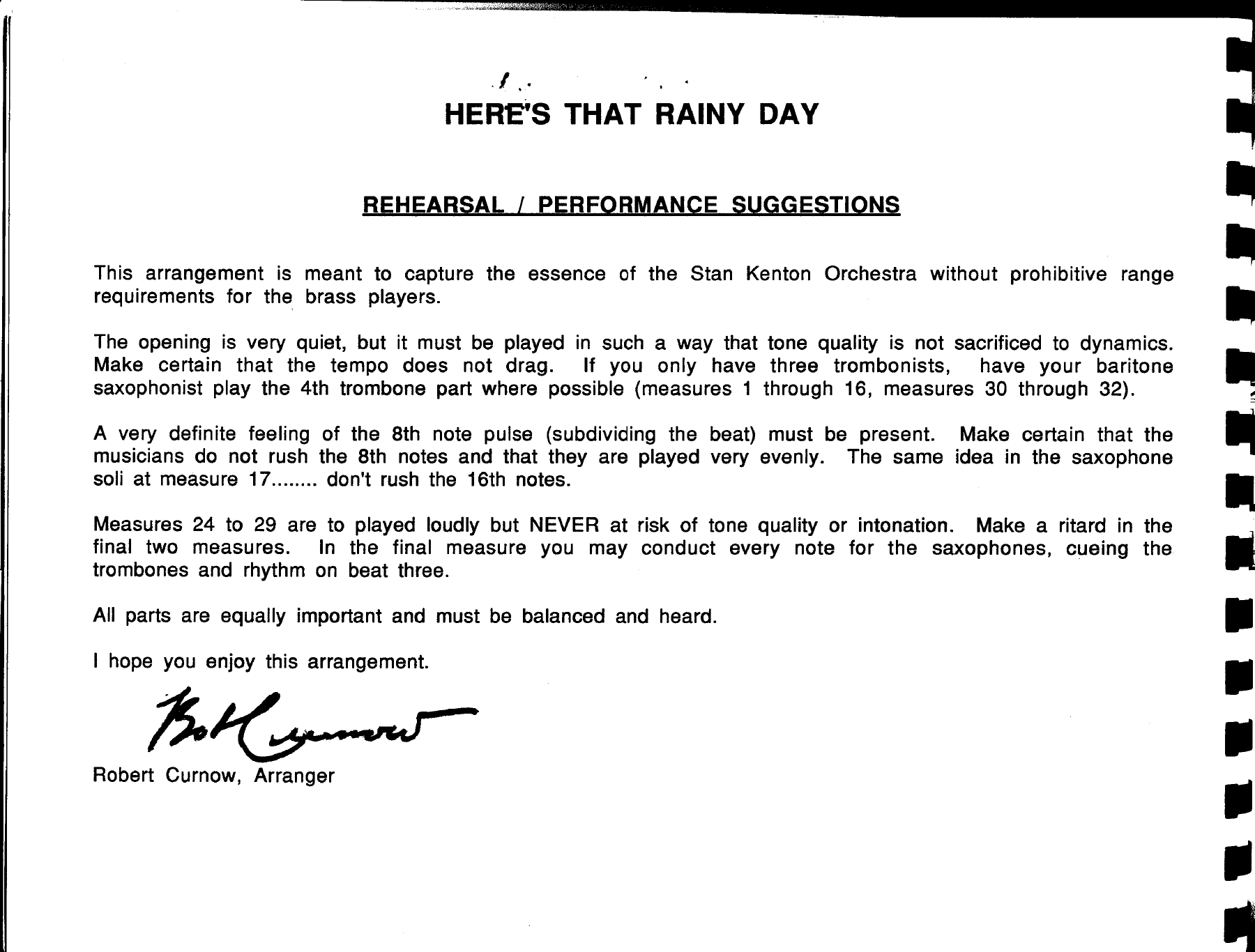
"Here's That Rainy Day," composed by Jimmy Van Heusen with lyrics by Johnny Burke, first graced the stage in 1953 as part of the short-lived Broadway musical *Carnival in Flanders*. Despite the show's brief run, this poignant ballad quickly transcended its origins to become one of the most enduring and widely recorded jazz standards of the mid-20th century. Its melancholic charm and sophisticated harmonic structure, often moving from a major tonic to distant tonal regions, resonated deeply with musicians and audiences alike, mirroring the lyric's theme of unexpected heartbreak and wistful reflection. The song's status as a jazz standard was cemented by iconic recordings from artists such as Frank Sinatra, whose 1959 rendition is considered definitive, and Bill Evans, known for his introspective piano interpretation. Bob Curnow's masterful big band arrangement of "Here's That Rainy Day" transforms this intimate ballad into a rich, expansive orchestral statement. Curnow, renowned for his work with the Stan Kenton Orchestra and his innovative arrangements of contemporary fusion and rock for large ensembles, brings his signature blend of harmonic depth and textural clarity to this classic. His approach often features intricate voicings, compelling counterpoint, and a keen ear for ensemble balance, drawing on influences from earlier Kenton arrangers like Pete Rugolo and Bill Holman. This arrangement is crafted as a slow, expressive ballad, typically in 4/4 time and often performed in the key of G major in instrumental jazz settings. The arrangement showcases Curnow's ability to maintain the original's emotional core while expanding its sonic palette. The melody is sensitively carried by various sections, often featuring the lead alto saxophone or flugelhorn, allowing for both individual expression and lush ensemble textures. Soli sections are meticulously crafted, providing challenging yet rewarding interplay between the horn sections, while the rhythm section lays down a supple, unhurried foundation. Performance challenges include achieving precise blend and balance within the dense harmonies, maintaining a consistent, expressive slow swing feel, and navigating the nuanced dynamic shifts that underscore the piece's introspective mood. The rewarding aspect lies in the collective creation of a deeply moving and sophisticated musical experience. This arrangement is ideally suited for advanced high school, collegiate, community, and professional big bands. Its sophisticated harmonic language and demands for expressive phrasing make it an excellent vehicle for developing musical maturity and ensemble cohesion. Bands capable of executing complex voicings and maintaining a refined ballad tempo will find this piece a standout in their repertoire, offering both a challenge and a profound artistic reward. To truly capture the essence of this Bob Curnow arrangement, conductors should emphasize a cohesive, unhurried slow swing feel, ensuring the rhythm section provides a steady, yet flexible, foundation. The primary technical challenge lies in achieving precise intonation and blend within the rich, often close-voiced harmonies, particularly in the saxophone and brass sections. Encourage musicians to listen across sections, tuning carefully to chord tones. Dynamics are crucial; the piece calls for a wide range of expression, from delicate pianissimos to full, resonant fortissimos, often within short phrases. Articulation should be smooth and legato, with careful attention to phrase shaping. Soloists (typically alto saxophone or flugelhorn) should focus on melodic interpretation and emotional depth rather than technical flash, allowing the poignant melody to unfold naturally. Rehearsal time should be dedicated to sectional tuning of sustained chords and practicing seamless transitions between ensemble and solo sections. **Q: What instruments are included in this arrangement?** A: This arrangement is scored for a standard 17-instrument big band, including Alto Saxophone 1, Alto Saxophone 2, Tenor Saxophone 1, Tenor Saxophone 2, Baritone Saxophone, 4 Trumpets, 4 Trombones (including Bass Trombone), Piano, Bass, Drums, and Guitar. **Q: What is the difficulty level of this arrangement?** A: This arrangement is considered advanced, suitable for high school, collegiate, community, and professional big bands. It requires strong ensemble playing, precise intonation, and mature musical interpretation. **Q: What is the musical style and historical context of "Here's That Rainy Day"?** A: "Here's That Rainy Day" is a classic jazz standard, originally composed by Jimmy Van Heusen in 1953. It is a melancholic ballad that became famous through iconic jazz vocal and instrumental recordings, representing the rich tradition of mid-20th century American popular song. **Q: What makes Bob Curnow's arrangement of this piece unique?** A: Bob Curnow's arrangement is distinguished by its sophisticated harmonic voicings, intricate counterpoint, and rich orchestral textures that expand upon the original ballad while preserving its emotional depth. It showcases his characteristic blend of traditional big band writing with contemporary sensibilities, often featuring expressive soli sections and nuanced dynamic contrasts. **Q: What is the typical performance duration and tempo for this arrangement?** A: As a slow ballad, the typical performance duration for this arrangement is approximately 4-6 minutes, depending on improvisation and interpretive choices. It is performed with an unhurried, expressive slow swing feel.
Questions and answers
- What is included in the Here's That Rainy Day (B.Curnow) PDF?
- The verified current file contains a conductor score and individual parts across 35 pages.
- How many instruments or parts are listed for Here's That Rainy Day (B.Curnow)?
- The verified instrumentation list contains 17 entries for this Big Band arrangement.
- Who is credited for Here's That Rainy Day (B.Curnow)?
- Composer: Jimmy Van Heusen. Arranger: B.Curnow.
- What difficulty is listed for Here's That Rainy Day (B.Curnow)?
- The verified difficulty level is advanced.
- What style is listed for Here's That Rainy Day (B.Curnow)?
- The catalog lists the style as Jazz Standard.
- Can I preview Here's That Rainy Day (B.Curnow) before buying?
- Yes. The product page provides a preview generated from the current PDF file.
- How is Here's That Rainy Day (B.Curnow) delivered?
- After successful payment, the digital PDF is made available for download. The displayed price is $24.99.
Musicians Also Search For
Here's That Rainy Day B.Curnow PDF • Here's That Rainy Day B.Curnow sheet music • Here's That Rainy Day arranged by B.Curnow • B.Curnow big band charts • B.Curnow jazz arrangements PDF • Here's That Rainy Day Jimmy Van Heusen sheet music • Here's That Rainy Day Jimmy Van Heusen big band arrangements • Jimmy Van Heusen big band charts • Here's That Rainy Day big band arrangements • Here's That Rainy Day big band PDF download • Here's That Rainy Day jazz sheet music • big band sheet music download • Here's That Rainy Day conductor score PDF • Here's That Rainy Day individual parts download • Here's That Rainy Day sheet music PDF • Here's That Rainy Day Jazz Standard charts • Jazz Standard big band arrangements • buy Here's That Rainy Day sheet music • download Here's That Rainy Day PDF • Here's That Rainy Day jazz charts • best B.Curnow big band arrangements • Jimmy Van Heusen arranged by B.Curnow • Here's That Rainy Day printable sheet music • big band repertoire PDF