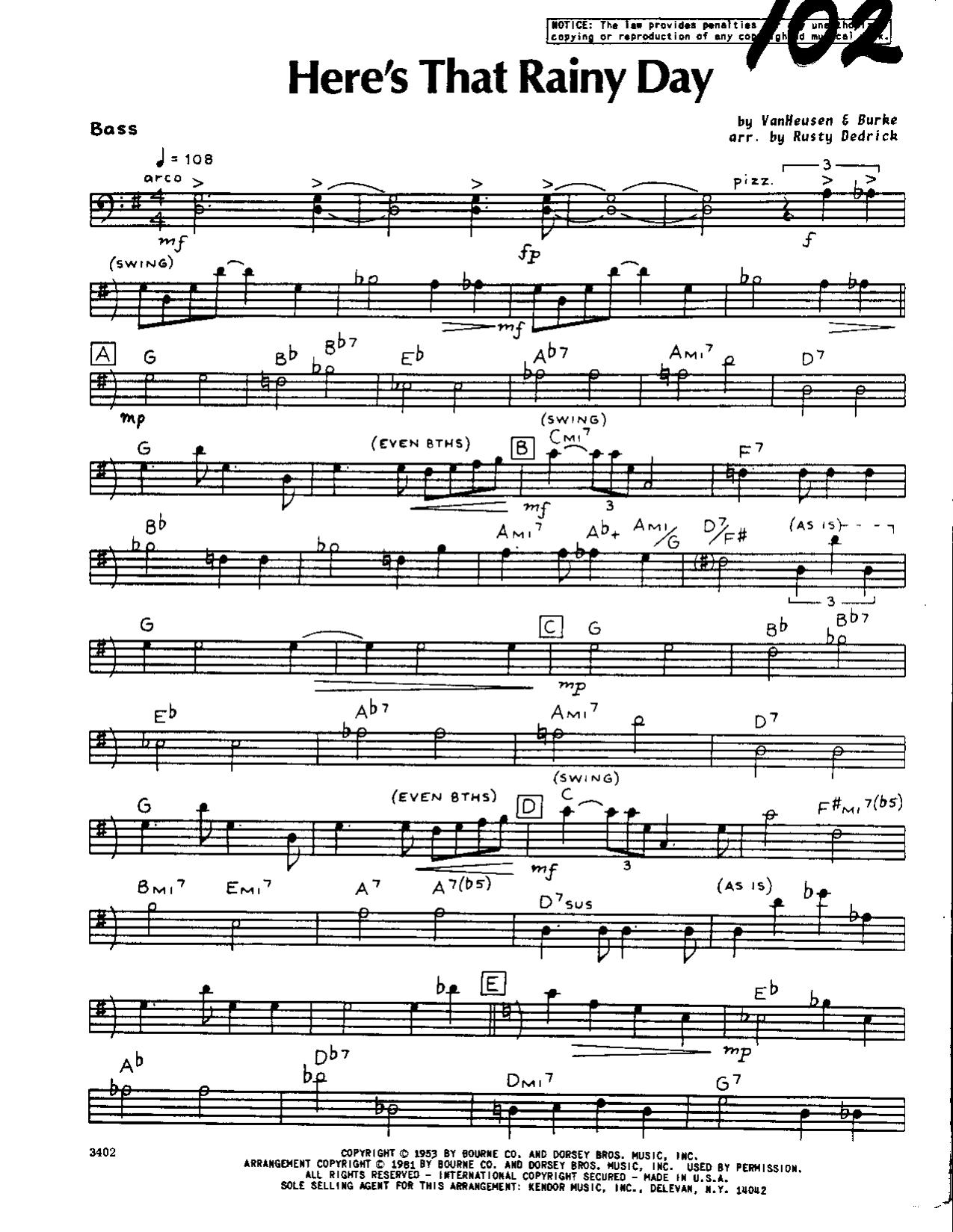
Here's that Rainy Day (R.Dedrick)
Composed by Jimmy Van Heusen and Johnny Burke
Arranged by Rusty Dedrick
- Ensemble: Small Ensemble
- Style: Jazz Standard
- Pages: 13
- Instruments (6): Horn 1 (Bb Trumpet), Horn 2 (Bb Tenor Sax), Horn 3 (Trombone), Piano/Guitar, Bass, Drums
- Difficulty: easy
- Content: Individual Parts
- Format: PDF Download (Instant)
- Price: $12.99
"Here's That Rainy Day," a poignant jazz standard, emerged from the Broadway musical *Carnival in Flanders* in 1953, with music by Jimmy Van Heusen and lyrics by Johnny Burke. Although the musical itself had a short run, closing after only six performances, Dolores Gray's introduction of the song cemented its place in the Great American Songbook. The piece quickly transcended its theatrical origins, becoming a beloved staple in the jazz repertoire, particularly after Frank Sinatra's influential 1959 recording, which is often considered definitive and helped establish it as a standard. Alec Wilder, a renowned composer, famously described it as a "very difficult song" with a complex bass line, possessing "great weight and authority" and showcasing the sophistication acceptable in popular songs of the era. Its enduring appeal lies in its melancholic yet gentle melody and lyrics that evoke themes of lost love and wistful reflection, making it one of the most widely covered songs of its year. Rusty Dedrick's small ensemble arrangement of "Here's That Rainy Day" captures the song's inherent melancholy and sophisticated harmonic depth within an intimate setting. Dedrick, a distinguished jazz trumpeter, composer, and arranger with a career spanning seven decades, is known for his traditional jazz sensibilities and his significant contributions to jazz education. His arrangements often reflect a deep understanding of classic jazz idioms, combining solo brilliance with thoughtful ensemble writing. This particular rendition is crafted as a slow, expressive ballad, typically performed in a common jazz key such as G major, allowing for a relaxed tempo that emphasizes its emotional resonance. The mood is introspective and tender, evoking the bittersweet feelings of reflection on past love. Harmonically, the original composition is noted for its immediate modal interchange, shifting between major and minor tonalities, and employing "side-slipping" II-V progressions, which Dedrick skillfully navigates and enhances through his voicings. Dedrick's approach to this standard likely features his characteristic rich, warm brass voicings, particularly given his background as a trumpeter. Expect carefully constructed harmonies that support the mournful melody without overpowering it, possibly utilizing extended harmonies and subtle modulations to deepen the emotional landscape. The arrangement will likely feature the melody carried primarily by a lead instrument, such as a trumpet or saxophone, allowing for expressive phrasing and dynamic control. There will undoubtedly be featured solo sections, offering improvisers the opportunity to explore the tune's intricate harmonic progression, which often includes shifts between distantly related keys and modal borrowing. The technical challenges lie in maintaining melodic continuity and harmonic sophistication through these shifts, demanding a refined harmonic ear from all musicians. The reward for performers is the chance to engage deeply with a timeless piece, delivering a performance rich in emotional nuance and musical integrity. This small ensemble arrangement is ideally suited for college-level jazz combos, advanced high school ensembles, and community jazz groups seeking to perform a classic standard with authenticity and depth. Its demands for precise intonation, sensitive phrasing, and harmonic awareness make it an excellent vehicle for developing musical maturity and ensemble cohesion. Professional musicians will also appreciate the thoughtful arrangement, which provides a solid framework for expressive interpretation while allowing ample space for individual artistry. The 13 pages of sheet music suggest a comprehensive yet concise arrangement, perfect for groups looking to add a sophisticated ballad to their repertoire. Approaching Rusty Dedrick's arrangement of "Here's That Rainy Day" requires a focus on lyrical interpretation and harmonic sensitivity. The piece should be played as a slow, reflective ballad, maintaining a relaxed tempo around 60-70 beats per minute, allowing phrases to breathe and emotions to unfold naturally. The primary technical challenge lies in navigating the sophisticated harmonic changes, which feature immediate modal interchange and "side-slipping" II-V progressions. Musicians must pay close attention to voice leading, particularly in inner voices, to ensure smooth transitions between chords. Rehearsal should emphasize listening across the ensemble to blend voicings and maintain intonation through the subtle harmonic shifts. Soloists should strive for melodic continuity and thematic development, reflecting the song's melancholic mood. Dynamic control is paramount, with careful attention to crescendos and diminuendos to enhance the emotional arc of the piece, particularly during the melody and any ensemble soli sections. Q: What instruments are included in this small ensemble arrangement? A: While specific instrumentation can vary for small ensembles, a typical setup for a jazz standard like this would include lead instruments (e.g., trumpet, alto/tenor saxophone), and a rhythm section comprised of piano, bass, and drums. Q: What is the difficulty level of this arrangement? A: This arrangement is considered intermediate to advanced. Its sophisticated harmonic structure and the need for expressive phrasing and dynamic control make it appropriate for college, advanced high school, or experienced community jazz ensembles. Q: What musical style and historical context does "Here's That Rainy Day" represent? A: "Here's That Rainy Day" is a classic jazz standard, originally composed in 1953 by Jimmy Van Heusen and Johnny Burke. It embodies the sophisticated ballad style of the mid-20th century, known for its melancholic mood and rich harmonic language. Q: What makes Rusty Dedrick's arrangement unique? A: Rusty Dedrick, a renowned jazz trumpeter and arranger, brings his traditional jazz sensibilities and deep harmonic understanding to this arrangement. His treatment emphasizes the song's inherent melancholy and harmonic depth through thoughtful voicings and a focus on lyrical interpretation within a small ensemble context. Q: What is the typical performance duration of this piece? A: As a slow ballad, a performance of "Here's That Rainy Day" typically ranges from 4 to 6 minutes, depending on the number and length of improvised solos and the overall interpretive approach to the tempo.
Questions and answers
- What is included in the Here's that Rainy Day (R.Dedrick) PDF?
- The verified current file contains individual parts across 13 pages.
- How many instruments or parts are listed for Here's that Rainy Day (R.Dedrick)?
- The verified instrumentation list contains 6 entries for this Small Ensemble arrangement.
- Who is credited for Here's that Rainy Day (R.Dedrick)?
- Composer: Jimmy Van Heusen and Johnny Burke. Arranger: Rusty Dedrick.
- What difficulty is listed for Here's that Rainy Day (R.Dedrick)?
- The verified difficulty level is easy.
- What style is listed for Here's that Rainy Day (R.Dedrick)?
- The catalog lists the style as Jazz Standard.
- Can I preview Here's that Rainy Day (R.Dedrick) before buying?
- Yes. The product page provides a preview generated from the current PDF file.
- How is Here's that Rainy Day (R.Dedrick) delivered?
- After successful payment, the digital PDF is made available for download. The displayed price is $12.99.
Musicians Also Search For
Here's that Rainy Day Rusty Dedrick PDF • Here's that Rainy Day Rusty Dedrick sheet music • Here's that Rainy Day arranged by Rusty Dedrick • Rusty Dedrick small ensemble charts • Rusty Dedrick jazz arrangements PDF • Here's that Rainy Day Jimmy Van Heusen and Johnny Burke sheet music • Here's that Rainy Day Jimmy Van Heusen and Johnny Burke small ensemble arrangements • Jimmy Van Heusen and Johnny Burke small ensemble charts • Here's that Rainy Day small ensemble arrangements • Here's that Rainy Day small ensemble PDF download • Here's that Rainy Day jazz sheet music • small ensemble sheet music download • Here's that Rainy Day individual parts download • Here's that Rainy Day sheet music PDF • Here's that Rainy Day Jazz Standard charts • Jazz Standard small ensemble arrangements • buy Here's that Rainy Day sheet music • download Here's that Rainy Day PDF • Here's that Rainy Day jazz charts • best Rusty Dedrick small ensemble arrangements • Jimmy Van Heusen and Johnny Burke arranged by Rusty Dedrick • Here's that Rainy Day printable sheet music • small ensemble repertoire PDF