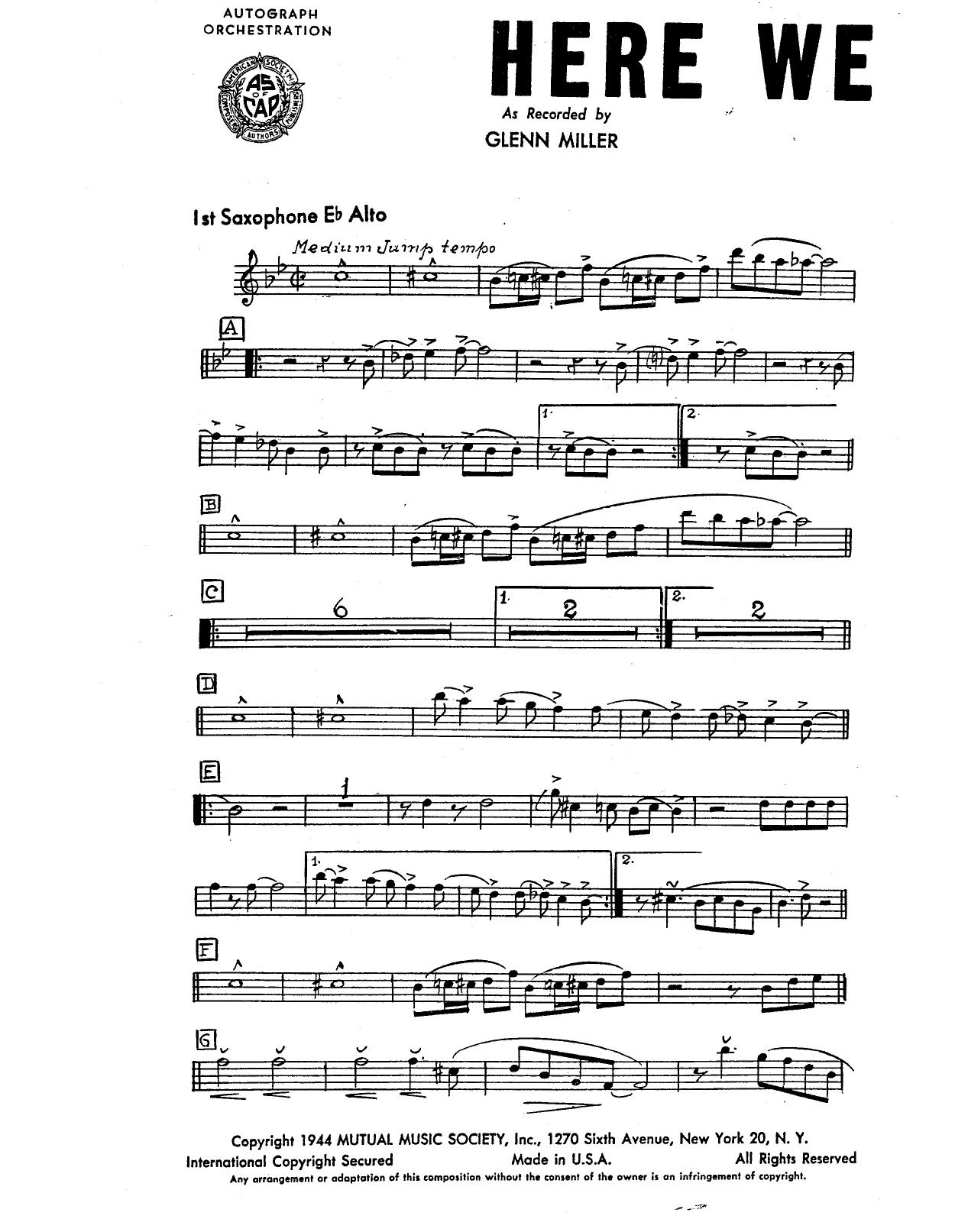
Here We Go Again (J.Gray)
Composed by Jerry Gray
Arranged by Glen Miller
- Ensemble: Big Band
- Pages: 30
- Instruments (15): 1st Saxophone Eb Alto, 2nd Saxophone Bb Tenor, 3rd Saxophone Eb Alto, 4th Saxophone Bb Tenor, 5th Eb Baritone Saxophone, 1st Trumpet in Bb, 2nd Trumpet in Bb, 3rd Trumpet in Bb, 1st Trombone, 2nd Trombone, Piano, Bass, Guitar, Drums, 1st Violins (Conductor)
- Difficulty: medium
- Content: Individual Parts
- Format: PDF Download (Instant)
- Price: $24.99
Jerry Gray’s dynamic composition "Here We Go Again" stands as a brilliant testament to the high-octane sophistication of the classic big band era. Originally forged in the workshops of the legendary Glenn Miller Orchestra during the early 1940s—an era when arrangers like Gray defined the soundscape of American popular music—this tune captures the infectious momentum and polished precision that made swing the dominant cultural force of a generation. While Miller is often universally celebrated for his reed-voicing techniques, Gray’s compositional and arranging contributions provided the orchestra with some of its most rhythmically driving, harmonically clever instrumental flag-wavers. "Here We Go Again" distills the kinetic energy of the wartime swing era into a tightly wound, sophisticated arrangement that rewards meticulous ensemble execution. Propelled by a vibrant, driving medium-up swing feel in 4/4 time, the arrangement radiates an irrepressible sense of forward motion and joyful optimism. The harmonic landscape is rooted in bright, brass-heavy textures balanced by the lithe, interwoven lines of the reed section. Right from the opening downbeat, the mood is buoyant and celebratory, evoking the bustling atmosphere of a crowded 1940s ballroom floor. The underlying groove relies on a crisp, driving ride-cymbal pulse and a walking bassline that locks in seamlessly with the piano comping, creating a buoyant pocket that invites both the band and the audience to lean into the rhythm. Glen Miller’s arranging methodology shines through in the meticulous voice-leading and the clever distribution of thematic material across the ensemble. True to the stylistic hallmarks of the Miller orbit, the arrangement makes brilliant use of tight, harmonized reed sonorities—traditionally featuring a clarinet leading the saxophone section—coupled with sharp, punchy brass interjections that answer the melodic phrases. The arrangement features intricate counterpoint and a brilliantly constructed shout chorus that builds tension through dynamic layering and syncopated rhythmic figures before releasing into a roaring final tutti. Rather than relying on over-extended solo spaces, the focus remains on ensemble cohesion, rhythmic crispness, and seamless transitions between sections, highlighting Gray's genius for architectural form within a dance-band framework. Tailored for advanced high school, collegiate, and professional community big bands, this 30-page arrangement for a 7-instrument ensemble provides a masterclass in ensemble articulation, balance, and style. The technical challenges lie primarily in the execution of rapid, articulated swing eighth notes, clean section blends, and dynamic contrast rather than extreme upper-register brass demands. The rhythm section acts as the engine, with the piano and drums requiring a delicate balance of percussive drive and restraint to keep the ensemble light on its feet. For musicians looking to authentically capture the golden age of swing while exercising precision and stylistic discipline, this chart offers an endlessly rewarding and deeply satisfying performance experience. Success with this arrangement hinges on achieving a unified, lightweight swing articulation across all sections. The tempo should be kept brisk and steady, allowing the rhythm section to establish an effortless, driving pocket without rushing. Horn players must pay close attention to dynamic markings, ensuring that background figures remain subservient to the primary melody while still maintaining a sharp, punchy attack on accented offbeats. For the reed section, clarity in fast scalar passages and tight unison or harmonized lines is paramount; use a dry, focused tone reminiscent of the classic 1940s big band aesthetic. Brass players should avoid overblowing during the shout chorus, prioritizing a rich, resonant core sound over sheer volume to maintain intonation integrity. The drummer should feather the bass drum lightly while keeping a steady, pulsing swing ride pattern, avoiding heavy rock-oriented fills that would disrupt the period-accurate groove. Rehearsal should begin slowly at a reduced tempo to lock in articulation and phrasing uniformity before pushing up to performance speed. Q: What instruments and parts are included in this 30-page arrangement? A: This arrangement is scored for a 7-instrument ensemble configuration consisting of Alto Saxophone, Tenor Saxophone, Trumpet, Trombone, Piano, and rhythm section support, optimized for flexible yet authentic big band voicing. Q: What is the difficulty level of this chart? A: This arrangement is calibrated for advanced high school, collegiate, and professional ensembles, presenting moderate technical challenges centered around precision swing articulation, stylistic uniformity, and ensemble balance rather than extreme range demands. Q: What is the historical style and context of "Here We Go Again"? A: Composed by Jerry Gray during the height of the 1940s swing era, this piece reflects the sophisticated, high-energy dance band style famously championed by the Glenn Miller Orchestra and its master arrangers. Q: What makes this specific arrangement by Glen Miller unique? A: It features Gray's signature architectural genius, utilizing tightly voiced reed counterpoint, crisp brass call-and-response figures, and a meticulously crafted shout chorus that prioritizes ensemble cohesion over extended soloing. Q: What is the suggested performance duration and tempo feel? A: The arrangement is designed to be performed at a brisk, driving medium-up swing tempo in 4/4 time, typically resulting in a performance duration of approximately 3 to 4 minutes depending on chosen repeats and tempo.
Questions and answers
- What is included in the Here We Go Again (J.Gray) PDF?
- The verified current file contains a conductor score and individual parts across 30 pages.
- How many instruments or parts are listed for Here We Go Again (J.Gray)?
- The verified instrumentation list contains 15 entries for this Big Band arrangement.
- Who is credited for Here We Go Again (J.Gray)?
- Composer: Jerry Gray. Arranger: Glen Miller.
- What difficulty is listed for Here We Go Again (J.Gray)?
- The verified difficulty level is medium.
- Can I preview Here We Go Again (J.Gray) before buying?
- Yes. The product page provides a preview generated from the current PDF file.
- How is Here We Go Again (J.Gray) delivered?
- After successful payment, the digital PDF is made available for download. The displayed price is $24.99.
Musicians Also Search For
Here We Go Again Glen Miller PDF • Here We Go Again Glen Miller sheet music • Here We Go Again arranged by Glen Miller • Glen Miller big band charts • Glen Miller jazz arrangements PDF • Here We Go Again Jerry Gray sheet music • Here We Go Again Jerry Gray big band arrangements • Jerry Gray big band charts • Here We Go Again big band arrangements • Here We Go Again big band PDF download • Here We Go Again jazz sheet music • big band sheet music download • Here We Go Again conductor score PDF • Here We Go Again individual parts download • Here We Go Again sheet music PDF • buy Here We Go Again sheet music • download Here We Go Again PDF • Here We Go Again jazz charts • best Glen Miller big band arrangements • Jerry Gray arranged by Glen Miller • Here We Go Again printable sheet music • big band repertoire PDF