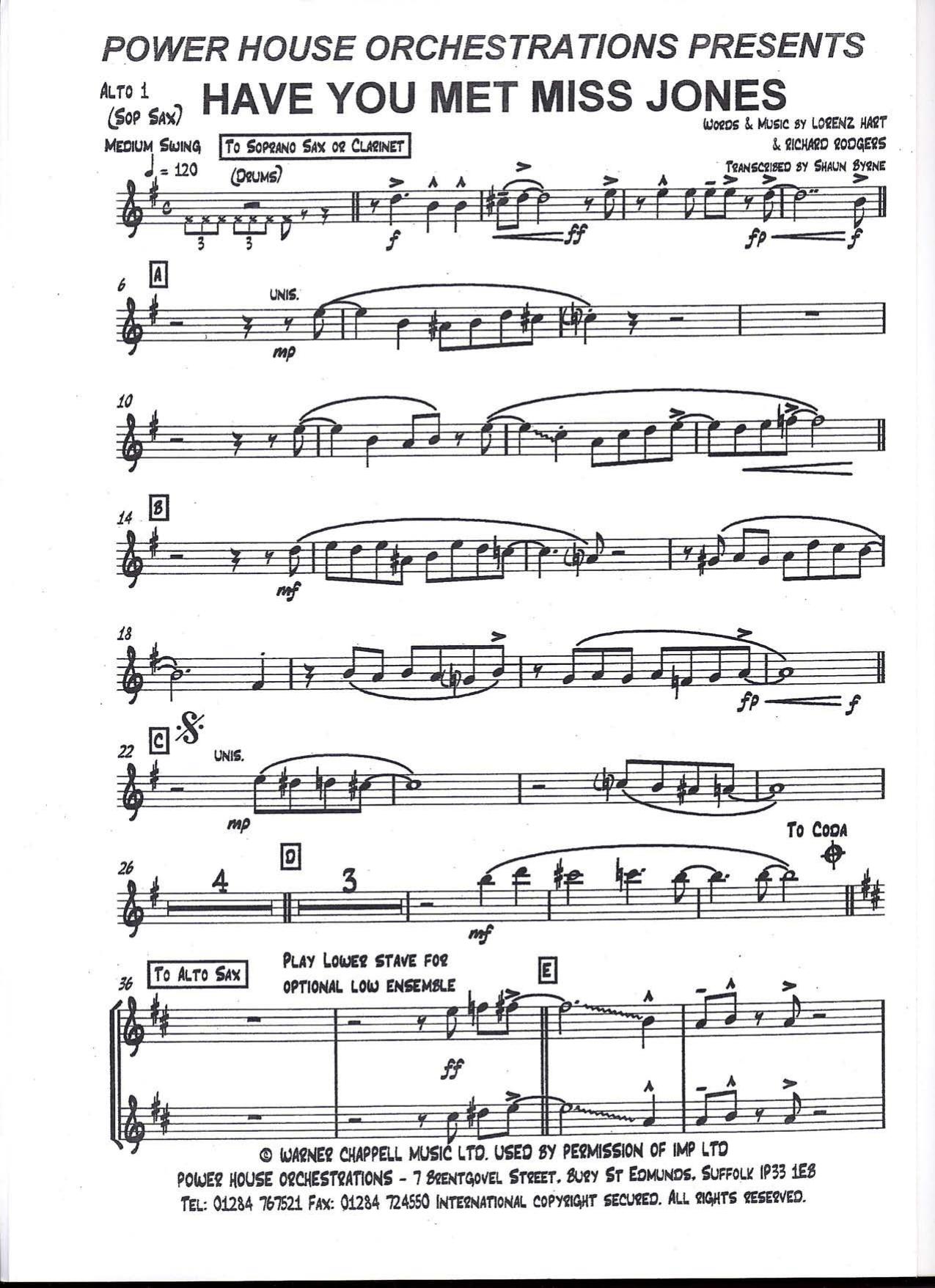
Have You Met Miss Jones (S.Byrne)
Composed by Richard Rodgers
Arranged by S.Byrne
- Ensemble: Big Band
- Style: Jazz Standard
- Pages: 50
- Instruments (21): Alto 1 (Sop Sax), Alto 2, Tenor 1, Tenor 2, Baritone, Trumpet 1, Trumpet 2, Trumpet 3, Trumpet 4, Trombone 1, Trombone 2, Trombone 3, Trombone 4, Guitar, Bass, Drums, Keyboard, Vocal, Eb Soloist, Bb Soloist, Bass Clef Soloist
- Difficulty: advanced
- Content: Individual Parts
- Format: PDF Download (Instant)
- Price: $24.99
Richard Rodgers' "Have You Met Miss Jones?" stands as a quintessential jazz standard, originally composed in 1937 for the musical *I'd Rather Be Right*. While the musical itself saw limited success, the tune quickly transcended its Broadway origins, becoming a cornerstone of the Great American Songbook. Its enduring popularity was cemented by influential recordings from jazz giants such as Frank Sinatra, whose 1961 rendition with Count Basie's orchestra is particularly iconic, and Nat King Cole. The song's sophisticated harmonic progression, featuring a distinctive bridge that modulates through several keys, makes it a perennial favorite for improvisers and arrangers alike, embodying the melodic ingenuity and harmonic richness characteristic of the pre-bebop swing era. It's a piece that evokes a sense of playful romance and sophisticated charm, a bright and optimistic musical narrative. S.Byrne’s big band arrangement of "Have You Met Miss Jones?" reimagines this classic with a vibrant, up-tempo swing feel, typically set at a brisk quarter note around 200-220 BPM. The arrangement is primarily in the key of F major, maintaining the original's bright character while injecting contemporary big band energy. Byrne's distinctive approach is evident in the meticulous voicings, which provide a rich, full sound without sacrificing clarity. Expect dynamic contrasts, with sections building from a subtle ensemble texture to powerful, full-band shout choruses that drive the piece forward. The arrangement skillfully balances ensemble precision with individual expression, offering a fresh perspective on a beloved standard. The melody is initially carried by the saxophone section, often in a tightly voiced soli, before being passed to the brass for a more assertive statement. A significant feature of this arrangement is the inclusion of multiple solo opportunities, typically for tenor saxophone and trumpet, allowing featured players to showcase their improvisational prowess over the tune's engaging chord changes. Byrne masterfully employs extended harmonies and rhythmic figures that keep the arrangement engaging for both performers and listeners. Technical challenges include precise articulation in fast swing passages, maintaining blend and balance in complex voicings, and navigating the dynamic shifts effectively. The rewarding aspect lies in the collective energy generated and the opportunity to present a familiar tune with a fresh, exhilarating interpretation. This arrangement is ideally suited for college-level jazz ensembles, advanced community big bands, or professional groups seeking a challenging yet highly rewarding chart. Its demands on ensemble precision, soloistic ability, and dynamic control make it an excellent vehicle for developing sophisticated big band performance skills. While high school bands with exceptionally strong sections and soloists might tackle it, the intricacies of the voicings and the required improvisational maturity suggest a more experienced ensemble will unlock its full potential, delivering a polished and impactful performance that truly honors the spirit of this timeless standard. This arrangement of "Have You Met Miss Jones?" thrives on an energetic, up-tempo swing feel, ideally around a quarter note of 200-220 BPM. Conductors should emphasize a light, driving eighth-note pulse, avoiding any heaviness. Key technical challenges include the intricate saxophone soli passages, which require meticulous attention to blend, balance, and unified articulation; precise brass attacks and releases are also crucial in the shout choruses. Encourage soloists to embrace the harmonic sophistication of the changes, focusing on melodic development within the fast tempo. Rehearsal time should be dedicated to dynamic shaping, particularly the gradual builds into the powerful shout sections and the controlled decrescendos. No special techniques like plunger mutes or falls are explicitly notated, allowing for performer discretion within the stylistic context. Q: What instruments and parts are included in this arrangement? A: This arrangement includes parts for 21 instruments, specifically Alto Saxophone 1, Alto Saxophone 2, Tenor Saxophone 1, Tenor Saxophone 2, Baritone Saxophone, Trumpet 1, Trumpet 2, Trumpet 3, Trumpet 4, Trombone 1, Trombone 2, Trombone 3, Bass Trombone, Guitar, Piano, Bass, Drums, and a conductor's score. Q: What is the difficulty level of this arrangement? A: This arrangement is considered advanced, best suited for college-level jazz ensembles, advanced community big bands, or professional groups. It requires strong ensemble precision, proficient soloists, and a solid understanding of big band dynamics and articulation. Q: What is the musical style and historical context of "Have You Met Miss Jones?" A: "Have You Met Miss Jones?" is a classic jazz standard from the Great American Songbook, originally composed by Richard Rodgers in 1937. It embodies the sophisticated, melodic swing style of the pre-bebop era, made famous by artists like Frank Sinatra and Nat King Cole. Q: What makes S.Byrne's arrangement unique? A: S.Byrne's arrangement features a vibrant, up-tempo swing feel with meticulous voicings, dynamic contrasts, and powerful shout choruses. It provides multiple solo opportunities and skillfully balances traditional big band elements with a fresh, energetic interpretation. Q: What is the typical performance duration and tempo for this piece? A: While variable based on solos, the typical performance duration for this arrangement is approximately 4-5 minutes. It is designed for an up-tempo swing feel, with a recommended tempo of around 200-220 beats per minute (BPM) for the quarter note.
Questions and answers
- What is included in the Have You Met Miss Jones (S.Byrne) PDF?
- The verified current file contains a conductor score and individual parts across 50 pages.
- How many instruments or parts are listed for Have You Met Miss Jones (S.Byrne)?
- The verified instrumentation list contains 21 entries for this Big Band arrangement.
- Who is credited for Have You Met Miss Jones (S.Byrne)?
- Composer: Richard Rodgers. Arranger: S.Byrne.
- What difficulty is listed for Have You Met Miss Jones (S.Byrne)?
- The verified difficulty level is advanced.
- What style is listed for Have You Met Miss Jones (S.Byrne)?
- The catalog lists the style as Jazz Standard.
- Can I preview Have You Met Miss Jones (S.Byrne) before buying?
- Yes. The product page provides a preview generated from the current PDF file.
- How is Have You Met Miss Jones (S.Byrne) delivered?
- After successful payment, the digital PDF is made available for download. The displayed price is $24.99.
Musicians Also Search For
Have You Met Miss Jones S.Byrne PDF • Have You Met Miss Jones S.Byrne sheet music • Have You Met Miss Jones arranged by S.Byrne • S.Byrne big band charts • S.Byrne jazz arrangements PDF • Have You Met Miss Jones Richard Rodgers sheet music • Have You Met Miss Jones Richard Rodgers big band arrangements • Richard Rodgers big band charts • Have You Met Miss Jones big band arrangements • Have You Met Miss Jones big band PDF download • Have You Met Miss Jones jazz sheet music • big band sheet music download • Have You Met Miss Jones conductor score PDF • Have You Met Miss Jones individual parts download • Have You Met Miss Jones sheet music PDF • Have You Met Miss Jones Jazz Standard charts • Jazz Standard big band arrangements • buy Have You Met Miss Jones sheet music • download Have You Met Miss Jones PDF • Have You Met Miss Jones jazz charts • best S.Byrne big band arrangements • Richard Rodgers arranged by S.Byrne • Have You Met Miss Jones printable sheet music • big band repertoire PDF