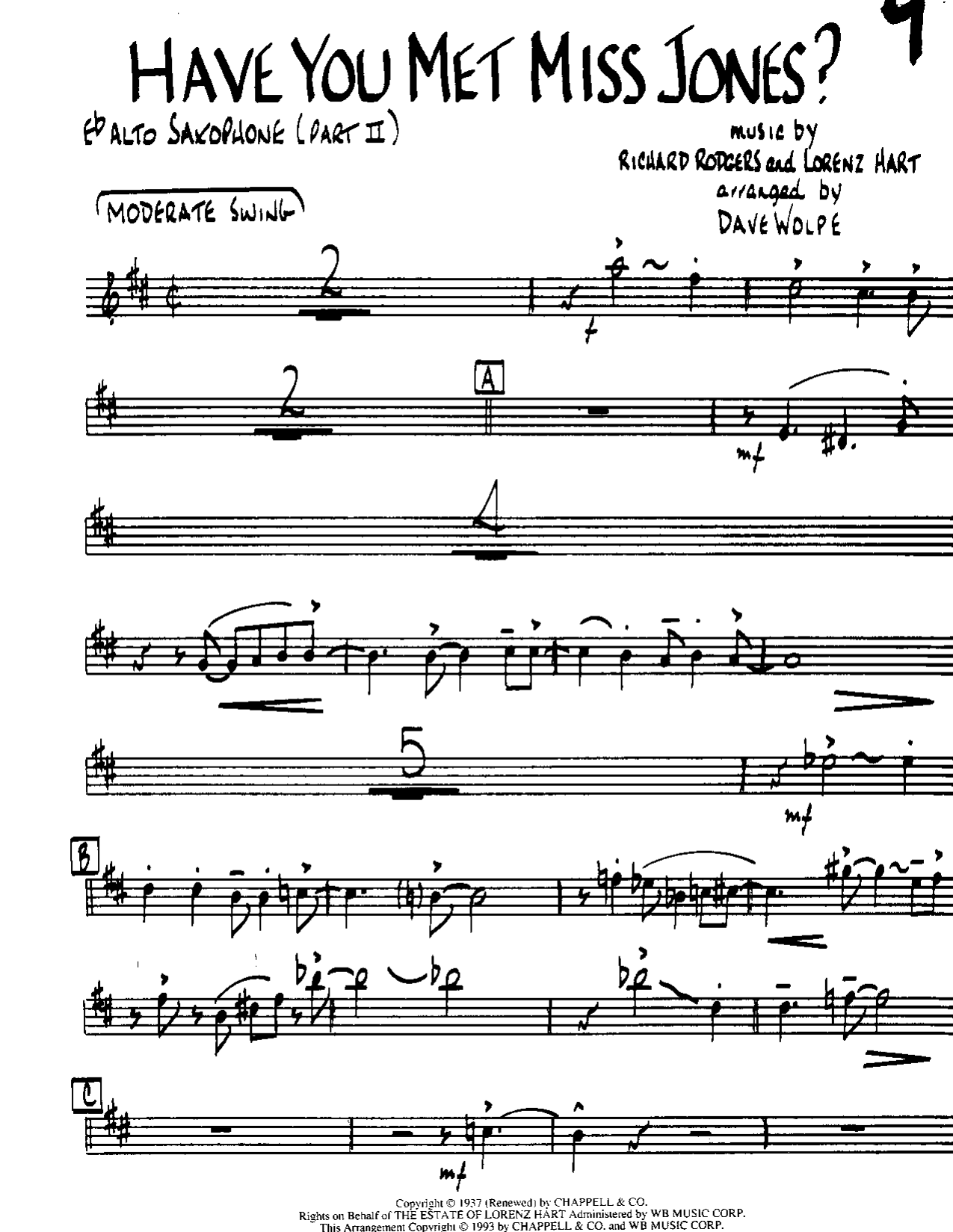
Have you met Miss Jones (D.Wolpe)
Composed by RICHARD RODGERS and LORENZ HART
Arranged by Dave Wolpe
- Ensemble: Small Ensemble
- Style: Jazz Standard
- Pages: 26
- Instruments (7): Eb Alto Saxophone (Part II), Bass, Drums, Piano, Bb Tenor Saxophone (Part III), Trombone (Part IV), Bb Trumpet (Part I)
- Difficulty: easy
- Content: Individual Parts
- Format: PDF Download (Instant)
- Price: $18.99
Written by legendary Broadway icons Richard Rodgers and Lorenz Hart for the 1937 musical *I'd Rather Be Right*, "Have You Met Miss Jones?" quickly transcended its theatrical origins to become one of the most enduring vehicles in the Great American Songbook. The tune achieved its definitive jazz pedigree through countless bebop and hard-bop interpretations, most notably by Art Tatum, Oscar Peterson, and the classic Miles Davis groups. Its sophisticated harmonic architecture—famous for its adventurous bridge featuring rapid-fire key changes through descending major thirds—makes it an essential testing ground for improvisers and a staple of the jazz standard repertoire. Dave Wolpe’s masterful setting translates the sophistication of the golden age of jazz into a vibrant, swinging chart tailored for small ensemble instrumentation. Operating at a brisk, driving medium-swing tempo, the arrangement captures an effervescent, high-energy mood that immediately engages listeners. Wolpe balances nostalgic, classic-era coolness with crisp, contemporary punch, evoking the sophisticated atmosphere of mid-century Manhattan supper clubs while maintaining the rhythmic drive demanded by modern players. The harmonic landscape retains the bittersweet elegance of the original Rodgers and Hart chord progressions while introducing clever reharmonizations that keep both performers and audiences on their toes. True to Wolpe’s signature arranging style, this chart places a heavy emphasis on tight, conversational horn writing and sparkling counterpoint. The head is stated with clarity, utilizing crisp dynamic contrasts and urbane voicings that let the intricate melody cut through the rhythm section's buoyant comping. Horns trade melodic fragments in tight interludes, building structural momentum toward the improvised solo sections. Wolpe provides ample space for featured soloists over the standard AABA form, ensuring that rhythm section players and horn soloists alike have fertile ground to stretch out. The backgrounds behind the soloists are cleanly scored, offering rich harmonic support without ever cluttering the texture or drowning out the improviser. Advanced high school ensembles, collegiate combos, and professional community groups will find this 26-page arrangement to be an exceptionally rewarding addition to their libraries. While the tempo and the treacherous changes of the bridge require technical fluency and a strong command of jazz vocabulary, the clear scoring and logical voice-leading make it remarkably accessible with proper rehearsal. It serves as an ideal showcase piece for concerts, festival adjudications, or club dates, rewarding precision, swing feel, and interactive ensemble listening. Achieving an authentic groove on this chart begins with the rhythm section. The drummer should maintain a feather-light, driving ride cymbal pattern with a crisp hi-hat chop on beats two and four, avoiding heavy backbeats that can bog down the buoyant medium-swing feel. Horn players must internalize the quarter-note triplet feel, ensuring that eighth notes are appropriately swung and articulated with a natural vocal inflection. Pay special attention to the bridge; the rapid modulation sequence requires horns to lock in their intonation and smoothly navigate shifting tonal centers without rushing the tempo. Rehearsals should initially focus on sectional isolation, particularly balancing the counterlines against the main melodic statements. Ensure the dynamic swells marked throughout the chart are exaggerated to create maximum contrast between the laid-back vocal-style phrasing and the punchy ensemble hits. Soloists should study the cyclical nature of the changes, utilizing chord-tone-driven lines to navigate the chromaticism of the bridge gracefully. Q: What specific instruments and parts are included in this small ensemble arrangement? A: The 26-page publication includes comprehensive horn parts tailored for a standard small-jazz-ensemble front line, alongside fully realized rhythm section parts including piano, bass, and drum set. Q: What is the difficulty level of Dave Wolpe's arrangement of "Have You Met Miss Jones?" A: This chart is graded as advanced intermediate to advanced, primarily due to the fast harmonic rhythm and key centers of the bridge, making it ideal for college musicians and accomplished high school players. Q: What is the historical and stylistic background of this piece? A: Originating from the 1937 Rodgers and Hart musical *I'd Rather Be Right*, this arrangement embraces a classic, driving medium-swing jazz standard style rooted in the bebop and great American songbook traditions. Q: What makes this specific arrangement by Dave Wolpe unique? A: Wolpe distinguishes this setting through his signature tight horn voicings, sophisticated yet accessible counterpoint, and clever background figures that support soloists without cluttering the harmonic texture. Q: What is the recommended performance tempo and duration for this piece? A: The arrangement is designed to be performed at a bright medium-swing tempo (approximately 144–152 BPM), yielding a performance duration of roughly three to four minutes depending on the number of solo choruses taken.
Questions and answers
- What is included in the Have you met Miss Jones (D.Wolpe) PDF?
- The verified current file contains individual parts across 26 pages.
- How many instruments or parts are listed for Have you met Miss Jones (D.Wolpe)?
- The verified instrumentation list contains 7 entries for this Small Ensemble arrangement.
- Who is credited for Have you met Miss Jones (D.Wolpe)?
- Composer: RICHARD RODGERS and LORENZ HART. Arranger: Dave Wolpe.
- What difficulty is listed for Have you met Miss Jones (D.Wolpe)?
- The verified difficulty level is easy.
- What style is listed for Have you met Miss Jones (D.Wolpe)?
- The catalog lists the style as Jazz Standard.
- Can I preview Have you met Miss Jones (D.Wolpe) before buying?
- Yes. The product page provides a preview generated from the current PDF file.
- How is Have you met Miss Jones (D.Wolpe) delivered?
- After successful payment, the digital PDF is made available for download. The displayed price is $18.99.
Musicians Also Search For
Have you met Miss Jones Dave Wolpe PDF • Have you met Miss Jones Dave Wolpe sheet music • Have you met Miss Jones arranged by Dave Wolpe • Dave Wolpe small ensemble charts • Dave Wolpe jazz arrangements PDF • Have you met Miss Jones RICHARD RODGERS and LORENZ HART sheet music • Have you met Miss Jones RICHARD RODGERS and LORENZ HART small ensemble arrangements • RICHARD RODGERS and LORENZ HART small ensemble charts • Have you met Miss Jones small ensemble arrangements • Have you met Miss Jones small ensemble PDF download • Have you met Miss Jones jazz sheet music • small ensemble sheet music download • Have you met Miss Jones individual parts download • Have you met Miss Jones sheet music PDF • Have you met Miss Jones Jazz Standard charts • Jazz Standard small ensemble arrangements • buy Have you met Miss Jones sheet music • download Have you met Miss Jones PDF • Have you met Miss Jones jazz charts • best Dave Wolpe small ensemble arrangements • RICHARD RODGERS and LORENZ HART arranged by Dave Wolpe • Have you met Miss Jones printable sheet music • small ensemble repertoire PDF