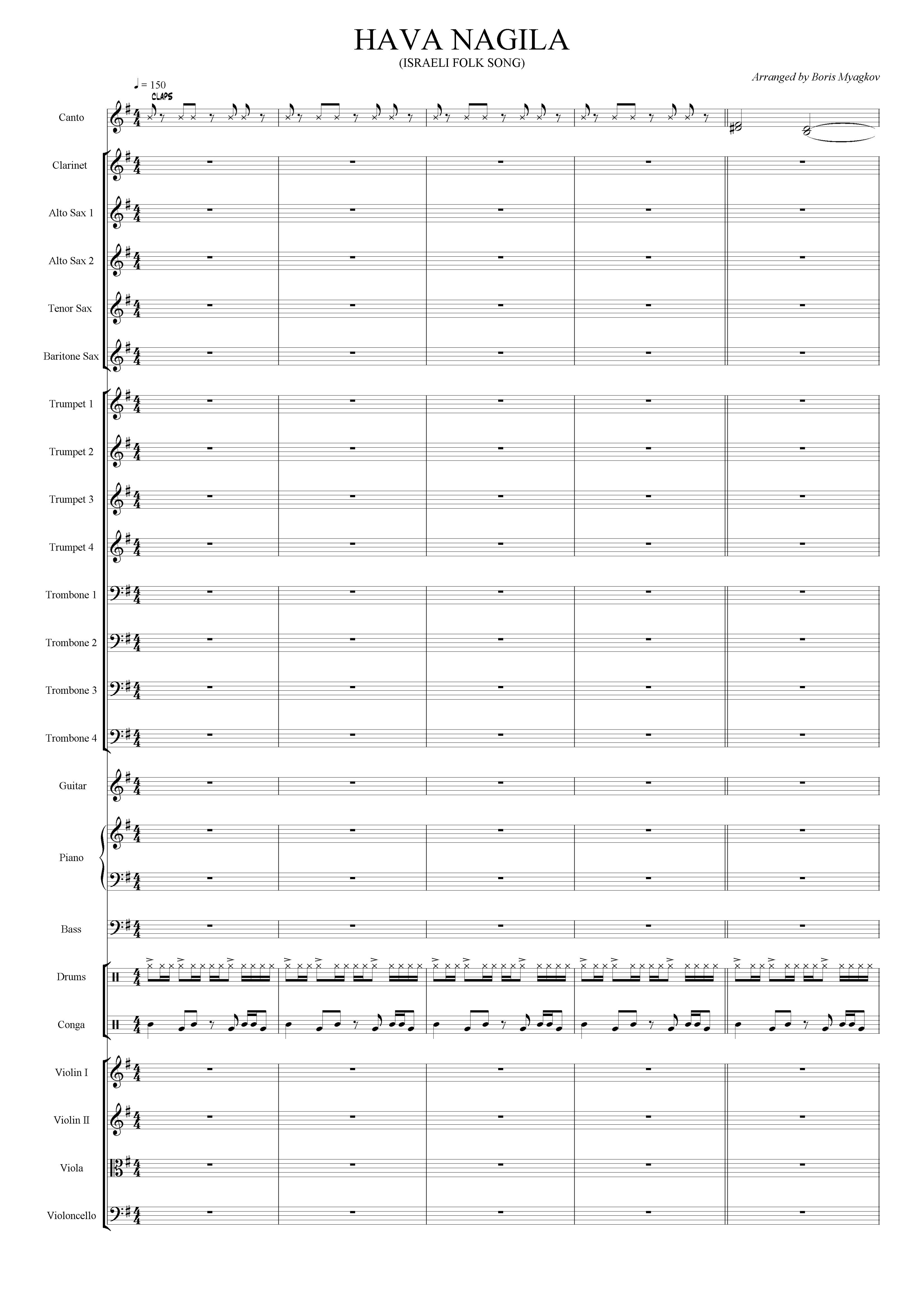
Hava Nagila (B.Myagkov) sheet music preview

Hava Nagila (B.Myagkov)

Composed by Boris Myagkov

Arranged by Boris Myagkov

  • Ensemble: Big Band
  • Style: Jazz Standard
  • Pages: 54
  • Instruments (23): Canto, Flute, Clarinet, Alto Sax 1, Alto Sax 2, Tenor Sax, Baritone Sax, Trumpet 1, Trumpet 2, Trumpet 3, Trumpet 4, Trombone 1, Trombone 2, Trombone 3, Trombone 4, Guitar, Piano, Bass, Drums, Violin I, Violin II, Viola, Violoncello
  • Difficulty: advanced
  • Content: Individual Parts
  • Format: PDF Download (Instant)
  • Price: $24.99

The melody of "Hava Nagila" traces its roots to a Hasidic *niggun*, a wordless chant, originating in Sadagora, Ukraine, in the mid-19th century. This traditional tune gained its iconic Hebrew lyrics, meaning "Let us rejoice," around 1915, attributed to Abraham Zevi Idelsohn, a music professor and ethnomusicologist in Jerusalem. It was first publicly performed in 1918 to celebrate the British victory over the Ottomans in World War I and quickly became a vibrant anthem for Jewish communities worldwide, symbolizing joy and celebration. While not originally a jazz piece, its infectious, driving rhythm and minor-key exoticism have made it a compelling subject for reinterpretation across diverse genres, establishing its place as a global folk standard frequently embraced by jazz artists for its improvisational potential and universal appeal. Harry Belafonte's impassioned performances in the 1950s significantly propelled "Hava Nagila" into mainstream popular culture, making it widely known beyond Jewish communities. Boris Myagkov's big band arrangement of "Hava Nagila" transforms this celebratory folk tune into an exhilarating, up-tempo swing chart, primarily in a minor key, infused with a sophisticated jazz sensibility. Myagkov, known for his versatile and often energetic arrangements across various styles, including swing, Latin, and rock, approaches this piece with a keen understanding of big band dynamics and harmonic richness. The arrangement maintains the original's infectious energy but elevates it with complex voicings, driving rhythms, and a dynamic interplay between sections. The mood is one of unbridled exuberance, building steadily from its initial statement to a powerful, climactic finish. This arrangement is characterized by its clever use of the full big band palette. The melody is initially presented by the clarinet, paying homage to its Klezmer roots, before being taken up by various sections, including a powerful brass soli and a saxophone soli that showcases intricate counterpoint. Myagkov masterfully employs extended harmonies and rhythmic variations, moving beyond a simple folk melody to create a rich, contemporary jazz sound. Featured solo opportunities are provided for alto saxophone and trumpet, allowing improvisers to explore the tune's modal qualities within a swinging context. The arrangement culminates in a thrilling shout chorus that builds to a grand finale, making it a rewarding experience for both performers and audiences. This arrangement is ideally suited for college, community, and professional big bands seeking a vibrant, challenging, and universally recognized piece to add to their repertoire. Its technical demands, particularly in the intricate soli sections and the sustained high energy, require proficient musicianship and strong ensemble cohesion. The blend of familiar melody with sophisticated jazz arranging makes it an excellent choice for concert programs where audience engagement and musical excitement are paramount. Conductors should establish a brisk, driving up-tempo swing feel from the outset, ensuring consistent energy throughout the piece. The opening clarinet melody requires a clear, articulate approach, reminiscent of Klezmer styling, before transitioning smoothly into the big band's more robust entrance. Technical challenges include fast chromatic runs in the saxophone soli and precise articulation in the brass sections. Rehearsal emphasis should be placed on rhythmic accuracy, particularly in the syncopated figures, and balancing the intricate voicings to ensure clarity. The dynamic contrasts are crucial; build from a strong mezzo-forte to a powerful fortissimo in the shout chorus. Soloists should be encouraged to embrace the minor key and modal opportunities, maintaining the celebratory spirit. No special techniques like plunger mutes are explicitly required, but strong section blend and unified phrasing are essential for a polished performance. **Q: What instruments are included in this arrangement?** A: This big band arrangement includes parts for 24 instruments: Clarinet, Alto Saxophone 1, Alto Saxophone 2, Tenor Saxophone, Baritone Saxophone, Trumpet 1, Trumpet 2, Trumpet 3, Trumpet 4, Trombone 1, Trombone 2, Trombone 3, Trombone 4, Guitar, Piano, Bass, Drums, and a full conductor score, totaling 54 pages. **Q: What is the difficulty level of this arrangement?** A: This arrangement is suitable for college, community, and professional big bands. It presents a medium-difficult to advanced challenge due to its up-tempo swing feel, intricate soli sections, extended harmonies, and dynamic demands. **Q: What is the musical style and historical context of "Hava Nagila"?** A: "Hava Nagila" is a traditional Jewish folk song, originally a Hasidic *niggun* from the 19th century, with Hebrew lyrics added around 1915. This arrangement reinterprets it as an up-tempo jazz standard for big band, blending its folk origins with contemporary jazz arranging techniques. **Q: What makes Boris Myagkov's arrangement of "Hava Nagila" unique?** A: Boris Myagkov's arrangement stands out for its transformation of the traditional folk melody into a sophisticated, driving up-tempo swing chart. It features complex voicings, dynamic soli sections for both brass and saxophones, and dedicated solo opportunities, all while maintaining the original's celebratory and energetic character. **Q: What is the typical performance duration and tempo for this piece?** A: The typical performance duration for this arrangement is approximately 3-4 minutes, played at a brisk up-tempo swing feel, around 200-220 beats per minute, to capture its intended energetic and celebratory mood.

Questions and answers

What is included in the Hava Nagila (B.Myagkov) PDF?
The verified current file contains a conductor score and individual parts across 54 pages.
How many instruments or parts are listed for Hava Nagila (B.Myagkov)?
The verified instrumentation list contains 23 entries for this Big Band arrangement.
Who is credited for Hava Nagila (B.Myagkov)?
Composer: Boris Myagkov. Arranger: Boris Myagkov.
What difficulty is listed for Hava Nagila (B.Myagkov)?
The verified difficulty level is advanced.
What style is listed for Hava Nagila (B.Myagkov)?
The catalog lists the style as Jazz Standard.
Can I preview Hava Nagila (B.Myagkov) before buying?
Yes. The product page provides a preview generated from the current PDF file.
How is Hava Nagila (B.Myagkov) delivered?
After successful payment, the digital PDF is made available for download. The displayed price is $24.99.

Musicians Also Search For

Hava Nagila Boris Myagkov PDFHava Nagila Boris Myagkov sheet musicHava Nagila arranged by Boris MyagkovBoris Myagkov big band chartsBoris Myagkov jazz arrangements PDFHava Nagila Boris Myagkov big band arrangementsHava Nagila big band arrangementsHava Nagila big band PDF downloadHava Nagila jazz sheet musicbig band sheet music downloadHava Nagila conductor score PDFHava Nagila individual parts downloadHava Nagila sheet music PDFHava Nagila Jazz Standard chartsJazz Standard big band arrangementsbuy Hava Nagila sheet musicdownload Hava Nagila PDFHava Nagila jazz chartsbest Boris Myagkov big band arrangementsHava Nagila printable sheet musicbig band repertoire PDF

All arrangements by Boris Myagkov All Boris Myagkov sheet music