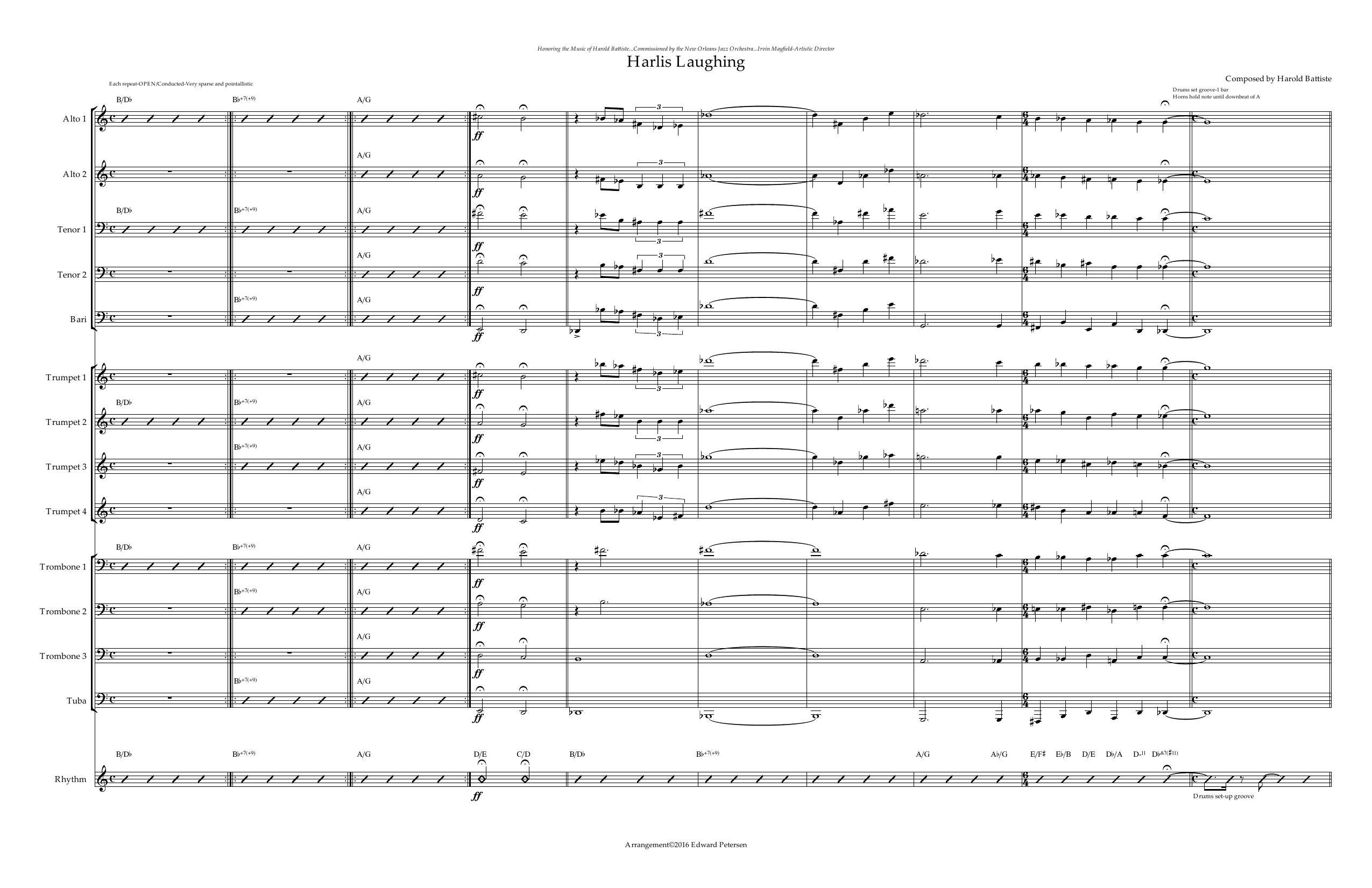
Harlis Laughing (H.Battiste)
Composed by Harold Battiste
Arranged by H.Battiste
- Ensemble: Big Band
- Style: Jazz Standard
- Pages: 17
- Instruments (14): Alto Saxophone 1, Alto Saxophone 2, Tenor Saxophone 1, Tenor Saxophone 2, Baritone Saxophone, Trumpet 1, Trumpet 2, Trumpet 3, Trumpet 4, Trombone 1, Trombone 2, Trombone 3, Tuba, Rhythm Section
- Difficulty: easy
- Content: Individual Parts
- Format: PDF Download (Instant)
- Price: $24.99
"Harlis Laughing," composed by the legendary Harold Battiste, Jr., is a vibrant testament to the enduring legacy of one of New Orleans' most influential musical figures. Battiste, a pivotal force in jazz and R&B since the 1950s, was a composer, arranger, producer, and educator who profoundly shaped the sound of the Crescent City and beyond. He founded AFO Records, the first African American musician-owned record label, and played a crucial role in the careers of artists like Sam Cooke, Sonny & Cher, and Dr. John. "Harlis Laughing" itself is a composition from his 1996 album, "Next Generation," showcasing his continued creative output into later decades and is notably named after his son, Harlis Battiste. The piece embodies the sophisticated yet soulful essence of post-bop jazz, reflecting Battiste's deep understanding of both traditional New Orleans roots and modern jazz sensibilities. Musically, "Harlis Laughing" is a medium-up swing chart, typically performed in a bright, energetic 4/4 feel. The mood is one of joyous sophistication, characterized by intricate melodic lines and rich harmonic textures that evoke a sense of playful exuberance. The piece often features a driving rhythm section that propels the ensemble forward, creating an infectious groove that is both challenging and exhilarating for performers and listeners alike. Its character is distinctly contemporary jazz, yet it carries the warmth and melodicism that are hallmarks of Battiste's compositional style, making it a compelling addition to any big band's repertoire. H. Battiste's arrangement of "Harlis Laughing" for big band showcases his masterful command of orchestration and his signature approach to ensemble writing. Expect meticulously crafted voicings that highlight the unique colors of the 16-instrument ensemble, including a full saxophone section (Alto 1 & 2, Tenor 1 & 2, Baritone), trumpets, trombones, and a robust rhythm section. The arrangement likely features engaging soli sections where different instrumental groups interact in call-and-response patterns or weave together complex contrapuntal lines. Battiste's arrangements are known for their intelligent use of extended harmonies and dynamic contrasts, building tension and release throughout the piece. The melody is typically carried by the saxophone section, often with brass interjections, leading into open solo sections that provide ample space for improvisation over rich chord changes. Performing "Harlis Laughing" is a rewarding experience, offering both technical challenges and immense musical satisfaction. The piece demands precision in articulation, strong rhythmic integrity from all sections, and a keen ear for blend and balance. Soloists will find stimulating harmonic landscapes for improvisation, while the ensemble will revel in the tightly woven ensemble passages and powerful shout choruses. This arrangement is ideally suited for advanced high school, collegiate, community, and professional jazz ensembles looking to explore a significant work by a jazz luminary. Its blend of historical context, musical depth, and engaging performance opportunities makes it a standout piece that will challenge and inspire musicians, solidifying its place as an authoritative representation of modern big band jazz. Conductors should emphasize a consistent, driving medium-up swing feel, ensuring the rhythm section lays down a solid, yet flexible, foundation. Attention to articulation is paramount, particularly in the saxophone soli sections and brass figures, where crisp attacks and releases will define the piece's character. Encourage soloists to embrace the sophisticated harmonic framework, allowing for creative melodic development that honors the composition's joyful spirit. Rehearsal time should be dedicated to balancing the intricate voicings, especially between the saxophone and brass sections, to achieve clarity without sacrificing power. Dynamic contrasts are crucial; build intensity gradually into the shout choruses and allow for moments of subtle interplay. No specific extended techniques like plunger mutes or falls are explicitly required, but tasteful interpretation of jazz inflections (scoops, bends, vibrato) will enhance authenticity. Q: What instruments and parts are included in this big band arrangement? A: This arrangement is scored for 16 instruments, including Alto Saxophone 1 & 2, Tenor Saxophone 1 & 2, Baritone Saxophone, 4 Trumpets, 4 Trombones, Piano, Bass, and Drums. A full conductor score is also included. Q: What is the difficulty level of "Harlis Laughing" for big band? A: This arrangement is considered advanced, suitable for advanced high school, collegiate, community, and professional jazz ensembles. It features complex harmonies, intricate ensemble passages, and demands strong technical proficiency and improvisational skill. Q: What is the musical style and historical context of "Harlis Laughing"? A: "Harlis Laughing" is a contemporary jazz standard composed by Harold Battiste, Jr., a pivotal figure in New Orleans jazz and R&B. It reflects his sophisticated post-bop compositional style and was originally featured on his 1996 album, "Next Generation." Q: What makes this arrangement unique or distinctive? A: This arrangement is unique as it is composed and arranged by Harold Battiste himself, showcasing his masterful orchestration, rich harmonic voicings, and engaging soli sections. It offers a direct insight into the creative mind of a jazz legend. Q: What is the typical performance duration or tempo for this piece? A: "Harlis Laughing" is typically performed at a medium-up swing tempo. While exact duration can vary with improvisation, a performance generally lasts between 5 to 7 minutes, depending on the length of solos.
Questions and answers
- What is included in the Harlis Laughing (H.Battiste) PDF?
- The verified current file contains a conductor score across 17 pages.
- How many instruments or parts are listed for Harlis Laughing (H.Battiste)?
- The verified instrumentation list contains 14 entries for this Big Band arrangement.
- Who is credited for Harlis Laughing (H.Battiste)?
- Composer: Harold Battiste. Arranger: H.Battiste.
- What difficulty is listed for Harlis Laughing (H.Battiste)?
- The verified difficulty level is easy.
- What style is listed for Harlis Laughing (H.Battiste)?
- The catalog lists the style as Jazz Standard.
- Can I preview Harlis Laughing (H.Battiste) before buying?
- Yes. The product page provides a preview generated from the current PDF file.
- How is Harlis Laughing (H.Battiste) delivered?
- After successful payment, the digital PDF is made available for download. The displayed price is $24.99.
Musicians Also Search For
Harlis Laughing H.Battiste PDF • Harlis Laughing H.Battiste sheet music • Harlis Laughing arranged by H.Battiste • H.Battiste big band charts • H.Battiste jazz arrangements PDF • Harlis Laughing Harold Battiste sheet music • Harlis Laughing Harold Battiste big band arrangements • Harold Battiste big band charts • Harlis Laughing big band arrangements • Harlis Laughing big band PDF download • Harlis Laughing jazz sheet music • big band sheet music download • Harlis Laughing conductor score PDF • Harlis Laughing sheet music PDF • Harlis Laughing Jazz Standard charts • Jazz Standard big band arrangements • buy Harlis Laughing sheet music • download Harlis Laughing PDF • Harlis Laughing jazz charts • best H.Battiste big band arrangements • Harold Battiste arranged by H.Battiste • Harlis Laughing printable sheet music • big band repertoire PDF