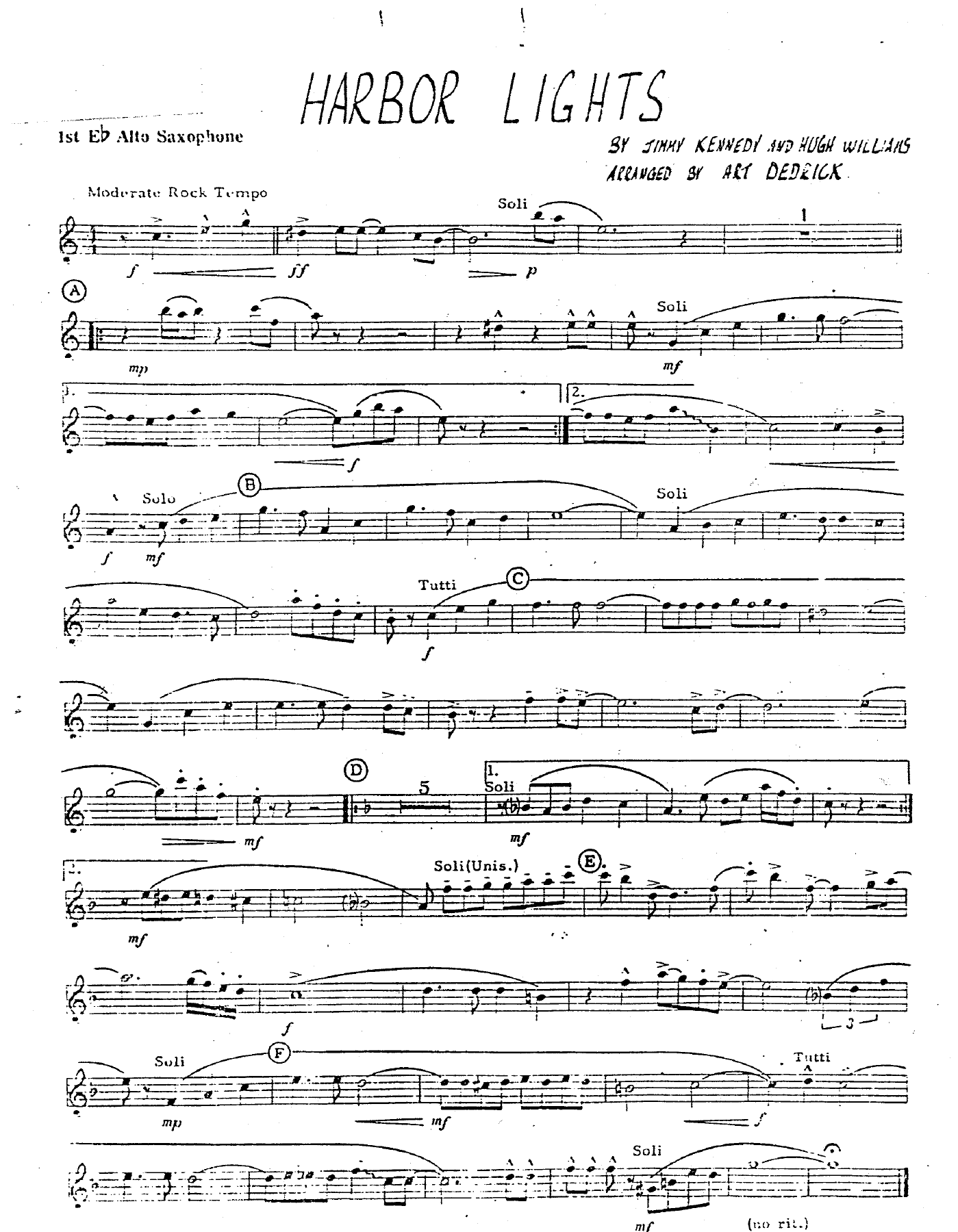
Harbor Lights (A.Dedrick)
Composed by Jimmy Kennedy, Hugh Williams
Arranged by Art Dedrick
- Ensemble: Big Band
- Style: Jazz Standard
- Pages: 18
- Instruments (17): 1st Eb Alto Saxophone, 2nd Eb Alto Saxophone, 1st Bb Tenor Saxophone, 2nd Bb Tenor Saxophone, Eb Baritone Saxophone, 1st Bb Trumpet, 2nd Bb Trumpet, 3rd Bb Trumpet, 4th Bb Trumpet, 1st Trombone, 2nd Trombone, 3rd Trombone, 4th Trombone, Piano, Electric Bass (String Bass), Drums, Guitar
- Difficulty: easy
- Content: Individual Parts
- Format: PDF Download (Instant)
- Price: $24.99
"Harbor Lights," a timeless ballad originally penned by Jimmy Kennedy and Hugh Williams, emerged in the pre-war era of 1937, quickly becoming a poignant symbol of longing and farewell. Its melancholic melody and evocative lyrics resonated deeply, propelling it into the repertoire of big bands and vocalists throughout the 1940s and beyond. While many artists recorded it, Sammy Kaye's 1950 rendition famously topped the charts, cementing its status as a beloved standard. The song embodies the lush, romantic orchestral jazz sound prevalent in the mid-20th century, characterized by soaring melodies, rich harmonies, and a gentle, reflective mood. It's a piece that speaks to the heart, evoking images of distant shores and cherished memories, making it a staple in the jazz standard canon for its enduring emotional appeal. Art Dedrick's arrangement of "Harbor Lights" masterfully transforms this classic ballad into a sophisticated big band feature, maintaining its inherent sentimentality while injecting the vibrant textures and dynamic possibilities of a full ensemble. Dedrick, known for his accessible yet musically rich charts, approaches this piece with a medium-slow swing feel, typically around 80-90 BPM, allowing ample space for the melody to breathe. The arrangement is set in a comfortable key, likely G or F major, which suits the brass and saxophones well. Dedrick's signature is evident in the warm, interwoven voicings, particularly in the saxophone section soli passages, which provide a lush harmonic bed for the main theme. The mood is consistently tender and reflective, building to moments of gentle grandeur without ever becoming overtly dramatic, preserving the song's original introspective character. The arrangement opens with a beautifully voiced saxophone section carrying the initial melodic statement, often doubled or lightly supported by muted trumpets, creating a soft, shimmering texture. Dedrick then cleverly passes the melody between sections, perhaps featuring a lead trumpet or trombone on subsequent phrases, allowing each part of the band to contribute to the narrative. There is typically a designated solo section, often for tenor saxophone or trombone, providing an opportunity for expressive improvisation over the familiar changes. The chart culminates in a tastefully orchestrated shout chorus that builds subtly, emphasizing the melodic contours rather than raw power, before returning to a subdued, reflective coda. This careful dynamic shaping and thoughtful melodic distribution make the arrangement both engaging for performers and deeply moving for audiences. This Art Dedrick arrangement is ideally suited for high school, college, and community jazz ensembles looking to cultivate expressive ballad playing. While not technically demanding in terms of blistering tempos or extreme ranges, its challenge lies in achieving a cohesive, lyrical ensemble sound, precise blend, and nuanced dynamic control. The rewarding aspect is the opportunity for the band to collectively interpret a timeless melody with sensitivity and musicality, fostering a deeper understanding of ensemble phrasing and emotional expression within the big band context. It offers a solid foundation for developing musical maturity and a refined sense of swing ballad performance. Conductors should aim for a medium-slow swing feel, around 80-90 BPM, emphasizing a smooth, legato quarter-note pulse rather than a heavy swing eighth. The primary technical challenge lies in achieving impeccable blend and balance, particularly within the saxophone soli sections and during sustained brass chords. Encourage players to listen across sections and match articulation and dynamic shaping precisely. Muted brass sections (straight or cup mutes) should be approached with a warm, controlled tone, ensuring intonation remains stable. Rehearsal time should focus on long, expressive phrases, ensuring the melody always sings above the accompaniment. Pay close attention to dynamic contrasts, from soft, reflective pianissimos to gently building mezzoforte sections, avoiding abrupt changes. Emphasize a unified approach to releases, allowing chords to decay naturally and lyrically. Q: What instruments are included in this arrangement? A: This arrangement is scored for a standard 17-piece big band: Alto Saxophone 1, Alto Saxophone 2, Tenor Saxophone 1, Tenor Saxophone 2, Baritone Saxophone, Trumpet 1, Trumpet 2, Trumpet 3, Trumpet 4, Trombone 1, Trombone 2, Trombone 3, Trombone 4, Piano, Bass, Drums, and Guitar. Q: What is the difficulty level of "Harbor Lights (A. Dedrick)"? A: This arrangement is considered medium-easy to medium difficulty. It is accessible for high school and community jazz ensembles, focusing on lyrical playing, blend, and dynamics rather than extreme technical demands. Q: What is the musical style and historical context of this piece? A: "Harbor Lights" is a classic jazz standard from the pre-war era (1937), arranged here in a medium-slow big band swing ballad style. It evokes the romantic, melancholic mood of mid-20th-century popular music. Q: What makes Art Dedrick's arrangement of "Harbor Lights" unique? A: Dedrick's signature approach features warm, accessible voicings, particularly in the saxophone soli, and a focus on lyrical melodic interpretation. The arrangement balances the original song's sentimentality with tasteful big band textures and dynamic shaping. Q: What is the typical performance duration and tempo for this arrangement? A: The typical performance duration for this arrangement is approximately 3 to 4 minutes. It is designed to be played at a medium-slow swing tempo, generally between 80 and 90 beats per minute.
Questions and answers
- What is included in the Harbor Lights (A.Dedrick) PDF?
- The verified current file contains individual parts across 18 pages.
- How many instruments or parts are listed for Harbor Lights (A.Dedrick)?
- The verified instrumentation list contains 17 entries for this Big Band arrangement.
- Who is credited for Harbor Lights (A.Dedrick)?
- Composer: Jimmy Kennedy, Hugh Williams. Arranger: Art Dedrick.
- What difficulty is listed for Harbor Lights (A.Dedrick)?
- The verified difficulty level is easy.
- What style is listed for Harbor Lights (A.Dedrick)?
- The catalog lists the style as Jazz Standard.
- Can I preview Harbor Lights (A.Dedrick) before buying?
- Yes. The product page provides a preview generated from the current PDF file.
- How is Harbor Lights (A.Dedrick) delivered?
- After successful payment, the digital PDF is made available for download. The displayed price is $24.99.
Musicians Also Search For
Harbor Lights Art Dedrick PDF • Harbor Lights Art Dedrick sheet music • Harbor Lights arranged by Art Dedrick • Art Dedrick big band charts • Art Dedrick jazz arrangements PDF • Harbor Lights Jimmy Kennedy, Hugh Williams sheet music • Harbor Lights Jimmy Kennedy, Hugh Williams big band arrangements • Jimmy Kennedy, Hugh Williams big band charts • Harbor Lights big band arrangements • Harbor Lights big band PDF download • Harbor Lights jazz sheet music • big band sheet music download • Harbor Lights individual parts download • Harbor Lights sheet music PDF • Harbor Lights Jazz Standard charts • Jazz Standard big band arrangements • buy Harbor Lights sheet music • download Harbor Lights PDF • Harbor Lights jazz charts • best Art Dedrick big band arrangements • Jimmy Kennedy, Hugh Williams arranged by Art Dedrick • Harbor Lights printable sheet music • big band repertoire PDF