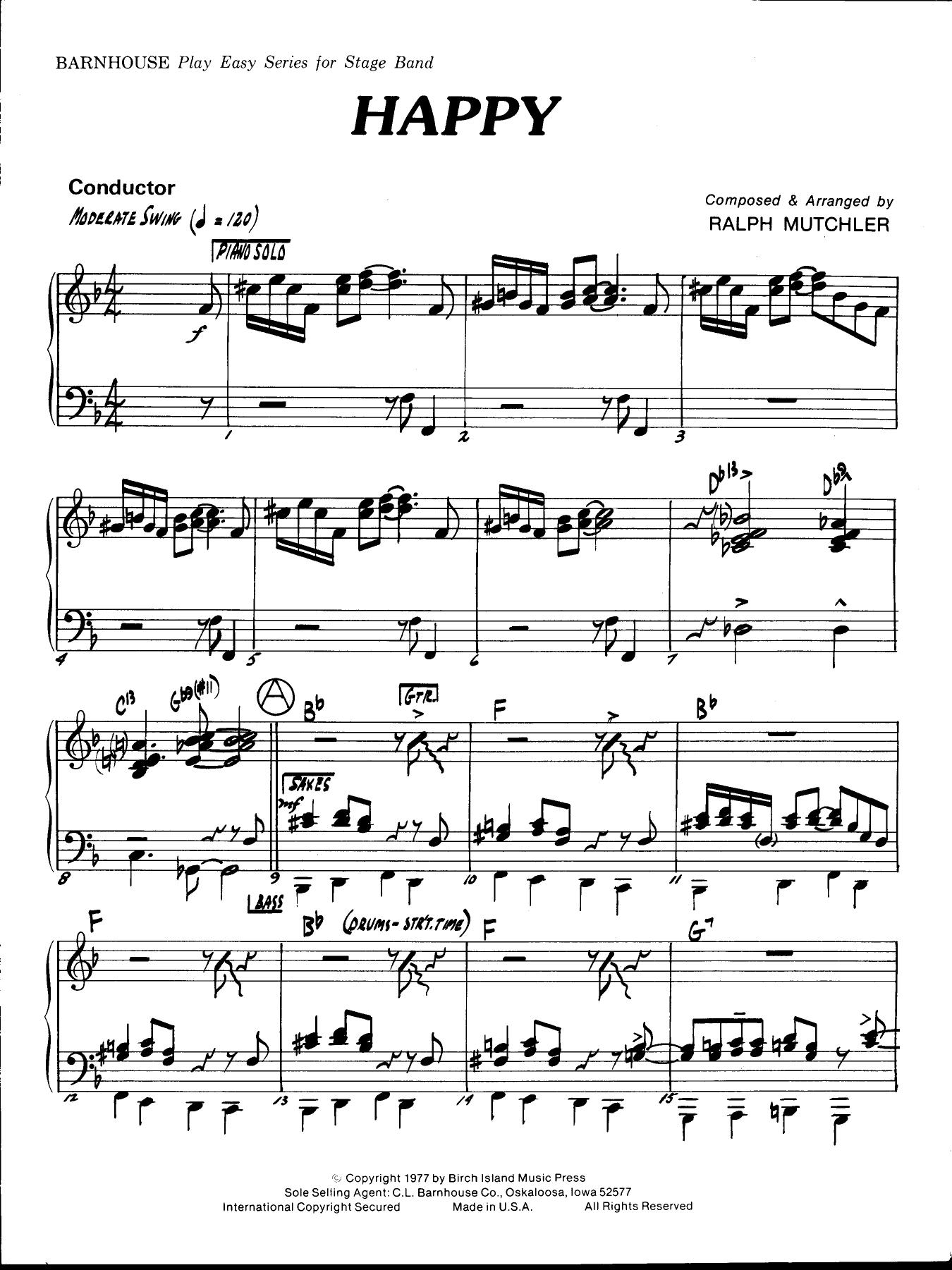
Happy (R.Mutchler)
Composed by Pharrell Williams
Arranged by R.Mutchler
- Ensemble: Big Band
- Style: Jazz Standard
- Pages: 42
- Instruments (18): Conductor, 1st Eb Alto Saxophone, 2nd Eb Alto Saxophone, 1st Bb Tenor Saxophone, 2nd Bb Tenor Saxophone, Eb Baritone Saxophone, 1st Bb Trumpet, 2nd Bb Trumpet, 3rd Bb Trumpet, 4th Bb Trumpet, 1st Trombone, 2nd Trombone, 3rd Trombone, 4th Trombone, Bass, Drums, Piano, Guitar
- Difficulty: medium
- Content: Individual Parts
- Format: PDF Download (Instant)
- Price: $24.99
Pharrell Williams's "Happy," originally released in 2013, quickly transcended its pop origins to become a global phenomenon, emblematic of contemporary feel-good music. While not a traditional jazz standard in the historical sense, its infectious groove, simple yet memorable melodic hooks, and universal appeal have made it a ubiquitous presence in popular culture, prompting numerous interpretations across genres. This arrangement by R.Mutchler recontextualizes the song within the rich tapestry of big band jazz, transforming its pop sensibilities into a sophisticated, yet equally uplifting, swing chart. The original's upbeat tempo and undeniable optimism are preserved, but filtered through the lens of classic big band orchestration, making it a compelling candidate for modern jazz ensembles seeking familiar repertoire with a fresh, swinging twist. R.Mutchler’s "Happy" is set at a medium-up swing tempo, typically around 144-152 BPM, radiating an infectious energy in the key of F major. The arrangement immediately establishes a buoyant, driving feel, propelled by a solid rhythm section foundation. The mood is unequivocally joyful and celebratory, inviting both performers and listeners to embrace its inherent positivity. Mutchler masterfully reharmonizes the original's straightforward chord progressions, introducing extended harmonies and sophisticated voice leading that add depth and color without sacrificing the song's accessible charm. The result is a vibrant, full-bodied sound that evokes the golden age of big band while remaining distinctly contemporary in its execution. The arranger’s distinctive approach is evident in the clever interplay between sections and the dynamic contour of the piece. The iconic melody is initially presented by the saxophone section in a tightly voiced soli, showcasing Mutchler's penchant for rich, harmonically interesting saxophone writing. This is contrasted by powerful brass interjections and a driving rhythm section. A standout feature is the meticulously crafted shout chorus, which builds in intensity, employing layered brass figures and intricate saxophone lines that culminate in a thrilling climax. R.Mutchler typically excels at creating arrangements that are both challenging and immensely rewarding, often incorporating unexpected rhythmic displacements and sophisticated counterpoint that demand precision from the ensemble. The arrangement includes a featured solo section, typically for an alto saxophone, providing an opportunity for improvisation over the familiar chord changes, further cementing its jazz credentials. Performing this arrangement offers numerous rewards, chief among them the opportunity to infuse a well-known pop hit with genuine jazz artistry. Technical challenges include precise articulation in the fast-moving saxophone soli passages, dynamic control in the brass sections, and maintaining a consistent, energetic swing feel throughout. The rhythm section needs to be tight and propulsive, driving the ensemble forward without overpowering the melodic lines. The arrangement is suitable for advanced high school, collegiate, and community big bands, as well as professional ensembles looking for a fresh, audience-pleasing chart. Its blend of familiarity and sophisticated jazz treatment makes it an excellent choice for concert programs, festivals, and educational settings, offering both entertainment and significant pedagogical value. Conductors should aim for a consistent medium-up swing tempo, ideally between 144-152 BPM, ensuring the rhythm section lays down a solid, driving foundation from the outset. Key technical challenges include the intricate saxophone soli passages, which require meticulous attention to articulation, blend, and rhythmic precision; encourage saxophonists to practice these sections slowly and gradually increase tempo. The brass section will need strong dynamic control, particularly in the shout chorus, to achieve the desired impact without overblowing. Rehearsal time should be dedicated to balancing the layered voicings, ensuring all parts speak clearly. While no special techniques like plunger mutes are explicitly notated, encouraging expressive falls and scoops from the brass can enhance the authentic big band feel. Focus on the overall buoyant and joyful mood, allowing the ensemble to convey the inherent optimism of the piece through their performance. Q: What instruments are included in this arrangement? A: This arrangement is scored for a standard 17-piece big band, including Piano, Bass, Guitar, Drum Set, Alto Saxophone 1, Alto Saxophone 2, Tenor Saxophone 1, Tenor Saxophone 2, Baritone Saxophone, Trumpet 1, Trumpet 2, Trumpet 3, Trumpet 4, Trombone 1, Trombone 2, Trombone 3, and Bass Trombone. Q: What is the difficulty level of "Happy (R.Mutchler)"? A: This arrangement is rated as medium-advanced, making it suitable for advanced high school, collegiate, community, and professional big bands. It presents challenges in articulation, ensemble precision, and dynamic control. Q: What musical style and historical context does this arrangement represent? A: This arrangement transforms Pharrell Williams's contemporary pop hit "Happy" into a vibrant jazz big band chart, blending modern pop sensibility with classic swing era orchestration and sophisticated jazz harmony. Q: What makes R.Mutchler's arrangement of "Happy" unique? A: R.Mutchler's treatment is distinctive for its sophisticated reharmonization, intricate saxophone soli sections, powerful brass voicings, and a meticulously crafted shout chorus that elevates the original's pop appeal into a compelling jazz statement. Q: What is the typical performance duration and tempo for this piece? A: The typical performance duration for this arrangement is approximately 3-4 minutes, maintaining a consistent medium-up swing tempo, generally around 144-152 beats per minute.
Questions and answers
- What is included in the Happy (R.Mutchler) PDF?
- The verified current file contains a conductor score and individual parts across 42 pages.
- How many instruments or parts are listed for Happy (R.Mutchler)?
- The verified instrumentation list contains 18 entries for this Big Band arrangement.
- Who is credited for Happy (R.Mutchler)?
- Composer: Pharrell Williams. Arranger: R.Mutchler.
- What difficulty is listed for Happy (R.Mutchler)?
- The verified difficulty level is medium.
- What style is listed for Happy (R.Mutchler)?
- The catalog lists the style as Jazz Standard.
- Can I preview Happy (R.Mutchler) before buying?
- Yes. The product page provides a preview generated from the current PDF file.
- How is Happy (R.Mutchler) delivered?
- After successful payment, the digital PDF is made available for download. The displayed price is $24.99.
Musicians Also Search For
Happy R.Mutchler PDF • Happy R.Mutchler sheet music • Happy arranged by R.Mutchler • R.Mutchler big band charts • R.Mutchler jazz arrangements PDF • Happy Pharrell Williams sheet music • Happy Pharrell Williams big band arrangements • Pharrell Williams big band charts • Happy big band arrangements • Happy big band PDF download • Happy jazz sheet music • big band sheet music download • Happy conductor score PDF • Happy individual parts download • Happy sheet music PDF • Happy Jazz Standard charts • Jazz Standard big band arrangements • buy Happy sheet music • download Happy PDF • Happy jazz charts • best R.Mutchler big band arrangements • Pharrell Williams arranged by R.Mutchler • Happy printable sheet music • big band repertoire PDF