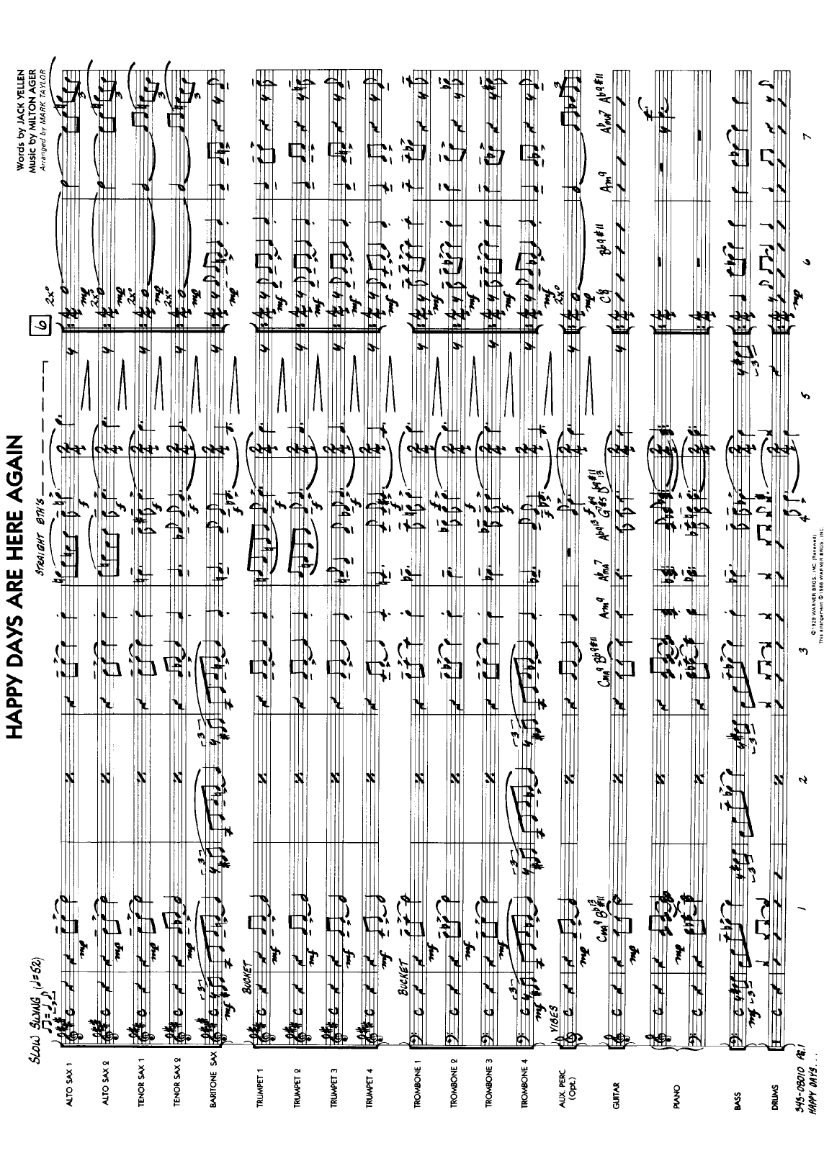
Happy Days Are Here Again (M.Taylor) sheet music preview

Happy Days Are Here Again (M.Taylor)

Composed by Milton Ager

Arranged by Mark Taylor

  • Ensemble: Big Band
  • Pages: 42
  • Instruments (17): Alto Sax 1, Alto Sax 2, Tenor Sax 1, Tenor Sax 2, Baritone Sax, Trumpet 1, Trumpet 2, Trumpet 3, Trumpet 4, Trombone 1, Trombone 2, Trombone 3, Trombone 4, Guitar, Piano, Bass, Drums
  • Difficulty: medium
  • Content: Individual Parts
  • Format: PDF Download (Instant)
  • Price: $24.99

Milton Ager and Jack Yellen’s 1929 anthem "Happy Days Are Here Again" occupies a unique space in American cultural history, forever linked to the dawn of the New Deal and the cautious optimism of a recovering nation. Originally popularized during the Great Depression and later cemented as an upbeat cultural touchstone by vocal icons like Barbra Streisand and Ben Bernie, the tune has long invited clever reinterpretations. In the hands of master big band writer Mark Taylor, this classic material sheds its vintage, vaudevillian skin to emerge as a sophisticated, swinging vehicle tailor-made for modern jazz ensembles. Taylor honors the infectious, life-affirming melody while injecting it with fresh harmonic colors and driving rhythmic momentum that bridge early jazz optimism with contemporary big band sophistication. Propelled by a bright, effervescent medium-up swing groove, this arrangement radiates high-energy optimism from the opening measure. The key center provides a brilliant sonic canvas for crisp brass writing and agile woodwind lines. Taylor crafts a dynamic journey that balances playful, tongue-in-cheek quotes with serious compositional craft, ensuring the chart never feels like a simple novelty tune. The mood shifts fluidly between breezy, relaxed swing interludes and thunderous, full-ensemble climaxes. From the initial downbeat, the arrangement evokes the spirit of a roaring 1930s dance hall filtered through the polished lens of contemporary jazz orchestration, driven by a relentless walking bassline and crisp ride-cymbal pulse. Taylor’s signature arranging style shines through in the clever interplay between sections and sophisticated voicing choices. The chart opens with a crisp, inviting intro that immediately establishes the buoyant swing feel before handing the primary melody to the saxophones, accented by punchy, counter-punching brass stabs. A standout feature of the arrangement is a tightly knit, harmonically rich brass soli that showcases the ensemble's blend and intonation, followed by a textbook build-up leading into an exhilarating shout chorus. Taylor utilizes modern dominant extensions and clever chromatic passing chords behind familiar phrases, revitalizing tired ears and offering advanced players plenty of harmonic depth to sink their teeth into. Executing this chart successfully requires a mature, cohesive rhythm section that can anchor the groove without rushing, particularly during the transition points between sparse ensemble textures and tutti explosions. Featured solo space allows a standout horn player to stretch out over changes that remain faithful to the traditional harmonic roadmap while inviting imaginative, swinging lines. Technical demands center primarily on articulation crispness—short notes must be light and precise, while longer lines require a smooth, connected jazz line. Advanced high school, collegiate, and community big bands will find this chart an absolute joy to rehearse and perform, offering a high-impact crowd-pleaser that rewards meticulous attention to style, balance, and articulation. Achieving an authentic jazz feel is paramount; conductors must ensure the rhythm section locks into a buoyant, forward-moving medium-up swing tempo where the eighth notes are characteristically swung with a triplet feel, avoiding any heavy-handedness on beats two and four. The brass section should pay close attention to dynamic contrast, ensuring that background figures remain supportive under featured soloists without masking the melodic line. Articulation is the primary technical hurdle: enforce strict uniformity across the sax and brass sections regarding short, clipped staccatos and smooth, connected phrasing on linear passages. Utilize subtle doits and falls where indicated in the chart to add traditional big band flavor, but caution players against overusing unwritten effects that could muddy Taylor's clean, transparent scoring. Rehearsal time should be heavily invested in the transition sections and the final shout chorus, ensuring that the ensemble maintains a relaxed, driving pulse even as dynamic levels push toward a roaring fortissimo. Q: What instruments and parts are included in this arrangement? A: The arrangement is scored for a standard 19-instrument big band instrumentation, comprising 5 saxophones (Alto 1, Alto 2, Tenor 1, Tenor 2, Baritone), 4 trumpets, 4 trombones, and a full rhythm section including piano, guitar, bass, and drums, spanning a comprehensive 42-page score and part set. Q: What is the difficulty level of this Mark Taylor chart? A: This arrangement is graded as medium-advanced, making it ideal for accomplished high school ensembles, university jazz bands, and professional community big bands that possess strong section playing capabilities and a solid grasp of swing articulation. Q: What is the historical style and context of this piece? A: Originally composed by Milton Ager in 1929 as an iconic Depression-era anthem, this chart reframes the historical tune within a vibrant, contemporary big band swing style while retaining its cheerful, high-energy character. Q: What makes this specific arrangement unique? A: Mark Taylor elevates a classic pop-standard into a sophisticated jazz chart by incorporating clever harmonic reharmonizations, a brilliant brass soli, and a powerful shout chorus that bridges vintage optimism with modern arranging techniques. Q: What is the performance duration and tempo feel of the piece? A: The arrangement is set in a bright, driving 4/4 meter with a medium-up swing tempo, designed to run approximately 3 to 4 minutes, providing an ideal length for festival programs or concert set openers.

Questions and answers

What is included in the Happy Days Are Here Again (M.Taylor) PDF?
The verified current file contains a conductor score and individual parts across 42 pages.
How many instruments or parts are listed for Happy Days Are Here Again (M.Taylor)?
The verified instrumentation list contains 17 entries for this Big Band arrangement.
Who is credited for Happy Days Are Here Again (M.Taylor)?
Composer: Milton Ager. Arranger: Mark Taylor.
What difficulty is listed for Happy Days Are Here Again (M.Taylor)?
The verified difficulty level is medium.
Can I preview Happy Days Are Here Again (M.Taylor) before buying?
Yes. The product page provides a preview generated from the current PDF file.
How is Happy Days Are Here Again (M.Taylor) delivered?
After successful payment, the digital PDF is made available for download. The displayed price is $24.99.

Musicians Also Search For

Happy Days Are Here Again Mark Taylor PDFHappy Days Are Here Again Mark Taylor sheet musicHappy Days Are Here Again arranged by Mark TaylorMark Taylor big band chartsMark Taylor jazz arrangements PDFHappy Days Are Here Again Milton Ager sheet musicHappy Days Are Here Again Milton Ager big band arrangementsMilton Ager big band chartsHappy Days Are Here Again big band arrangementsHappy Days Are Here Again big band PDF downloadHappy Days Are Here Again jazz sheet musicbig band sheet music downloadHappy Days Are Here Again conductor score PDFHappy Days Are Here Again individual parts downloadHappy Days Are Here Again sheet music PDFbuy Happy Days Are Here Again sheet musicdownload Happy Days Are Here Again PDFHappy Days Are Here Again jazz chartsbest Mark Taylor big band arrangementsMilton Ager arranged by Mark TaylorHappy Days Are Here Again printable sheet musicbig band repertoire PDF

All Milton Ager sheet music