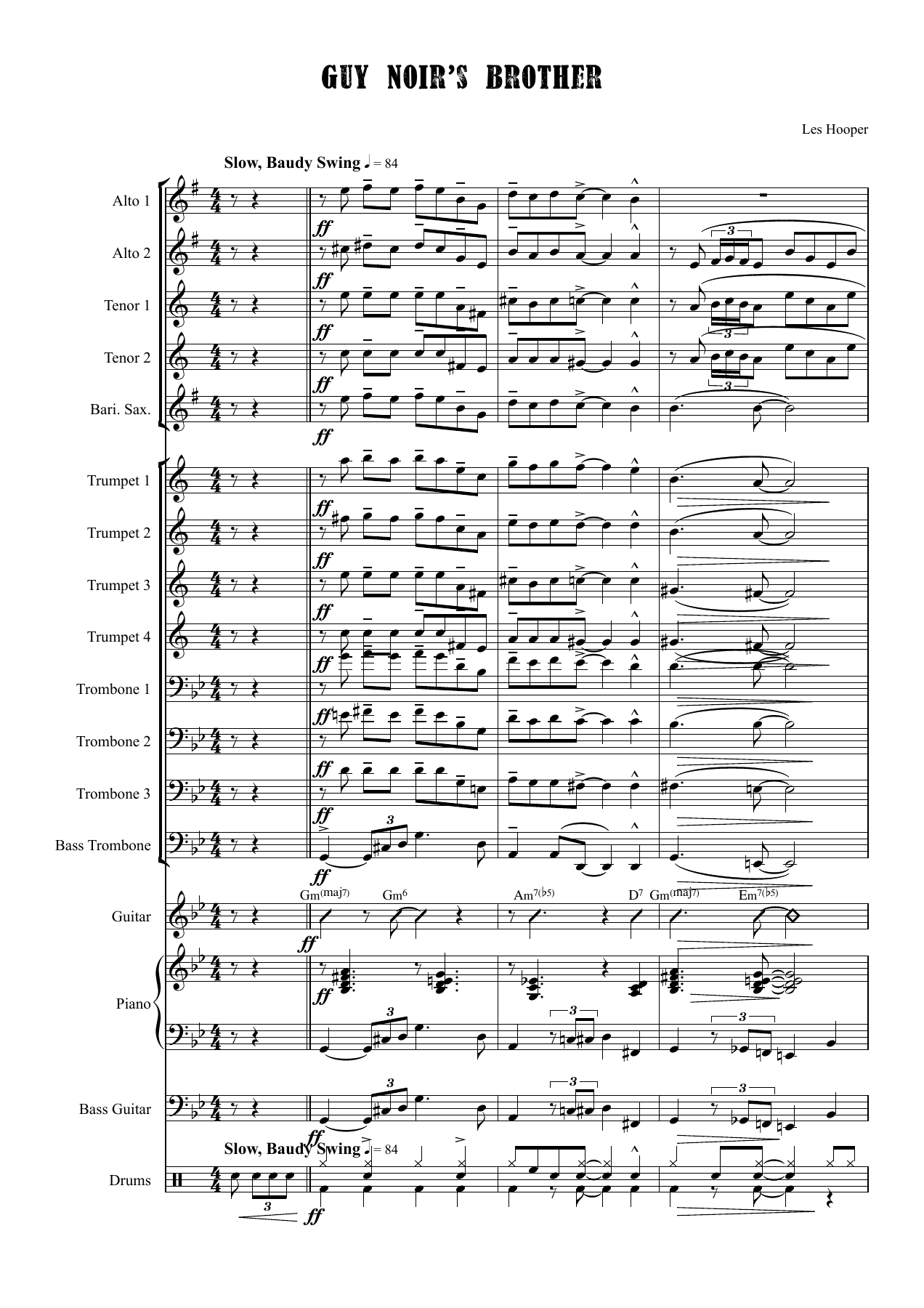
Guy Noir's Younger Brother (Les Hooper) sheet music preview

Guy Noir's Younger Brother (Les Hooper)

Composed by Les Hooper

Arranged by Les Hooper

  • Ensemble: Big Band
  • Style: Jazz Standard
  • Pages: 18
  • Instruments (17): Alto Saxophone 1, Alto Saxophone 2, Tenor Saxophone 1, Tenor Saxophone 2, Baritone Saxophone, Trumpet 1, Trumpet 2, Trumpet 3, Trumpet 4, Trombone 1, Trombone 2, Trombone 3, Bass Trombone, Guitar, Piano, Bass, Drums
  • Difficulty: easy
  • Content: Individual Parts
  • Format: PDF Download (Instant)
  • Price: $24.99

"Guy Noir's Younger Brother" is an original composition by the acclaimed jazz educator and arranger Les Hooper, a piece that has quietly established itself as a staple in contemporary big band literature. While not a traditional "standard" in the historical sense of Tin Pan Alley tunes, Hooper's works, including this one, often achieve a standard-like status within educational and professional jazz circles due to their enduring quality, sophisticated harmonic language, and engaging melodic content. Composed in an era that saw a resurgence of interest in modern big band writing, Hooper's pieces are celebrated for bridging the gap between classic big band sounds and contemporary jazz sensibilities, making them highly effective for showcasing a band's versatility and musicianship. This particular arrangement captures a vibrant, medium-up swing feel, typically around 144-152 BPM, maintaining a bright yet relaxed energy throughout. The primary key is F major, but Hooper masterfully navigates through various harmonic centers, employing his characteristic use of extended harmonies and colorful voicings that evoke a sophisticated, almost film-noir-esque mood—a nod to its title's inspiration. The piece opens with a catchy, syncopated melody, often presented in unison or tight octaves by the saxophones, immediately establishing its cool, confident character. The overall mood is one of playful intrigue, with moments of driving intensity balanced by sections of lyrical elegance. Les Hooper's arranging approach is immediately recognizable in "Guy Noir's Younger Brother." He is renowned for his meticulous voicings, which provide a rich, full sound even with complex harmonic structures. Expect intricate soli sections for the saxophones, often featuring tight, challenging lines that demand precision and blend. The brass sections are given powerful, articulate figures, contributing to the piece's dynamic contour. Hooper frequently employs call-and-response patterns between sections, building tension and release. There are typically two prominent improvised solo sections: one for alto saxophone and another for tenor saxophone, offering excellent opportunities for featured players to shine over a well-crafted, driving rhythm section accompaniment. The arrangement builds to a powerful shout chorus, showcasing the full ensemble's might before returning to a recapitulation of the main theme, often with added countermelodies or reharmonizations. The technical demands of "Guy Noir's Younger Brother" make it particularly suitable for advanced high school, college, community, and professional big bands. The sax soli passages require strong technical facility and excellent intonation, while the brass parts demand good range, articulation, and endurance. The rhythm section needs to maintain a consistent, driving swing feel, with the bass and drums providing a solid, interactive foundation. The rewarding aspects lie in the ensemble's ability to execute Hooper's sophisticated harmonic and rhythmic ideas, achieving a polished, professional sound. Specific moments, such as the tightly voiced saxophones weaving through a chromatic passage or the explosive brass figures punctuating a dynamic build, are designed to captivate both performers and audiences, making this a standout piece in any concert program. "Guy Noir's Younger Brother" thrives on a precise, medium-up swing feel, ideally around 144-152 BPM. Conductors should emphasize a relaxed, yet driving eighth-note pulse, avoiding any stiffness. Key technical challenges include the intricate saxophone soli sections, which require meticulous attention to articulation, blend, and intonation; careful sectional rehearsals are crucial here. The brass parts demand strong attacks and releases, particularly in the accented figures and shout chorus, ensuring clarity without overblowing. Rhythm section players must lock into a cohesive groove, with the drummer providing consistent swing patterns and the bassist offering a walking line that propels the ensemble forward. Pay close attention to dynamic contrasts throughout, especially the sudden shifts between forte and piano, to maximize the piece's dramatic impact. Encourage soloists to embrace the bluesy, sophisticated harmonic landscape. Q: What instruments and parts are included in this arrangement? A: This big band arrangement includes parts for 17 instruments: Alto Saxophone 1, Alto Saxophone 2, Tenor Saxophone 1, Tenor Saxophone 2, Baritone Saxophone, Trumpet 1, Trumpet 2, Trumpet 3, Trumpet 4, Trombone 1, Trombone 2, Trombone 3, Bass Trombone, Piano, Bass, Drums, and Guitar. A full conductor's score is also included. Q: What is the difficulty level of "Guy Noir's Younger Brother"? A: This arrangement is considered advanced, suitable for experienced high school, college, community, and professional big bands. It demands strong technical proficiency, advanced sight-reading skills, and a sophisticated understanding of jazz ensemble playing. Q: What is the musical style and historical context of this piece? A: "Guy Noir's Younger Brother" is an original composition by Les Hooper, representing a contemporary big band jazz style that blends traditional swing elements with modern harmonic sophistication. It showcases the evolution of big band writing from the late 20th century onwards. Q: What makes Les Hooper's arrangement of "Guy Noir's Younger Brother" unique? A: Hooper's arrangement is distinguished by its intricate saxophone soli passages, sophisticated harmonic voicings, and engaging melodic lines. It features well-crafted improvised solo sections and a powerful shout chorus, all contributing to its enduring appeal and educational value. Q: What is the typical performance duration and tempo for this arrangement? A: The typical performance duration for "Guy Noir's Younger Brother" is approximately 4-5 minutes, depending on the length of the improvised solos. It is designed to be performed at a medium-up swing tempo, generally ranging from 144 to 152 beats per minute.

Musicians Also Search For

Guy Noir's Younger Brother Les Hooper PDFGuy Noir's Younger Brother Les Hooper sheet musicGuy Noir's Younger Brother arranged by Les HooperLes Hooper big band chartsLes Hooper jazz arrangements PDFGuy Noir's Younger Brother Les Hooper big band arrangementGuy Noir's Younger Brother big band arrangementGuy Noir's Younger Brother big band PDF downloadGuy Noir's Younger Brother jazz ensemble sheet musicbig band sheet music instant downloadGuy Noir's Younger Brother conductor score PDFGuy Noir's Younger Brother individual parts downloadGuy Noir's Younger Brother sheet music with partsGuy Noir's Younger Brother Jazz Standard chartJazz Standard big band arrangementsbuy Guy Noir's Younger Brother sheet music onlinedownload Guy Noir's Younger Brother PDFGuy Noir's Younger Brother jazz chartbest Les Hooper big band arrangementsGuy Noir's Younger Brother printable sheet musicbig band repertoire PDF

All arrangements by Les Hooper All Les Hooper sheet music