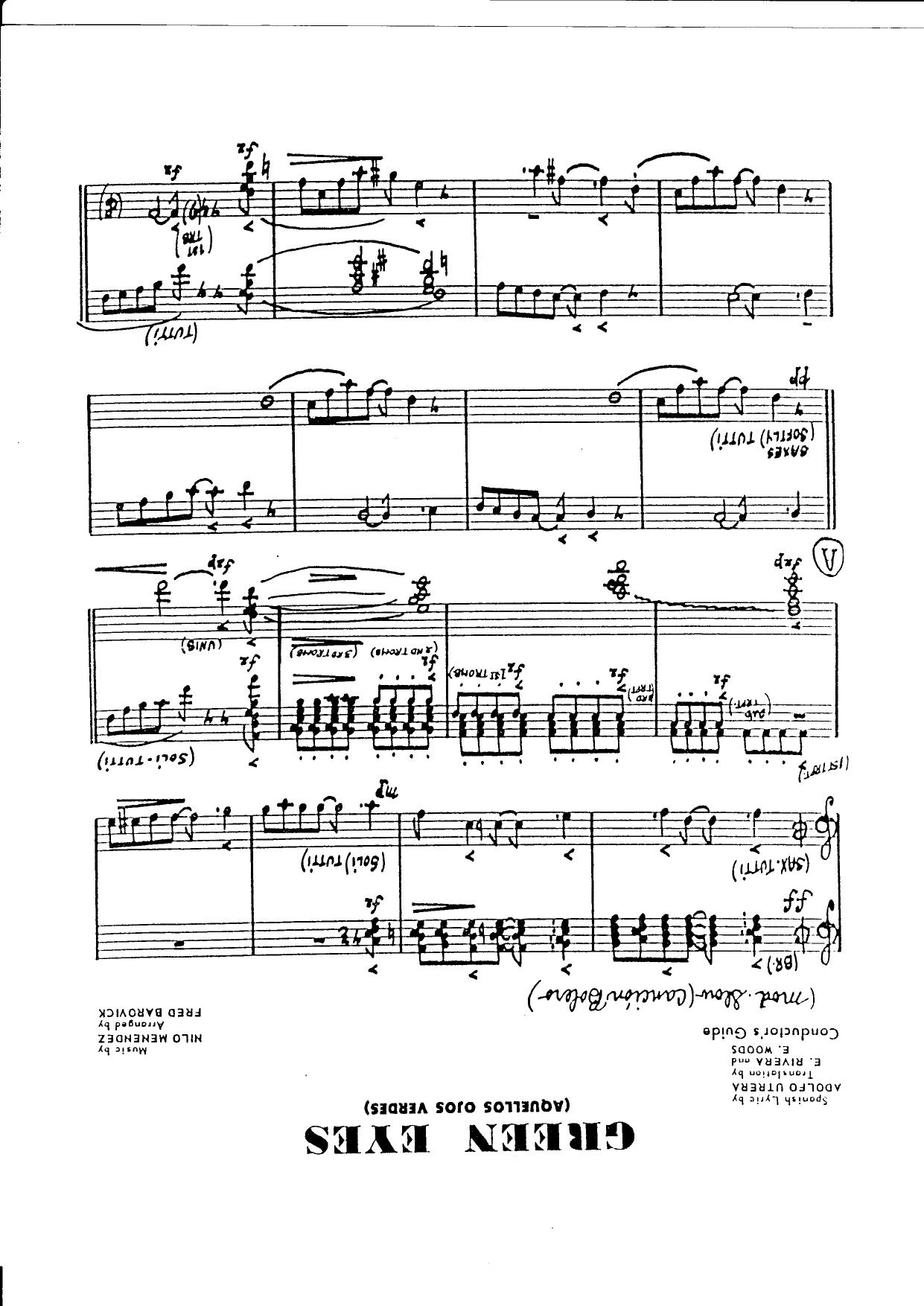
Green Eyes (F.Barovick)
Composed by Nilo Menéndez
Arranged by Fred Barovick
- Ensemble: Big Band
- Pages: 40
- Instruments (18): Conductor's Guide, 1st Eb Alto Saxophone, 2nd Eb Alto Saxophone, 1st Bb Tenor Saxophone, 2nd Bb Tenor Saxophone, Baritone Saxophone, 1st Trumpet, 2nd Trumpet, 3rd Trumpet, 4th Trumpet, 1st Trombone, 2nd Trombone, 3rd Trombone, Bass Trombone, Piano, Guitar, String Bass, Drums
- Difficulty: medium
- Content: Individual Parts
- Format: PDF Download (Instant)
- Price: $24.99
Originating as the haunting Cuban bolero "Aquellos Ojos Verdes" composed by Nilo Menéndez with lyrics by Adolfo Utrera in 1929, this timeless composition crossed over into the American consciousness most famously through Jimmy Dorsey and His Orchestra's 1941 recording featuring vocalists Helen O'Connell and Bob Eberly, which dominated the Billboard charts. Fred Barovick’s sophisticated big band adaptation honors this rich Latin-jazz lineage while reframing the iconic melody through a lush, horn-centric jazz lens. The piece bridges the intimate, romantic sensibility of the Latin American salon tradition with the swinging sophistication of the golden age of big bands, resulting in a captivating hybrid that balances rhythmic vitality with evocative harmonic depth. Musically, the arrangement is anchored by a supple, undulating Latin-swing groove in 4/4 time that encourages a relaxed yet propulsive foundation from the rhythm section. The mood shifts fluidly between sultry, nocturnal introspection and soaring, passionate outbursts, capturing the yearning sentiment of the original Spanish lyrics through rich chord extensions and gorgeous saxophone solis. Barovick employs sophisticated voicings that maximize the expressive potential of the 17-piece instrumentation, utilizing warm sustained pads in the brass to cushion intricate, intertwined counterlines in the reed section. The arrangement builds organically, using subtle dynamic shifts and clever harmonic turnarounds to maintain tension before opening up into a rewarding ensemble climax. Throughout the chart, the melodic weight is shared gracefully across sections, with the alto and tenor saxophones frequently carrying the primary thematic statements before passing the torch to muted brass figures. Solos are integrated seamlessly into the structural flow, allowing featured improvisers space to stretch out over accessible changes that evoke the classic club date atmosphere. Technical demands center primarily on stylistic execution—requiring precise articulation, controlled vibrato, and a deep understanding of Latin-swing phrasing rather than blistering velocity. Performers will find immense satisfaction in the meticulous attention to detail, particularly in the way inner voicings move independently to create a lush, professional soundscape. Advanced high school ensembles, collegiate jazz orchestras, and professional community big bands will find this arrangement to be an exceptional vehicle for developing stylistic versatility and ensemble blend. Directors will appreciate how the chart teaches students the nuances of balancing a latin groove with traditional jazz swing phrasing, making it an ideal centerpiece for festival performances or concert programs seeking a balance of nostalgic charm and high-level musicianship. Navigating this arrangement successfully requires careful attention to the stylistic balance between straight-eighth Latin feels and traditional jazz swing. The tempo should remain steady and unhurried, allowing the syncopated bass line and percussion elements to drive the groove without rushing. Conductors should ensure the rhythm section locks in tight, with the piano and guitar utilizing sparse, authentic comping voicings that complement rather than clutter the texture. Brass players should make ample use of cup or straight mutes where indicated to achieve the authentic 1940s mood, paying close attention to dynamic shading during ensemble backgrounds. The saxophone section must prioritize a unified, warm tone quality during the featured solis, matching vibrato speeds and blending inner voices meticulously. Rehearsals should initially isolate the syncopated figures between the brass and reeds to ensure crisp articulation on all off-beat accents before integrating the full ensemble blend. Q: What specific instruments and parts are included in this arrangement? A: The 17-instrument package includes a full big band instrumentation comprising Alto Saxophone 1, Alto Saxophone 2, Tenor Saxophone 1, Tenor Saxophone 2, Baritone Saxophone, standard brass parts, rhythm section, and a comprehensive conductor score spanning 40 pages. Q: What is the overall difficulty level of this big band chart? A: This arrangement is graded as medium-advanced, making it well-suited for proficient high school groups, collegiate jazz ensembles, and professional community big bands looking for stylistic polish. Q: What is the historical background and musical style of the piece? A: Based on Nilo Menéndez’s 1929 Latin standard "Aquellos Ojos Verdes" and popularized by the Jimmy Dorsey Orchestra in 1941, this arrangement blends a sultry Latin-swing groove with classic mid-century big band jazz harmony. Q: What makes Fred Barovick’s treatment unique compared to other versions? A: Barovick’s arrangement stands out through its lush, texturally rich saxophone voicings, seamless transitions between romantic ballad styling and rhythmic momentum, and intricate inner-voice counterlines that elevate the source material. Q: What is the expected performance duration and tempo feel? A: The chart is structured around a medium-tempo Latin-swing feel designed to be played at a relaxed, danceable pace, with a typical performance duration of approximately 3 to 4 minutes depending on solo choruses.
Questions and answers
- What is included in the Green Eyes (F.Barovick) PDF?
- The verified current file contains a conductor score and individual parts across 40 pages.
- How many instruments or parts are listed for Green Eyes (F.Barovick)?
- The verified instrumentation list contains 18 entries for this Big Band arrangement.
- Who is credited for Green Eyes (F.Barovick)?
- Composer: Nilo Menéndez. Arranger: Fred Barovick.
- What difficulty is listed for Green Eyes (F.Barovick)?
- The verified difficulty level is medium.
- Can I preview Green Eyes (F.Barovick) before buying?
- Yes. The product page provides a preview generated from the current PDF file.
- How is Green Eyes (F.Barovick) delivered?
- After successful payment, the digital PDF is made available for download. The displayed price is $24.99.
Musicians Also Search For
Green Eyes Fred Barovick PDF • Green Eyes Fred Barovick sheet music • Green Eyes arranged by Fred Barovick • Fred Barovick big band charts • Fred Barovick jazz arrangements PDF • Green Eyes Nilo Menéndez sheet music • Green Eyes Nilo Menéndez big band arrangements • Nilo Menéndez big band charts • Green Eyes big band arrangements • Green Eyes big band PDF download • Green Eyes jazz sheet music • big band sheet music download • Green Eyes conductor score PDF • Green Eyes individual parts download • Green Eyes sheet music PDF • buy Green Eyes sheet music • download Green Eyes PDF • Green Eyes jazz charts • best Fred Barovick big band arrangements • Nilo Menéndez arranged by Fred Barovick • Green Eyes printable sheet music • big band repertoire PDF