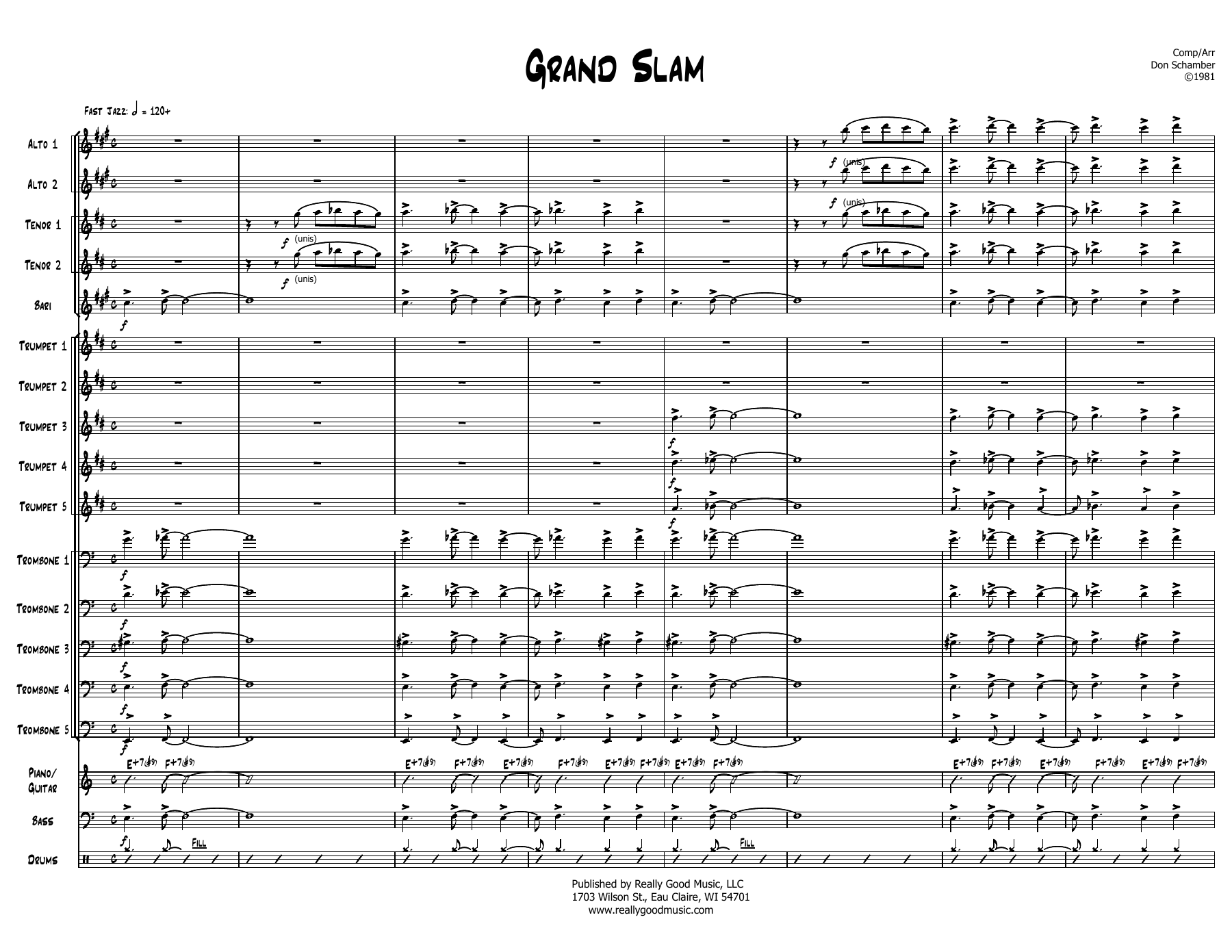
Grand Slam (D.Schamber)
Composed by Don Schamber
Arranged by D.Schamber
- Ensemble: Big Band
- Style: Jazz Standard
- Pages: 80
- Instruments (18): Alto 1, Alto 2, Tenor 1, Tenor 2, Bari, Trumpet 1, Trumpet 2, Trumpet 3, Trumpet 4, Trumpet 5, Trombone 1, Trombone 2, Trombone 3, Trombone 4, Trombone 5, Piano/Guitar, Bass, Drums
- Difficulty: advanced
- Content: Individual Parts
- Format: PDF Download (Instant)
- Price: $24.99
"Grand Slam," composed by Don Schamber, emerges from an era of vibrant big band innovation, embodying the energetic and sophisticated sound that characterized much of the mid-20th century jazz landscape. While the specific recording that made "Grand Slam" a household name isn't universally cited, its very structure and melodic invention place it firmly within the tradition of classic big band charts, reminiscent of the Basie or Kenton orchestras, where powerful brass and intricate saxophone lines converged to create an exhilarating sonic experience. This piece represents a pinnacle of the big band writing style, emphasizing tight ensemble work, dynamic contrasts, and the sheer joy of swinging. It's a composition that celebrates the full spectrum of a large jazz ensemble, designed to showcase both individual sections and the collective might of the band. D.Schamber's arrangement of "Grand Slam" is a masterclass in capturing the essence of this high-energy, medium-up swing feel. The piece is set in a bright, driving tempo, typically around 180-200 BPM, in the key of F major, radiating an undeniable sense of triumph and exhilaration. The mood is consistently upbeat and assertive, demanding precision and enthusiasm from every player. The arrangement opens with a powerful, brass-driven fanfare that immediately establishes the piece's commanding presence, quickly transitioning into a propulsive swing groove. Throughout, the energy is maintained through rhythmic interplay between sections, punctuated by crisp articulations and dynamic shifts that build and release tension effectively. This particular arrangement by D.Schamber distinguishes itself through its meticulous attention to detail and its authentic big band voicings. Schamber employs rich, full-bodied harmonies that are both challenging and immensely rewarding to execute, often featuring dense brass chords and intricate saxophone soli sections that weave complex melodic and rhythmic patterns. The melody is predominantly carried by the saxophone section in unison or octaves during the initial statements, later transitioning to powerful brass figures. A standout feature is the expertly crafted shout chorus, which builds dynamically to a thrilling climax, showcasing the full power of the ensemble. While specific solo sections are not explicitly designated for improvisation, the arrangement's structure allows for optional ad-lib solos over the chord changes, typically for tenor saxophone or trumpet, providing opportunities for individual expression within the ensemble's framework. The technical challenges lie in maintaining precise articulation, navigating rapid-fire ensemble passages, and achieving a cohesive, powerful sound across all sections. "Grand Slam" is an ideal selection for advanced high school, collegiate, community, and professional big bands. Its demands for precise ensemble playing, strong sectional leadership, and a mature understanding of swing articulation make it a superb vehicle for developing advanced musicianship. The rewarding nature of performing this piece comes from the sheer exhilaration of its powerful ensemble sections, the intricate interplay between voices, and the satisfying culmination of its dynamic build-ups. It’s a chart that truly allows a big band to flex its collective muscle and deliver a memorable, high-impact performance. "Grand Slam" demands a precise and energetic approach to truly shine. The primary technical challenge lies in achieving unified articulation and rhythmic precision, especially in the rapid brass figures and intricate saxophone soli sections. Conductors should emphasize a consistent, driving medium-up swing feel, targeting 180-200 BPM, ensuring the eighth notes are swung evenly and with conviction. Pay close attention to dynamic contrasts; the chart utilizes a wide range, from punchy fortes to nuanced mezzo-pianos, which are crucial for shaping the musical narrative. Rehearsal tips include isolating challenging rhythmic passages for brass and saxophones, focusing on clean attacks and releases. The lead trumpet should aim for a bright, commanding sound, while the rhythm section must lay down an unshakeable groove, particularly the bass and drums. No special mutes or extended techniques are explicitly required, but a strong, full tone from all instruments is paramount. Q: What instruments and parts are included in the "Grand Slam (D.Schamber)" arrangement? A: This big band arrangement includes parts for 19 instruments: Alto Saxophone 1, Alto Saxophone 2, Tenor Saxophone 1, Tenor Saxophone 2, Baritone Saxophone, Trumpet 1, Trumpet 2, Trumpet 3, Trumpet 4, Trombone 1, Trombone 2, Trombone 3, Trombone 4, Guitar, Piano, Bass, Drums, and an included conductor score. Q: What is the difficulty level of this arrangement? A: "Grand Slam" is considered advanced, suitable for collegiate, community, and professional big bands. It requires strong technical proficiency, precise ensemble playing, and a mature understanding of jazz articulation and dynamics. Q: What is the musical style and historical context of "Grand Slam"? A: "Grand Slam" is a high-energy jazz standard composed by Don Schamber, arranged by D.Schamber. It embodies the classic big band sound of the mid-20th century, characterized by a driving medium-up swing feel, powerful brass, and intricate saxophone soli sections. Q: What makes D.Schamber's arrangement of "Grand Slam" unique? A: D.Schamber's arrangement is notable for its authentic big band voicings, rich harmonies, and meticulously crafted ensemble sections, including a powerful shout chorus. It captures the triumphant and exhilarating essence of the original composition with great detail and dynamic range. Q: What is the typical performance duration or tempo for "Grand Slam"? A: "Grand Slam" is typically performed at a medium-up swing tempo, ranging from 180 to 200 beats per minute. The total performance duration will vary slightly based on tempo and any optional improvised solos, but generally falls within the 4-6 minute range.
Questions and answers
- What is included in the Grand Slam (D.Schamber) PDF?
- The verified current file contains a conductor score and individual parts across 80 pages.
- How many instruments or parts are listed for Grand Slam (D.Schamber)?
- The verified instrumentation list contains 18 entries for this Big Band arrangement.
- Who is credited for Grand Slam (D.Schamber)?
- Composer: Don Schamber. Arranger: D.Schamber.
- What difficulty is listed for Grand Slam (D.Schamber)?
- The verified difficulty level is advanced.
- What style is listed for Grand Slam (D.Schamber)?
- The catalog lists the style as Jazz Standard.
- Can I preview Grand Slam (D.Schamber) before buying?
- Yes. The product page provides a preview generated from the current PDF file.
- How is Grand Slam (D.Schamber) delivered?
- After successful payment, the digital PDF is made available for download. The displayed price is $24.99.
Musicians Also Search For
Grand Slam D.Schamber PDF • Grand Slam D.Schamber sheet music • Grand Slam arranged by D.Schamber • D.Schamber big band charts • D.Schamber jazz arrangements PDF • Grand Slam Don Schamber sheet music • Grand Slam Don Schamber big band arrangements • Don Schamber big band charts • Grand Slam big band arrangements • Grand Slam big band PDF download • Grand Slam jazz sheet music • big band sheet music download • Grand Slam conductor score PDF • Grand Slam individual parts download • Grand Slam sheet music PDF • Grand Slam Jazz Standard charts • Jazz Standard big band arrangements • buy Grand Slam sheet music • download Grand Slam PDF • Grand Slam jazz charts • best D.Schamber big band arrangements • Don Schamber arranged by D.Schamber • Grand Slam printable sheet music • big band repertoire PDF