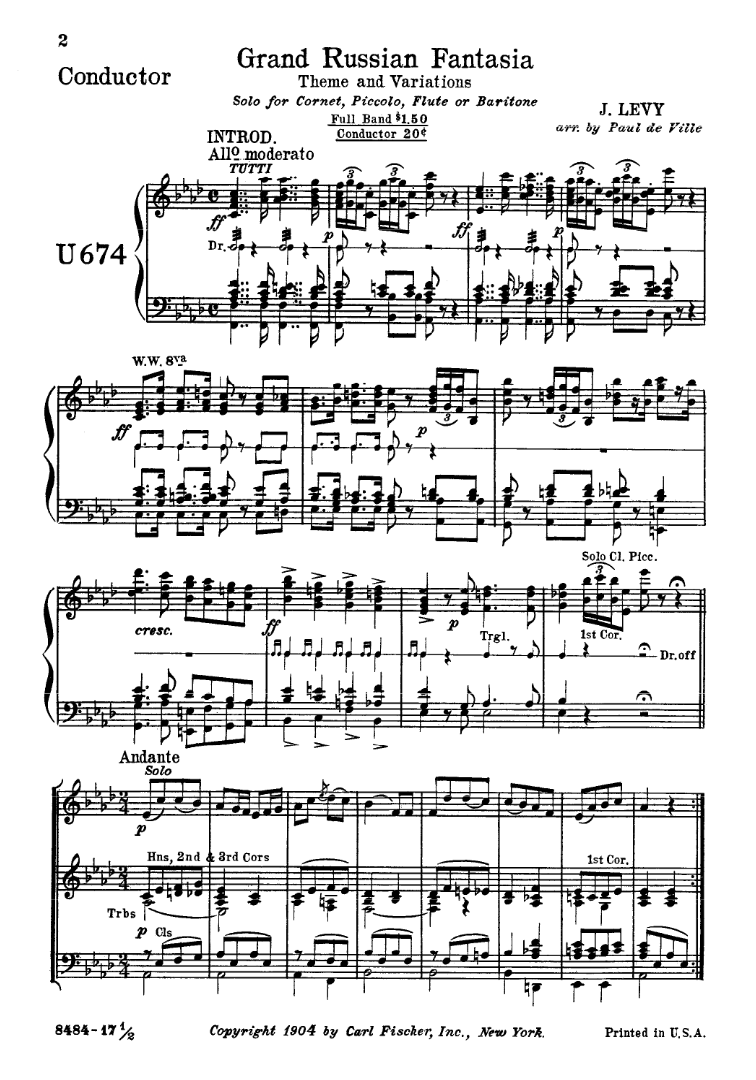
Grand Russian Fantasia (J.Levy)
Composed by J. Levy
- Ensemble: Concert Band
- Pages: 28
- Instruments (16): Flute, Oboe, Clarinet, Bass Clarinet, Alto Saxophone, Tenor Saxophone, Baritone Saxophone, Trumpet, French Horn, Trombone, Euphonium, Tuba, Piano, Bass, Drums, Percussion
- Difficulty: medium
- Content: Individual Parts
- Format: PDF Download (Instant)
- Price: $22.99
Jules Levy's "Grand Russian Fantasia" originates from the late 19th century, a period when virtuoso cornetists like Levy captivated audiences with their technical prowess and melodic artistry. While the original composition is a staple of brass band and solo cornet repertoire, showcasing a blend of Russian folk melodies and operatic flourishes, its transformation into a jazz idiom for concert band offers a fascinating bridge between classical virtuosity and swing era sensibilities. This arrangement reimagines Levy's intricate themes through the lens of jazz, inviting a contemporary audience to appreciate its melodic richness within a vibrant, swinging framework. It's not a jazz standard in the traditional sense, but rather a classical piece given a unique jazz treatment, making it a notable and distinctive addition to any concert program. The musical character of this arrangement is a captivating blend of the original's dramatic flair and an undeniable jazz pulse. It primarily operates as a medium-up swing, often settling into a comfortable 4/4 groove that propels the piece forward with energy and sophistication. The key signature shifts throughout, navigating between major and minor tonalities to reflect the original's emotional breadth, from majestic pronouncements to more introspective, lyrical passages. The overall mood is one of celebratory grandeur infused with the infectious rhythmic vitality of big band jazz. Expect moments of lush, harmonically rich voicings juxtaposed with driving, energetic sections, evoking a sense of both historical reverence and modern exuberance. While the arranger remains unknown, their approach to "Grand Russian Fantasia" is distinctly thoughtful and effective. They have skillfully reharmonized Levy's original melodies, replacing traditional classical harmonies with extended jazz chords (9ths, 11ths, 13ths, altered dominant voicings) that add color and sophistication. The arrangement features several prominent soli sections, particularly for the saxophone and brass sections, which allow individual instrument families to shine with intricate melodic and rhythmic interplay. The original's virtuosic cornet lines are cleverly distributed among the woodwinds and brass, often appearing as unison or octave melodies, creating a powerful and cohesive sound. A standout feature is the clever use of call-and-response between sections, building dynamic tension and release, culminating in a powerful shout chorus that brings the piece to a thrilling climax. Performance details reveal a piece that is both challenging and immensely rewarding. The primary melodic lines are shared dynamically across the ensemble, with the flute, oboe, and clarinet often carrying the initial statements, later joined and reinforced by the alto saxophones and trumpets. While there are no explicit written solos, ample opportunity exists for improvisation over the provided chord changes during designated sections, particularly for alto saxophone or trumpet, allowing for individual expression. Technical challenges include intricate rhythmic figures, demanding articulation, and precise ensemble blend, especially in the faster soli passages. The reward lies in mastering the piece's dynamic contrasts, its seamless transitions between classical grandeur and jazz swing, and the sheer joy of performing such a unique and engaging arrangement. This piece is most suitable for advanced high school, college, or community concert bands with strong section leaders and a solid understanding of jazz articulation and swing feel. Professional ensembles will also find it a fresh and exciting addition to their repertoire, offering a unique crossover appeal. Conductors should emphasize a consistent, relaxed medium-up swing feel from the outset, ensuring the rhythmic foundation is solid. Key technical challenges include navigating the frequent key changes and maintaining precise articulation in the quick woodwind and brass soli passages. Encourage musicians to listen across sections for melodic hand-offs and harmonic blend, particularly in the reharmonized sections where extended voicings require careful balance. While no specific special techniques like plunger mutes are explicitly notated, encouraging a "jazz" approach to articulation, including subtle falls and scoops where appropriate, will enhance the stylistic authenticity. Rehearsal time should be dedicated to isolating the intricate rhythmic figures and ensuring all entrances are confident and unified, especially after dynamic contrasts. Focus on shaping the longer melodic lines and building the dynamic arc towards the powerful shout chorus, ensuring a cohesive and energetic climax. Q: What instruments and parts are included in this arrangement? A: This arrangement is scored for 16 instruments, typically including Flute, Oboe, Clarinet, Bass Clarinet, Alto Saxophone, Tenor Saxophone, Baritone Saxophone, Trumpet, French Horn, Trombone, Euphonium, Tuba, and Percussion, with specific parts detailed on the 28 pages. Q: What is the difficulty level of "Grand Russian Fantasia (J.Levy)" for concert band? A: This arrangement is considered advanced, suitable for strong high school, college, or community concert bands due to its intricate rhythmic figures, challenging articulation, frequent key changes, and the demand for a sophisticated jazz swing feel. Q: What is the musical style and historical context of this arrangement? A: This piece is a jazz arrangement of Jules Levy's late 19th-century classical cornet showpiece, "Grand Russian Fantasia." It blends the original's melodic grandeur with a medium-up swing jazz idiom, offering a unique crossover experience. Q: What makes this particular arrangement unique compared to other versions of "Grand Russian Fantasia"? A: Its uniqueness lies in its complete reharmonization and reinterpretation for concert band in a jazz style, featuring extended jazz chords, prominent soli sections for various instrument families, and a dynamic shout chorus, transforming a classical virtuoso piece into a swinging ensemble work. Q: What is the approximate performance duration and recommended tempo for this piece? A: While specific duration can vary with interpretation, expect a performance time of approximately 4-5 minutes. The recommended tempo is a medium-up swing, typically around 144-160 beats per minute, ensuring a lively and energetic feel.
Musicians Also Search For
Grand Russian Fantasia J. Levy sheet music • Grand Russian Fantasia J. Levy concert band arrangement • J. Levy concert band charts • Grand Russian Fantasia concert band arrangement • Grand Russian Fantasia concert band PDF download • Grand Russian Fantasia jazz ensemble sheet music • concert band sheet music instant download • Grand Russian Fantasia individual parts download • Grand Russian Fantasia sheet music with parts • buy Grand Russian Fantasia sheet music online • download Grand Russian Fantasia PDF • Grand Russian Fantasia jazz chart • Grand Russian Fantasia printable sheet music • concert band repertoire PDF