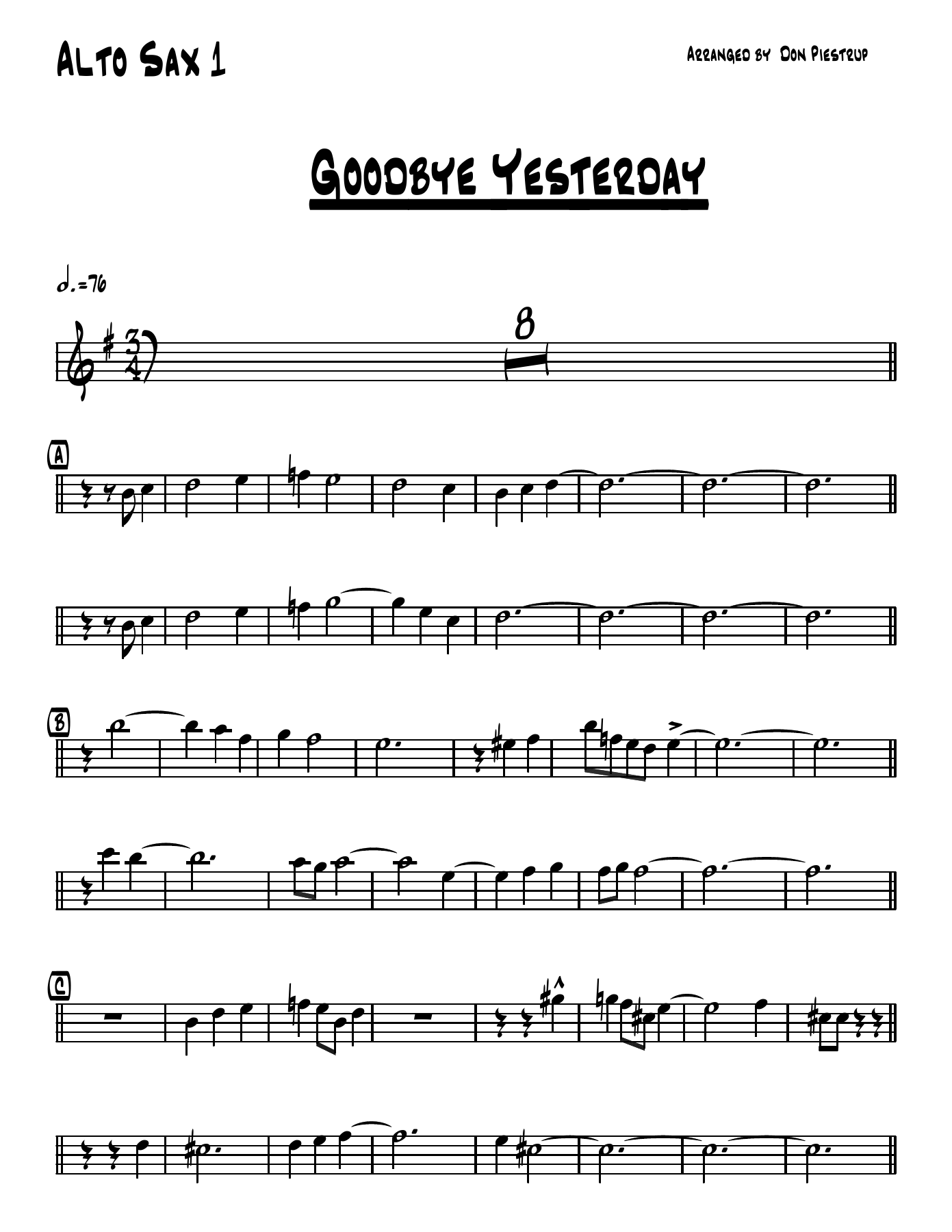
Goodbye Yesterday (D.Piestrup)
Composed by Gordon Goodwin
Arranged by D. Piestrup
- Ensemble: Big Band
- Style: Waltz
- Pages: 153
- Instruments (18): Alto Saxophone 1, Alto Saxophone 2, Tenor Saxophone 1, Tenor Saxophone 2, Baritone Saxophone, Trumpet 1, Trumpet 2, Trumpet 3, Trumpet 4, Trumpet 5, Trombone 1, Trombone 2, Trombone 3, Trombone 4, Guitar, Piano, Bass, Drum Set
- Difficulty: advanced
- Content: Individual Parts
- Format: PDF Download (Instant)
- Price: $24.99
Gordon Goodwin's "Goodbye Yesterday" stands as a poignant and evocative waltz, originally composed and recorded as a signature piece for his renowned Big Phat Band. Emerging in the early 2000s, this composition quickly distinguished itself within the contemporary big band repertoire, showcasing Goodwin's masterful command of melody, harmony, and sophisticated orchestration. While not a traditional jazz standard in the historical sense, its widespread popularity among modern jazz ensembles and its frequent inclusion in educational and professional concert programs have solidified its place as a contemporary classic. The original recording is celebrated for its lush textures, emotional depth, and intricate yet accessible melodic lines, making it a compelling listen and a rewarding challenge for performers. Its enduring appeal lies in its ability to blend contemporary jazz sensibilities with the timeless grace of the waltz form, creating a piece that is both innovative and deeply moving. D. Piestrup's arrangement of "Goodbye Yesterday" respectfully builds upon Goodwin's original vision while imbuing it with Piestrup's distinctive orchestrational flair. This rendition maintains the piece's characteristic medium-slow waltz tempo, typically around 120-130 beats per minute in 3/4 time, preserving its reflective and slightly melancholic mood. Piestrup's approach is characterized by his meticulous attention to voicings, often employing rich, dense harmonies that expand upon the original's emotional resonance. Expect beautifully crafted saxophone soli sections that weave intricate melodic counterpoint, showcasing the section's blend and precision. The arrangement features the melody initially carried by a lead alto saxophone, often doubled or harmonized by other saxophones or trombones, creating a warm, inviting timbre. As the piece progresses, the melody gracefully shifts between sections, providing opportunities for various instrumental colors to shine. One of the hallmarks of Piestrup's writing is his ability to create dynamic contrasts and build intensity organically. This arrangement features a powerful, yet controlled, shout chorus that provides a climactic moment without sacrificing the piece's inherent elegance. While there are no extended open solos, Piestrup often incorporates brief, lyrical improvised fills or obligatos for various instruments, requiring a strong sense of melodic invention and stylistic understanding. The technical challenges lie primarily in achieving a seamless ensemble blend, precise articulation within the waltz feel, and navigating the rich harmonic language. The brass sections will need excellent control over dynamics and intonation, particularly in the softer passages and sustained chords. The rhythm section is crucial for maintaining the consistent, flowing waltz groove, providing a solid yet flexible foundation. Performing "Goodbye Yesterday" is profoundly rewarding due to its inherent beauty and the opportunity it provides for an ensemble to showcase its musical maturity, expressive capabilities, and collective sensitivity. This arrangement is ideally suited for advanced high school, collegiate, community, and professional big bands. Its musical sophistication and the demands it places on ensemble blend, intonation, and expressive phrasing make it an excellent vehicle for developing a band's musicality beyond purely technical proficiency. While the technical demands are significant, they are always in service of the music, offering a challenging yet highly gratifying experience for dedicated musicians. The 17-instrument orchestration (including Alto Saxophone 1 & 2, Tenor Saxophone 1 & 2, Baritone Saxophone, Trumpet 1-4, Trombone 1-4, Guitar, Piano, Bass, Drums) provides a full, lush sound palette, allowing the arranger's intricate voicings to be fully realized. Conductors should emphasize a consistent, flowing waltz feel, avoiding any tendency to rush or drag the tempo. Aim for a medium-slow, expressive 3/4 at approximately 120-130 BPM. Key technical challenges include achieving precise intonation within the rich, often close-voiced harmonies, particularly in the saxophone and trombone sections. Encourage musicians to listen across sections for balance and blend. Dynamics are crucial; ensure a wide range is explored, from delicate pianissimos to controlled fortissimos in the shout chorus. Articulation should be legato and lyrical for the melodic lines, with clear, unified releases. Rehearsal time should be dedicated to shaping phrases, understanding the harmonic movement, and ensuring the rhythm section provides a buoyant yet steady foundation. No special mutes or extended techniques are explicitly required beyond standard brass mutes (straight, cup) for color changes as indicated. Q: What instruments are included in this arrangement? A: This arrangement is scored for a full 17-instrument big band, including Alto Saxophone 1 & 2, Tenor Saxophone 1 & 2, Baritone Saxophone, Trumpet 1-4, Trombone 1-4, Guitar, Piano, Bass, and Drums. Q: What is the difficulty level of "Goodbye Yesterday (D. Piestrup)"? A: This arrangement is considered advanced, suitable for collegiate, community, and professional big bands, as well as highly skilled high school ensembles. It demands strong ensemble blend, precise intonation, and expressive musicality. Q: What is the musical style and historical context of this piece? A: "Goodbye Yesterday" is a contemporary jazz waltz, originally composed by Gordon Goodwin in the early 2000s. It represents modern big band writing, blending sophisticated harmonies and melodies with the timeless elegance of the waltz form. Q: What makes D. Piestrup's arrangement of "Goodbye Yesterday" unique? A: Piestrup's arrangement is distinguished by its rich, dense voicings, beautifully crafted saxophone soli sections, and dynamic build-ups that enhance the original's emotional depth while maintaining its characteristic medium-slow waltz feel. Q: What is the typical performance duration and tempo for this arrangement? A: The typical performance duration for "Goodbye Yesterday" is approximately 5-6 minutes. It is performed at a medium-slow waltz tempo, generally around 120-130 beats per minute in 3/4 time.
Musicians Also Search For
Goodbye Yesterday D. Piestrup PDF • Goodbye Yesterday D. Piestrup sheet music • Goodbye Yesterday arranged by D. Piestrup • D. Piestrup big band charts • D. Piestrup jazz arrangements PDF • Goodbye Yesterday Gordon Goodwin sheet music • Goodbye Yesterday Gordon Goodwin big band arrangement • Gordon Goodwin big band charts • Goodbye Yesterday big band arrangement • Goodbye Yesterday big band PDF download • Goodbye Yesterday jazz ensemble sheet music • big band sheet music instant download • Goodbye Yesterday conductor score PDF • Goodbye Yesterday individual parts download • Goodbye Yesterday sheet music with parts • Goodbye Yesterday Waltz chart • Waltz big band arrangements • buy Goodbye Yesterday sheet music online • download Goodbye Yesterday PDF • Goodbye Yesterday jazz chart • best D. Piestrup big band arrangements • Gordon Goodwin songs arranged by D. Piestrup • Goodbye Yesterday printable sheet music • big band repertoire PDF