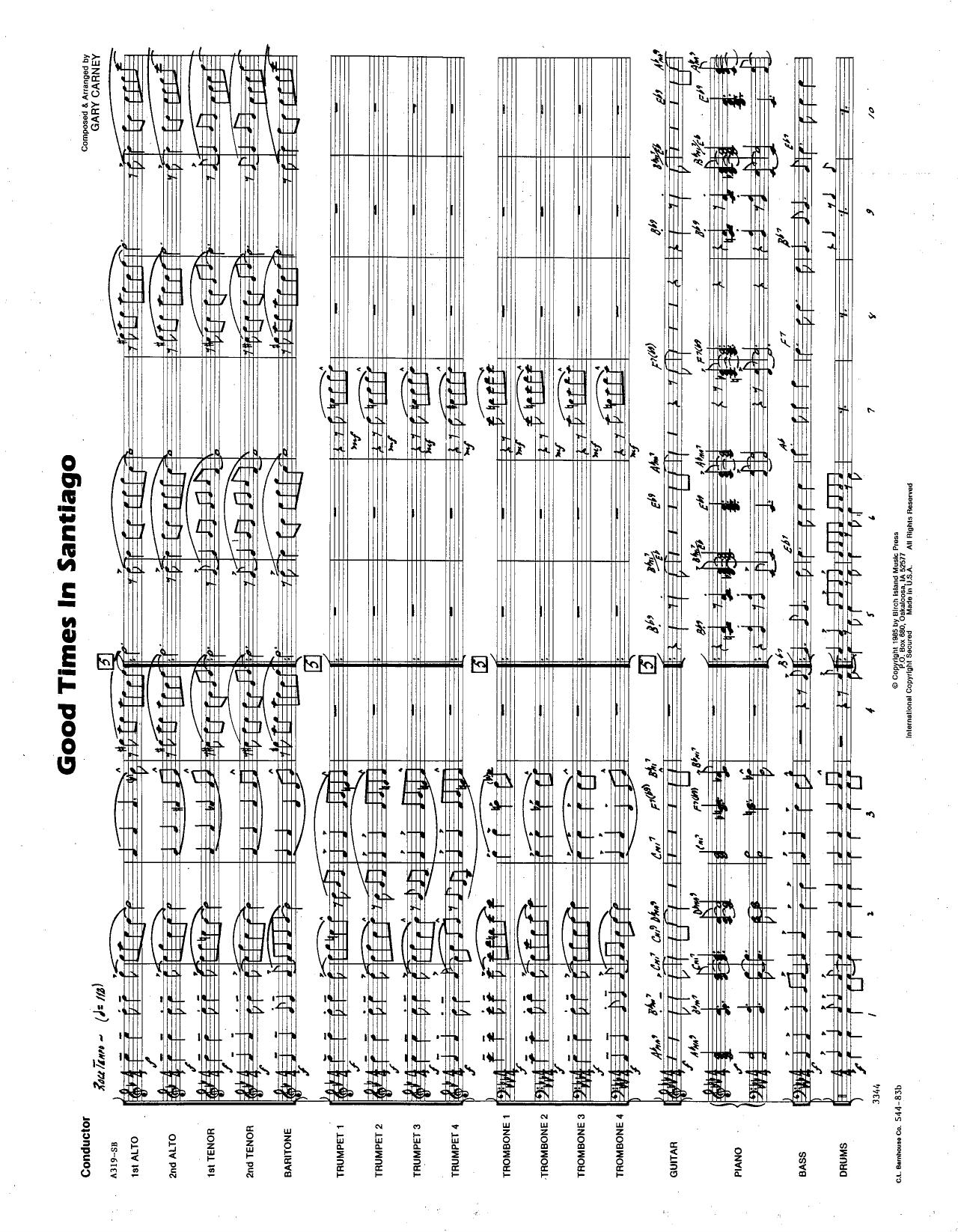
Good Times In Santiago (G.Carney) sheet music preview

Good Times In Santiago (G.Carney)

Composed by Gary Carney

Arranged by G.Carney

  • Ensemble: Big Band
  • Style: Jazz Standard
  • Pages: 46
  • Instruments (17): 1st Eb Alto Saxophone, 2nd Eb Alto Saxophone, 1st Bb Tenor Saxophone, 2nd Bb Tenor Saxophone, Eb Baritone Saxophone, 1st Bb Trumpet, 2nd Bb Trumpet, 3rd Bb Trumpet, 4th Bb Trumpet, 1st Trombone, 2nd Trombone, 3rd Trombone, 4th Trombone, Piano, Guitar, Bass, Drums
  • Difficulty: medium
  • Content: Individual Parts
  • Format: PDF Download (Instant)
  • Price: $24.99

"Good Times In Santiago" by Gary Carney is a vibrant original composition that has become a staple in the repertoire of many jazz ensembles since its publication in 1985. While not a traditional jazz standard from the Great American Songbook, its enduring popularity and frequent performance have solidified its place as a contemporary standard within the educational and community big band circuits. The piece embodies the energetic and accessible big band writing style prevalent in the mid-1980s, characterized by clear melodic lines, driving rhythms, and arrangements designed to showcase a full ensemble sound. Gary Carney himself is a recognized figure in jazz education and arranging, known for crafting charts that are both musically engaging and pedagogically sound. This arrangement bursts forth with a medium-up Latin groove, immediately establishing an infectious and celebratory mood. The primary key of C minor (or a related mode) lends a sophisticated yet approachable feel, allowing for rich harmonic textures without excessive complexity. The energy is consistently high, driven by a pulsating rhythm section and bright brass figures, evoking images of a lively festival or a bustling city square. The piece's character is one of joyful exuberance, with moments of call-and-response between sections contributing to a dynamic and interactive soundscape. It's a piece designed to make both performers and audiences tap their feet and smile, embodying the "good times" promised in its title. G. Carney's approach to this arrangement is a masterclass in effective big band writing for developing ensembles. The melody is initially carried by the alto saxophones, often doubled by trumpets, providing a strong, unified sound that is both lyrical and rhythmically precise. Distinctive soli sections for the saxophones and brass are expertly voiced, creating full, harmonically interesting passages that are challenging yet achievable. The arrangement features a well-placed tenor saxophone solo, offering an opportunity for an improviser to shine over a supportive and grooving background. Technical challenges include precise articulation in the brass, maintaining rhythmic integrity in the Latin feel, and navigating some moderately fast scale passages in the saxophones. The rewarding aspect lies in the collective power of the ensemble, the satisfying blend of the voicings, and the sheer joy of performing such an uplifting piece. This arrangement is ideally suited for ambitious high school jazz ensembles, college bands, and community big bands. Its structure provides ample opportunity for all sections to contribute significantly, fostering ensemble cohesion and individual development. The clear melodic presentation, coupled with approachable harmonic language and a compelling rhythmic foundation, makes it an excellent choice for bands looking to expand their repertoire with an engaging, accessible, and thoroughly enjoyable Latin-infused big band chart. To capture the true essence of "Good Times In Santiago," conductors should emphasize a consistent, driving medium-up Latin groove from the rhythm section, particularly the bass and drums. The tempo should be vibrant, around 130-140 BPM, ensuring the piece maintains its celebratory energy. Key technical challenges include precise articulation in the brass, especially in the punchy rhythmic figures, and maintaining a light, agile feel in the saxophone soli sections. Encourage brass players to use short, crisp articulations, avoiding overblowing. The tenor saxophone soloist should be guided to embrace the Latin feel, perhaps incorporating some blues-based melodic ideas over the provided chord changes. Rehearsal tips include isolating the rhythm section to solidify the groove, then adding the horns in layers. Pay close attention to dynamics, ensuring the shout chorus builds to a powerful, unified climax without sacrificing blend. Q: What instruments and parts are included in this arrangement? A: This arrangement includes parts for a standard 17-piece big band: 1st Alto Saxophone, 2nd Alto Saxophone, 1st Tenor Saxophone, 2nd Tenor Saxophone, Baritone Saxophone, 4 Trumpets, 4 Trombones, Piano, Bass, Guitar, and Drums. It also comes with a comprehensive conductor score. Q: What is the difficulty level of "Good Times In Santiago (G.Carney)"? A: This arrangement is considered to be of intermediate difficulty, making it appropriate for advanced high school, college, and community big bands. It presents engaging challenges in rhythm and articulation but is highly rewarding to perform. Q: What is the musical style and historical context of this piece? A: "Good Times In Santiago" is an original jazz composition by Gary Carney, published in 1985. It features a lively Latin jazz style, characterized by a medium-up tempo and an infectious groove, reflecting the accessible big band writing popular in that era. Q: What makes this arrangement unique compared to other big band charts? A: This arrangement stands out for its vibrant Latin groove, memorable melodic lines, and expertly voiced soli sections that provide rich harmonic textures. It offers a fantastic balance of ensemble challenges and solo opportunities, all while maintaining a consistently joyful and energetic mood. Q: What is the typical performance duration or tempo for this piece? A: "Good Times In Santiago" is typically performed at a medium-up tempo, around 130-140 beats per minute, which usually results in a performance duration of approximately 3 to 4 minutes, depending on the length of the improvised solo.

Questions and answers

What is included in the Good Times In Santiago (G.Carney) PDF?
The verified current file contains a conductor score and individual parts across 46 pages.
How many instruments or parts are listed for Good Times In Santiago (G.Carney)?
The verified instrumentation list contains 17 entries for this Big Band arrangement.
Who is credited for Good Times In Santiago (G.Carney)?
Composer: Gary Carney. Arranger: G.Carney.
What difficulty is listed for Good Times In Santiago (G.Carney)?
The verified difficulty level is medium.
What style is listed for Good Times In Santiago (G.Carney)?
The catalog lists the style as Jazz Standard.
Can I preview Good Times In Santiago (G.Carney) before buying?
Yes. The product page provides a preview generated from the current PDF file.
How is Good Times In Santiago (G.Carney) delivered?
After successful payment, the digital PDF is made available for download. The displayed price is $24.99.

Musicians Also Search For

Good Times In Santiago G.Carney PDFGood Times In Santiago G.Carney sheet musicGood Times In Santiago arranged by G.CarneyG.Carney big band chartsG.Carney jazz arrangements PDFGood Times In Santiago Gary Carney sheet musicGood Times In Santiago Gary Carney big band arrangementsGary Carney big band chartsGood Times In Santiago big band arrangementsGood Times In Santiago big band PDF downloadGood Times In Santiago jazz sheet musicbig band sheet music downloadGood Times In Santiago conductor score PDFGood Times In Santiago individual parts downloadGood Times In Santiago sheet music PDFGood Times In Santiago Jazz Standard chartsJazz Standard big band arrangementsbuy Good Times In Santiago sheet musicdownload Good Times In Santiago PDFGood Times In Santiago jazz chartsbest G.Carney big band arrangementsGary Carney arranged by G.CarneyGood Times In Santiago printable sheet musicbig band repertoire PDF

All arrangements by G.Carney All Gary Carney sheet music