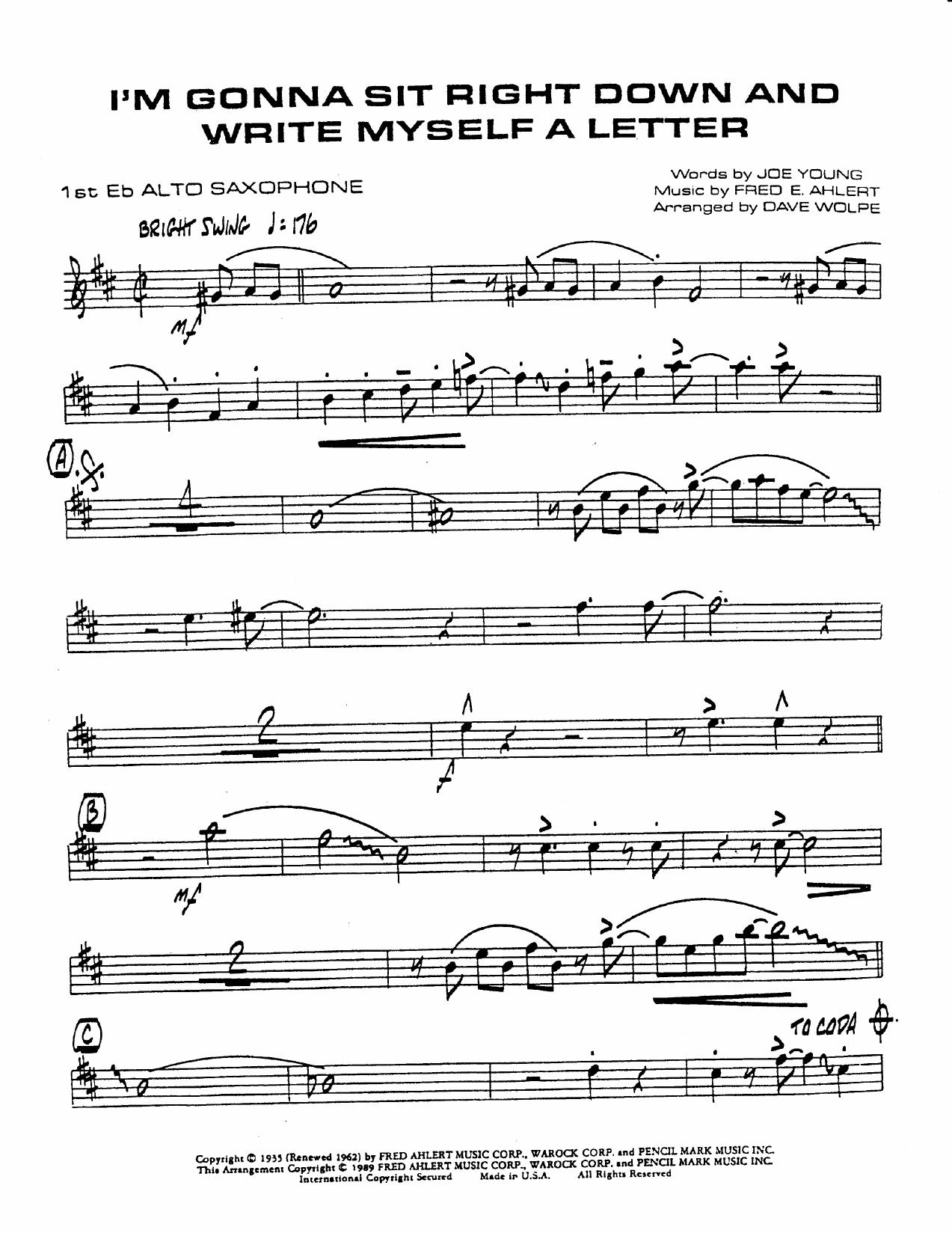
Gonna Sit Right Down And Write Myself (D.Wolpe)
Composed by Fred E. Ahlert
Arranged by Dave Wolpe
- Ensemble: Big Band
- Pages: 44
- Instruments (19): 1st Eb Alto Saxophone, 2nd Eb Alto Saxophone, 1st Bb Tenor Saxophone, 2nd Bb Tenor Saxophone, Eb Baritone Saxophone, 1st Bb Trumpet, 2nd Bb Trumpet, 3rd Bb Trumpet, 4th Bb Trumpet, 1st Trombone, 2nd Trombone, 3rd Trombone, 4th Trombone, Trombone 5, Piano, Bass, Drums, Guitar, Vocal Solo
- Difficulty: medium
- Content: Individual Parts
- Format: PDF Download (Instant)
- Price: $24.99
Fred E. Ahlert and Joe Young crafted "Gonna Sit Right Down and Write Myself a Letter" in 1935, a quintessential upbeat pop-standard that quickly found a permanent home in the swinging heart of the Great American Songbook. While famously popularized by Fats Waller and later immortalized by vocal heavyweights like Frank Sinatra and Nat King Cole, the tune's infectious optimism and driving AABA song form make it an absolute natural for instrumental big band adaptation. It captures the effervescent, high-spirited energy of mid-1930s swing, translating effortlessly into a vibrant showcase for horn sections that thrive on buoyant, swinging rhythms and classic harmonic motion. Dave Wolpe’s masterwork big band arrangement breathes fresh vitality into this timeless classic, injecting it with a swinging, bright-tempo bounce that immediately engages both performers and audiences. Built around a classic medium-up swing feel, the chart radiates a joyful, toe-tapping energy driven by crisp percussion and interlocking horn lines. Wolpe utilizes a bright, brass-forward palette, opening with a playful thematic statement before rolling into rich, classic 1930s-inspired voicings. The arrangement cleverly balances tutti ensemble power with sparse, driving accompaniments that allow the rhythm section to lock into an authentic pocket, evoking the legendary ballrooms of the swing era while maintaining a polished, contemporary crispness. Throughout the 44-page score, Wolpe showcases his signature arranging genius through sparkling brass counter-melodies and tight, harmonized saxophone solis that effortlessly navigate the changes. The melody is initially introduced cleanly by the frontline reeds before being tossed playfully across the sections. A high-energy shout chorus serves as the structural climax, building rhythmic tension through syncopated cross-rhythms before opening up into a soaring ensemble tutti that resolves into a clever, high-spirited tag ending. Solo opportunities are strategically integrated, giving featured instrumentalists a comfortable framework over standard jazz changes to stretch out and establish the mood. Advanced high school, collegiate, and community jazz orchestras will find this chart to be an exceptionally rewarding addition to their repertoire. While the tempo demands clean articulation and agile fingerwork—particularly in the saxophone and trumpet sections—the technical requirements are entirely accessible to bands with a solid grasp of fundamental swing phrasing. It functions brilliantly as an energetic concert opener, a mid-set mood elevator, or a crowd-pleasing festival chart that highlights precision, ensemble blend, and an authentic, swinging jazz attitude. Success with this Dave Wolpe arrangement hinges on maintaining a relentless, driving medium-up swing feel without letting the tempo drag or rush. The rhythm section is the engine; the drummer should keep a light, pulsing ride cymbal pattern with crisp hi-hat chicks on beats 2 and 4, while the bass player walks a steady, quarter-note line that clearly outlines the harmonic root movements. Horn players must pay meticulous attention to articulation markings—short, punchy staccatos on off-beat figures and full-value, connected phrasing on sustained lines. Pay careful attention to dynamic contrasts, ensuring that background figures sit comfortably beneath whoever is carrying the melodic line. Brass players should use subtle, stylistic falls and doits sparingly to preserve the authentic 1930s aesthetic without descending into caricature. Rehearsals should initially focus on locking the ensemble together at a reduced tempo, gradually building up to performance speed while strictly monitoring section balance during the dense shout chorus passages. Q: What instruments and parts are included in this big band arrangement? A: This 44-page arrangement is scored for a standard 17-piece big band instrumentation, comprising 5 saxophones (Alto 1, Alto 2, Tenor 1, Tenor 2, Baritone), 4 trumpets, 4 trombones, and a standard 4-piece rhythm section (piano, guitar, bass, and drums). Q: What is the difficulty level of this Dave Wolpe chart? A: This arrangement is graded as medium-advanced, making it ideal for accomplished high school ensembles, university jazz bands, and community big bands looking for a polished and engaging swing chart. Q: What is the historical style and musical context of this piece? A: Composed in 1935 by Fred E. Ahlert, the piece is a foundational swing-era standard famously performed by jazz icons like Fats Waller and Frank Sinatra, captured here in a traditional medium-swing big band style. Q: What makes this specific arrangement by Dave Wolpe unique? A: Wolpe’s chart stands out for its clever integration of vintage 1930s harmonic voicings combined with modern big band punch, featuring sparkling saxophone solis, crisp brass counterlines, and an exhilarating shout chorus. Q: What is the performance duration and tempo feel of the arrangement? A: The chart is designed to be performed at a bright, energetic medium-swing tempo (approx. Quarter note = 152-160 BPM), resulting in a performance duration of approximately 3 to 4 minutes.
Questions and answers
- What is included in the Gonna Sit Right Down And Write Myself (D.Wolpe) PDF?
- The verified current file contains individual parts across 44 pages.
- How many instruments or parts are listed for Gonna Sit Right Down And Write Myself (D.Wolpe)?
- The verified instrumentation list contains 19 entries for this Big Band arrangement.
- Who is credited for Gonna Sit Right Down And Write Myself (D.Wolpe)?
- Composer: Fred E. Ahlert. Arranger: Dave Wolpe.
- What difficulty is listed for Gonna Sit Right Down And Write Myself (D.Wolpe)?
- The verified difficulty level is medium.
- Can I preview Gonna Sit Right Down And Write Myself (D.Wolpe) before buying?
- Yes. The product page provides a preview generated from the current PDF file.
- How is Gonna Sit Right Down And Write Myself (D.Wolpe) delivered?
- After successful payment, the digital PDF is made available for download. The displayed price is $24.99.
Musicians Also Search For
Gonna Sit Right Down And Write Myself Dave Wolpe PDF • Gonna Sit Right Down And Write Myself Dave Wolpe sheet music • Gonna Sit Right Down And Write Myself arranged by Dave Wolpe • Dave Wolpe big band charts • Dave Wolpe jazz arrangements PDF • Gonna Sit Right Down And Write Myself Fred E. Ahlert sheet music • Gonna Sit Right Down And Write Myself Fred E. Ahlert big band arrangements • Fred E. Ahlert big band charts • Gonna Sit Right Down And Write Myself big band arrangements • Gonna Sit Right Down And Write Myself big band PDF download • Gonna Sit Right Down And Write Myself jazz sheet music • big band sheet music download • Gonna Sit Right Down And Write Myself individual parts download • Gonna Sit Right Down And Write Myself sheet music PDF • buy Gonna Sit Right Down And Write Myself sheet music • download Gonna Sit Right Down And Write Myself PDF • Gonna Sit Right Down And Write Myself jazz charts • best Dave Wolpe big band arrangements • Fred E. Ahlert arranged by Dave Wolpe • Gonna Sit Right Down And Write Myself printable sheet music • big band repertoire PDF