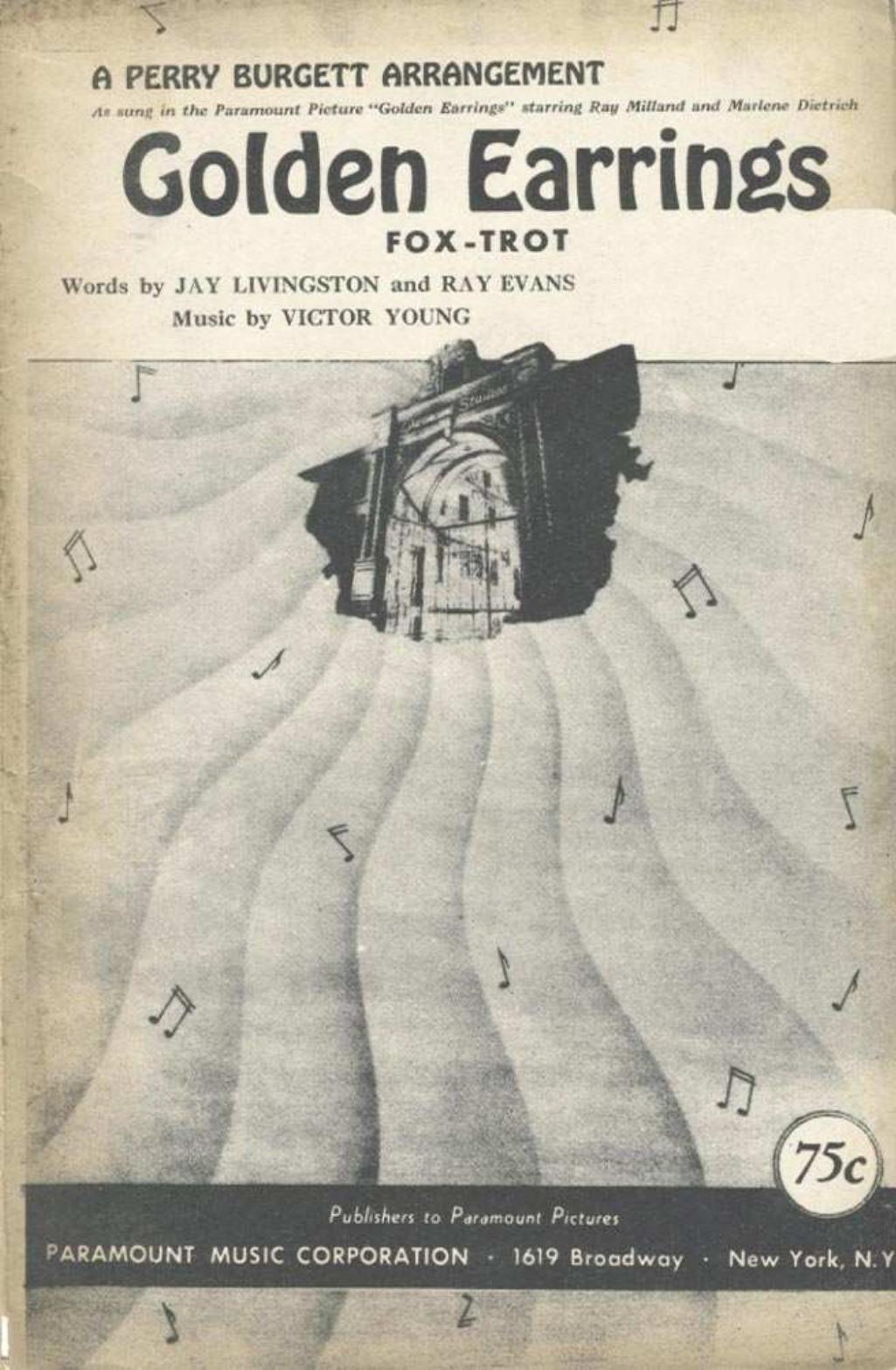
Golden Earrings (P.Burgett) sheet music preview

Golden Earrings (P.Burgett)

Composed by Victor Young

Arranged by P.Burgett

  • Ensemble: Big Band
  • Style: Jazz Standard
  • Pages: 35
  • Instruments (17): 1st Sax. Eb Alto (doubles Bb Clarinet), 2nd Sax. Bb Tenor, 3rd Sax. Eb Alto (doubles Bb Clarinet), 4th Sax. Bb Tenor (doubles Bb Clarinet), Baritone Sax. Eb Alto, 1st Bb Trumpet, 2nd Bb Trumpet, 3rd Bb Trumpet, 1st Trombone, 2nd Trombone, 3rd Trombone, Piano (includes lyrics), Guitar, Bass, Drums, Violins A-B, Violin C
  • Difficulty: medium
  • Content: Individual Parts
  • Format: PDF Download (Instant)
  • Price: $24.99

Victor Young's timeless composition, "Golden Earrings," originally penned in 1947 for the film of the same name, has long captivated audiences with its evocative melody and romantic allure. While the film starred Marlene Dietrich, it was Peggy Lee's iconic 1947 recording that cemented the tune's status as a beloved jazz standard, showcasing its enduring appeal as a lyrical and harmonically rich vehicle for improvisation and arrangement. This piece hails from an era when popular songs frequently crossed over into the jazz repertoire, providing fertile ground for interpreters to explore new harmonic and rhythmic possibilities. Its enduring popularity lies in its memorable theme and its adaptability across various jazz styles, making it a staple in the Great American Songbook. P. Burgett's big band arrangement of "Golden Earrings" transforms this classic into a sophisticated, medium-swing chart, set in the key of C minor, that balances reverence for the original with fresh, contemporary voicings. The arrangement opens with a lush, harmonically rich introduction, immediately establishing a mood of elegant introspection before settling into a relaxed, yet propulsive, 4/4 swing feel. Burgett's signature approach is evident in the artful use of dense, yet clear, saxophone voicings that provide a warm foundation, complemented by brass lines that articulate the melody with precision and warmth. The arrangement skillfully navigates through periods of collective ensemble playing and features a beautifully crafted soli section for the saxophones, showcasing intricate counterpoint and harmonic ingenuity that will challenge and reward a developing section. The arrangement features the melody initially carried by the lead alto saxophone, offering a chance for expressive interpretation, before being passed to other sections, creating dynamic interest. A significant feature is the open solo section, typically over the form, providing ample space for a featured soloist—ideally on tenor saxophone or trombone—to explore the tune's rich harmonic landscape. This section is supported by thoughtfully constructed ensemble backgrounds that build in intensity, culminating in a powerful, yet nuanced, shout chorus that maintains the piece's inherent lyricism while adding a layer of big band grandeur. The technical demands are moderate, focusing more on blend, balance, and expressive phrasing than on extreme ranges or rapid-fire articulation, making it particularly rewarding for bands that prioritize musicality and ensemble cohesion. This arrangement is ideally suited for college-level jazz ensembles, advanced community big bands, or professional groups seeking a sophisticated and engaging addition to their repertoire. Its blend of familiar melody, intelligent arranging, and opportunities for both ensemble precision and individual expression makes it an excellent choice for concert programming or festival performances. The chart offers a fantastic opportunity for developing musicality, focusing on dynamic control, intonation, and the subtle art of swing phrasing, ensuring a deeply satisfying performance for both musicians and audience. Conductors should emphasize a relaxed, yet consistent, medium-swing feel throughout, ensuring the rhythm section lays down a solid, unhurried groove. The opening introduction requires careful attention to blend and intonation within the brass and saxophone sections to achieve its intended lushness. The saxophone soli section, a highlight of the arrangement, demands precise rhythmic articulation and careful balance to allow the inner voices to speak clearly without overpowering the lead. Encourage soloists to embrace the lyrical nature of the tune, focusing on melodic development and harmonic exploration over purely technical display. Dynamics are crucial; ensure the ensemble observes the nuanced crescendos and decrescendos, particularly in the shout chorus, to build and release tension effectively. There are no special techniques like plungers or falls indicated, so the focus should be on clean articulation and expressive phrasing. Rehearsal time should be dedicated to perfecting the ensemble's blend and balance, especially in the harmonically rich passages and the interaction between the brass and saxophone sections. Q: What instruments are included in this arrangement? A: This arrangement is scored for a standard 17-piece big band: Alto Saxophone 1, Alto Saxophone 3, Tenor Saxophone 2, Tenor Saxophone 4, Baritone Saxophone, Trumpets 1-4, Trombones 1-4, Piano, Bass, and Drums. Q: What is the difficulty level of P. Burgett's "Golden Earrings" arrangement? A: This arrangement is rated as medium-advanced, suitable for college-level jazz ensembles, advanced community big bands, or professional groups. It requires good ensemble blend, intonation, and rhythmic precision. Q: What is the musical style and historical context of "Golden Earrings"? A: "Golden Earrings" is a classic jazz standard from the 1940s, originally composed by Victor Young. P. Burgett's arrangement presents it as a sophisticated medium-swing chart, reflecting the lyrical and harmonically rich style prevalent in that era. Q: What makes P. Burgett's arrangement of "Golden Earrings" unique? A: Burgett's arrangement is distinguished by its lush, contemporary voicings, a beautifully crafted saxophone soli section, and a powerful yet nuanced shout chorus. It balances reverence for the original melody with fresh harmonic and rhythmic treatments. Q: What is the typical performance duration and tempo for this arrangement? A: The typical performance duration for this arrangement is approximately 4-5 minutes, depending on the length of the improvised solos. It is intended to be performed at a medium-swing tempo, around 120-130 beats per minute.

Questions and answers

What is included in the Golden Earrings (P.Burgett) PDF?
The verified current file contains individual parts across 35 pages.
How many instruments or parts are listed for Golden Earrings (P.Burgett)?
The verified instrumentation list contains 17 entries for this Big Band arrangement.
Who is credited for Golden Earrings (P.Burgett)?
Composer: Victor Young. Arranger: P.Burgett.
What difficulty is listed for Golden Earrings (P.Burgett)?
The verified difficulty level is medium.
What style is listed for Golden Earrings (P.Burgett)?
The catalog lists the style as Jazz Standard.
Can I preview Golden Earrings (P.Burgett) before buying?
Yes. The product page provides a preview generated from the current PDF file.
How is Golden Earrings (P.Burgett) delivered?
After successful payment, the digital PDF is made available for download. The displayed price is $24.99.

Musicians Also Search For

Golden Earrings P.Burgett PDFGolden Earrings P.Burgett sheet musicGolden Earrings arranged by P.BurgettP.Burgett big band chartsP.Burgett jazz arrangements PDFGolden Earrings Victor Young sheet musicGolden Earrings Victor Young big band arrangementsVictor Young big band chartsGolden Earrings big band arrangementsGolden Earrings big band PDF downloadGolden Earrings jazz sheet musicbig band sheet music downloadGolden Earrings individual parts downloadGolden Earrings sheet music PDFGolden Earrings Jazz Standard chartsJazz Standard big band arrangementsbuy Golden Earrings sheet musicdownload Golden Earrings PDFGolden Earrings jazz chartsbest P.Burgett big band arrangementsVictor Young arranged by P.BurgettGolden Earrings printable sheet musicbig band repertoire PDF

All arrangements by P.Burgett All Victor Young sheet music