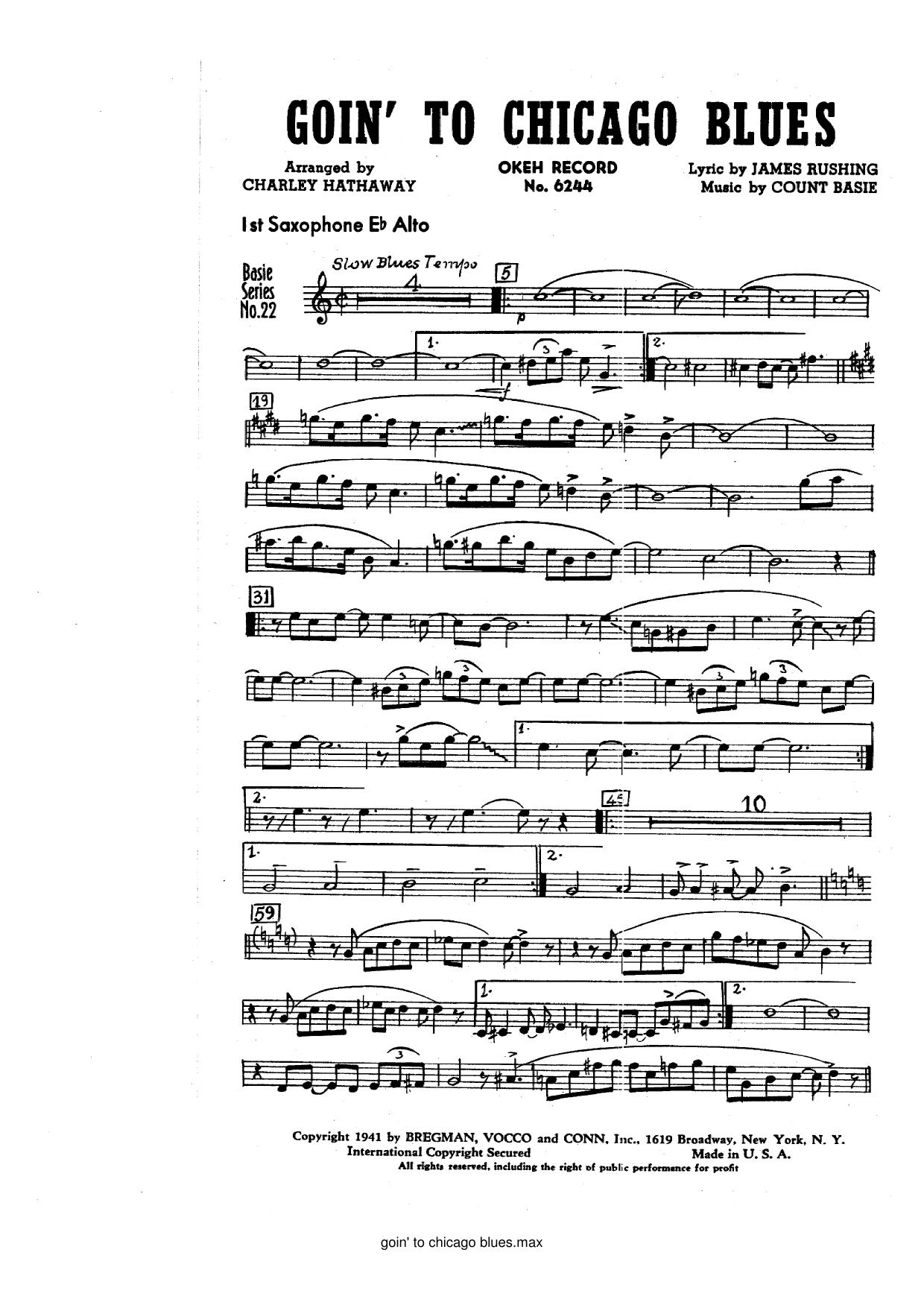
Going To Chicago Blues (C.Hathaway)
Composed by Charles Hathaway
Arranged by Count Basie
- Ensemble: Big Band
- Pages: 20
- Instruments (16): 1st Saxophone Eb Alto, 2nd Saxophone Bb Tenor, 3rd Saxophone Eb Alto, 4th Saxophone Bb Tenor, 5th Saxophone Eb Baritone, 1st Trumpet in Bb, 2nd Trumpet in Bb, 3rd Trumpet in Bb, 1st Trombone, 2nd Trombone, 3rd Trombone, Bass, Drums, 1st Violins, Guitar, Piano
- Difficulty: easy
- Content: Individual Parts
- Format: PDF Download (Instant)
- Price: $24.99
Charles Hathaway’s "Going To Chicago Blues," famously interpreted and recorded by the legendary Count Basie Orchestra, stands as a quintessential pillar of Kansas City swing and mid-century big band literature. Emerging from an era where blues-inflected, riff-driven jazz dominated the national consciousness, this composition captures the raw, unadulterated energy and effortless groove that made the Basie band a global institution. While Count Basie was renowned for letting his rhythm section dictate the weather, Hathaway’s chart provides a masterclass in how tightly knit horn arrangements can elevate a classic 12-bar blues progression into a sophisticated orchestral statement. Grooving at a confident, mid-tempo swing (typically around 120–132 BPM), the arrangement exudes a relaxed yet driving intensity. The mood shifts effortlessly between smoky, late-night Kansas City blues intimacy and explosive, high-spirited ensemble jubilation. The piece opens with the rhythm section establishing that unmistakable, feather-light Basie pulse—where the ride cymbal and piano comping create an irresistible forward momentum. The harmonic language relies heavily on blues-infused minor pentatonics, sharp dominant-seventh extensions, and quintessential Basie-style voicings that prioritize space, dynamic contrast, and crisp articulation over dense, cluttering counterpoint. Count Basie’s signature approach to arranging and interpreting material like this centers on call-and-response dynamics and economic, highly effective writing. Rather than burying the ensemble in relentless sound, Hathaway utilizes lean, punchy horn voicings across the eight instruments, giving individual sections room to breathe. The melody is carried primarily by the alto and tenor saxophones, often locked in tight, harmonized swing solis that demand absolute rhythmic precision and a unified articulation style. The brass instruments—trumpet and trombone—act as dynamic interrupters, punctuating the silence with razor-sharp staccato hits, expressive falls, and blues-drenched bends. A muscular, hard-swinging shout chorus serves as the emotional climax, forcing the entire ensemble to lock together in a display of power, balance, and communal phrasing. Performing this chart requires an advanced high school, collegiate, or professional ensemble that possesses a deep internal clock and an authentic understanding of swing subdivision. Because the instrumentation is streamlined for an 8-instrument ensemble, every player acts as a soloist within the collective; there are no places to hide weak intonation or lagging eighth notes. The primary technical challenges lie in executing the subtle art of the triplet swing feel at a medium tempo—avoiding a stiff, overly mechanical interpretation—and balancing the dynamic range so that the softer, tongue-in-cheek interplay between the piano and horns retains its conversational intimacy before opening up into the roaring ensemble climaxes. Conductors approaching "Going To Chicago Blues" must prioritize the rhythmic integrity of the swing eighth note. Avoid a square, dotted-eighth-and-sixteenth interpretation; the underlying 12/8 feel must remain relaxed, anchored by a steady, unhurried bass line and crisp hi-hat closure on beats two and four. Articulation is paramount: mark all unstressed notes with a gentle legato tongue while treating accented notes with a sharp, Blues-infused punch. The brass section should utilize subtle plunger mutes or gentle cup mutes where appropriate to mimic the vocalized, crying blues traditions of early Kansas City jazz, ensuring that mutes do not sacrifice projection during unison lines. In rehearsal, isolate the rhythm section first to lock in the foundational groove before layering in the horns. Pay close attention to dynamic markings; the transition from whisper-quiet comping to full-ensemble volume must be controlled dynamically rather than forced technically, preserving the effortless "power under the hood" aesthetic that defined the Count Basie sound. Q: What instruments and parts are included in this arrangement? A: This chart is scored for an 8-instrument big band ensemble, featuring dedicated parts for Alto Saxophone, Tenor Saxophone, Trumpet, Trombone, Piano, and rhythm section support spanning a comprehensive 20-page score and parts set. Q: What is the difficulty level of this arrangement? A: This arrangement is ideally suited for advanced high school, collegiate, and professional jazz ensembles due to its demand for tight ensemble intonation, mature swing phrasing, and exposed, uncrowded voicing textures. Q: What style and historical era does this piece represent? A: It represents the classic Kansas City swing style of the 1930s and 1940s, embodying the blues-soaked, riff-driven tradition famously championed by Count Basie and arranged by Charles Hathaway. Q: What makes this particular arrangement unique? A: Unlike dense, modern big band charts, this 8-instrument configuration relies on Basie-esque economy, utilizing sparse, punchy voicings, dynamic call-and-response structures, and driving blues phrasing to maximize impact with a smaller horn section. Q: What is the recommended tempo and performance duration for this piece? A: The arrangement is best performed at a medium-tempo swing of approximately 120 to 132 BPM, resulting in a performance duration of roughly 3 to 4 minutes depending on solo extensions.
Questions and answers
- What is included in the Going To Chicago Blues (C.Hathaway) PDF?
- The verified current file contains individual parts across 20 pages.
- How many instruments or parts are listed for Going To Chicago Blues (C.Hathaway)?
- The verified instrumentation list contains 16 entries for this Big Band arrangement.
- Who is credited for Going To Chicago Blues (C.Hathaway)?
- Composer: Charles Hathaway. Arranger: Count Basie.
- What difficulty is listed for Going To Chicago Blues (C.Hathaway)?
- The verified difficulty level is easy.
- Can I preview Going To Chicago Blues (C.Hathaway) before buying?
- Yes. The product page provides a preview generated from the current PDF file.
- How is Going To Chicago Blues (C.Hathaway) delivered?
- After successful payment, the digital PDF is made available for download. The displayed price is $24.99.
Musicians Also Search For
Going To Chicago Blues Count Basie PDF • Going To Chicago Blues Count Basie sheet music • Going To Chicago Blues arranged by Count Basie • Count Basie big band charts • Count Basie jazz arrangements PDF • Going To Chicago Blues Charles Hathaway sheet music • Going To Chicago Blues Charles Hathaway big band arrangements • Charles Hathaway big band charts • Going To Chicago Blues big band arrangements • Going To Chicago Blues big band PDF download • Going To Chicago Blues jazz sheet music • big band sheet music download • Going To Chicago Blues individual parts download • Going To Chicago Blues sheet music PDF • buy Going To Chicago Blues sheet music • download Going To Chicago Blues PDF • Going To Chicago Blues jazz charts • best Count Basie big band arrangements • Charles Hathaway arranged by Count Basie • Going To Chicago Blues printable sheet music • big band repertoire PDF