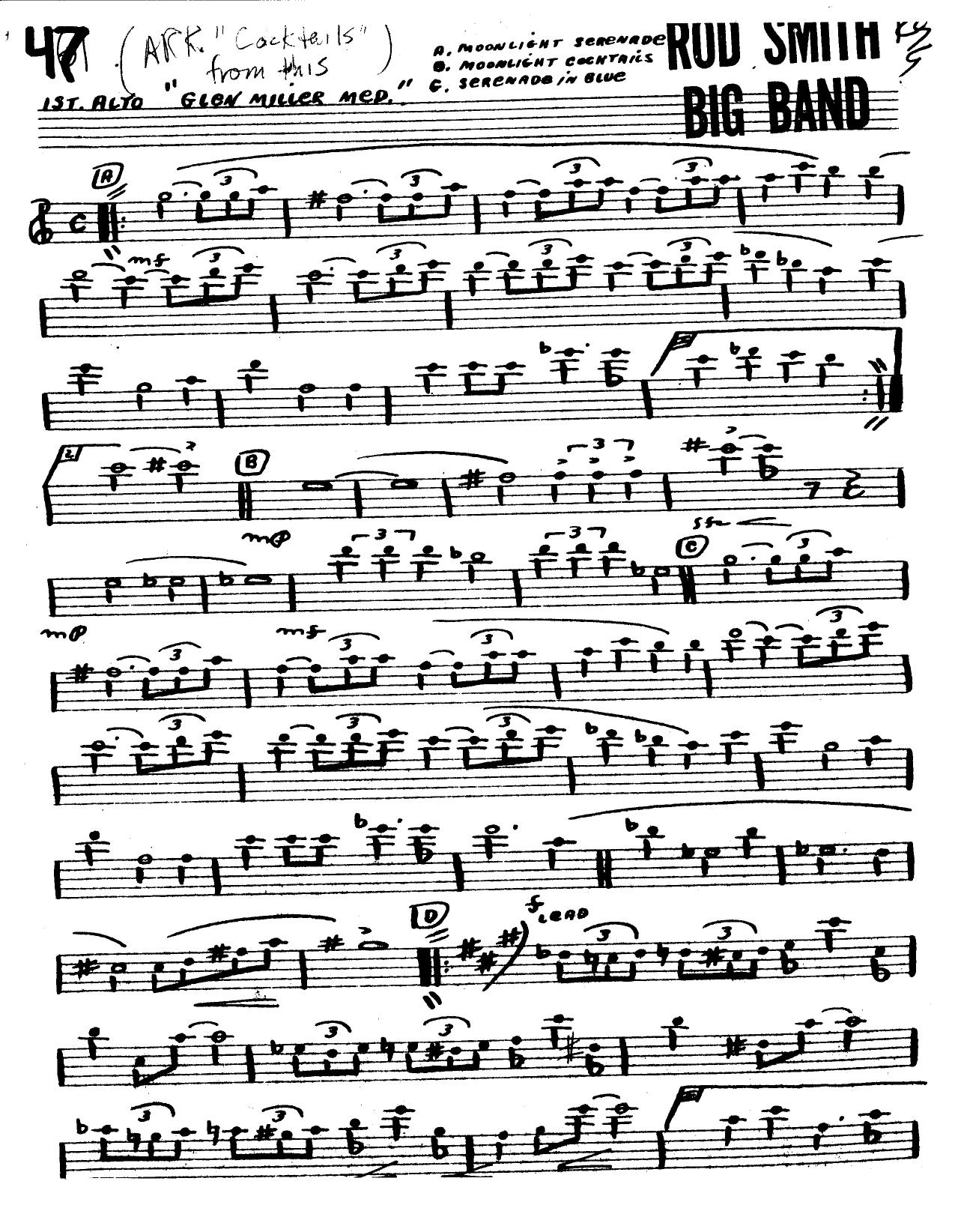
Glenn Miller Medley (G.Miller) sheet music preview

Glenn Miller Medley (G.Miller)

Composed by Various

Arranged by Glen Miller

  • Ensemble: Big Band
  • Pages: 25
  • Instruments (18): 1st Alto Saxophone, 2nd Alto Saxophone, 1st Tenor Saxophone, 2nd Tenor Saxophone, Baritone Saxophone, Clarinet, 1st Trumpet, 2nd Trumpet, 3rd Trumpet, 4th Trumpet, 1st Trombone, 2nd Trombone, 3rd Trombone, 4th Trombone, Piano, Guitar, Bass, Drums
  • Difficulty: medium
  • Content: Individual Parts
  • Format: PDF Download (Instant)
  • Price: $24.99

The unmistakable sonic tapestry of the 1930s and 40s swing era comes alive through the timeless artistry of the Glenn Miller Orchestra, a powerhouse ensemble that defined the soundscape of American popular music during World War II. Masterminded by trombonist and bandleader Glenn Miller, this signature style relies heavily on a distinctive reed voicing technique where the clarinet carries the primary melody an octave above a tenor saxophone, harmonized tightly by three other saxophones. This medley captures the golden age of big band radio broadcasts, glittering ballroom dances, and troop morale tours, synthesizing some of the era's most recognizable motifs into a cohesive, high-energy suite that remains a touchstone of the jazz idiom. Characterized by an infectious medium-to-up-tempo swing feel in 4/4 time, the arrangement radiates nostalgic optimism, sophisticated elegance, and driving rhythmic momentum. The harmonic language is firmly rooted in traditional swing-era jazz, featuring lush seventh and ninth chord voicings, clever chromatic passing tones, and seamless modulations that bridge the distinct themes. The mood shifts effortlessly from sultry, muted brass statements to exuberant, foot-tapping shout choruses that evoke the packed dance floors of the Hotel Pennsylvania or the Paramount Theatre. Every phrase is engineered to swing with precision, demanding an ensemble that can lock into a unified groove without losing its lyrical fluidity. In crafting this medley, Glenn Miller utilizes his trademark orchestral architecture, balancing thick, homophonic block-chord textures with transparent counterpoint. The arrangement showcases classic call-and-response dynamics between the brass and reed sections, utilizing cup and straight mutes to alter timbre and create depth. While the full 25-page score is tailored for a nimble 7-instrument ensemble (Alto Saxophone, Tenor Saxophone, Trumpet, Trombone, Piano, Bass, and Drums), it brilliantly preserves the illusion of a massive 17-piece big band. The scoring cleverly redistributes essential counter-melodies and harmonic pads among the reduced instrumentation, ensuring that the rich, multi-layered aesthetic of the original recordings remains intact. Advanced high school, collegiate, and professional chamber jazz ensembles will find this arrangement an ideal vehicle for developing stylistic authenticity, section blend, and rhythmic articulation. The primary technical challenges lie in executing uniform swing eighth notes at moderate-to-fast tempos, maintaining a light and airy articulation in the reed section, and balancing the dynamic interplay between the rhythm section and the horns. Pianists and bassists must anchor the groove with a steady, driving stride or walking bassline, while horn players must master precise dynamic shaping and controlled vibrato. Performing this medley offers immense artistic rewards, providing musicians and audiences alike with an authentic, exhilarating journey into the heart of big band history. Achieving an authentic swing-era sound with a 7-instrument ensemble requires rigorous attention to stylistic articulation and dynamic balance. The foundational tempo should remain steady, driven by the drummer maintaining a classic ride-cymbal "ding-da-ding" pattern with a crisp hi-hat closure on beats two and four. Horn players must internalize the lifted, triplet-based eighth-note feel, ensuring that upbeats are naturally accented without rushing the beat. Special technical demands include precise use of harmon and cup mutes in the trumpet and trombone sections to replicate the classic 1940s radio broadcast timbre. Pay close attention to dynamic markings during ensemble solis; because the instrumentation is compact, every player must grade their volume carefully to allow inner-voice harmony to project. Rehearsals should initially focus on sectional isolation, getting the saxophones to lock their intonation on the tight, parallel voicings before integrating the rhythm section's harmonic foundation. Q: What specific instruments and parts are included in this 7-instrument arrangement? A: The instrumentation is tailored for a compact yet fully functional big band setup, consisting of Alto Saxophone, Tenor Saxophone, Trumpet, Trombone, Piano, Bass, and Drums, spread across a comprehensive 25-page score and part set. Q: What is the difficulty level of this Glenn Miller medley? A: This arrangement is best suited for advanced high school, collegiate, and professional musicians who possess a strong command of swing articulation, stylistic phrasing, and ensemble blend within a smaller group setting. Q: What musical style and historical era does this piece represent? A: It represents the classic American swing era of the late 1930s and 1940s, capturing the signature sound, harmonic style, and upbeat dance-band energy popularized by Glenn Miller and his orchestra. Q: What makes this particular arrangement unique? A: It successfully condenses the lush, multi-layered textures and iconic section voicings of a 17-piece big band into a tight 7-instrument arrangement without losing the signature Glenn Miller harmonic warmth and driving momentum. Q: What is the expected performance duration and tempo feel of the medley? A: The medley features a predominant medium-to-up-tempo swing feel in 4/4 time, with a typical performance duration of approximately 4 to 5 minutes depending on the chosen tempos and transitions.

Questions and answers

What is included in the Glenn Miller Medley (G.Miller) PDF?
The verified current file contains individual parts across 25 pages.
How many instruments or parts are listed for Glenn Miller Medley (G.Miller)?
The verified instrumentation list contains 18 entries for this Big Band arrangement.
Who is credited for Glenn Miller Medley (G.Miller)?
Composer: Various. Arranger: Glen Miller.
What difficulty is listed for Glenn Miller Medley (G.Miller)?
The verified difficulty level is medium.
Can I preview Glenn Miller Medley (G.Miller) before buying?
Yes. The product page provides a preview generated from the current PDF file.
How is Glenn Miller Medley (G.Miller) delivered?
After successful payment, the digital PDF is made available for download. The displayed price is $24.99.

Musicians Also Search For

Glenn Miller Medley Glen Miller PDFGlenn Miller Medley Glen Miller sheet musicGlenn Miller Medley arranged by Glen MillerGlen Miller big band chartsGlen Miller jazz arrangements PDFGlenn Miller Medley Various sheet musicGlenn Miller Medley Various big band arrangementsVarious big band chartsGlenn Miller Medley big band arrangementsGlenn Miller Medley big band PDF downloadGlenn Miller Medley jazz sheet musicbig band sheet music downloadGlenn Miller Medley individual parts downloadGlenn Miller Medley sheet music PDFbuy Glenn Miller Medley sheet musicdownload Glenn Miller Medley PDFGlenn Miller Medley jazz chartsbest Glen Miller big band arrangementsVarious arranged by Glen MillerGlenn Miller Medley printable sheet musicbig band repertoire PDF

All arrangements by Glen Miller All Various sheet music