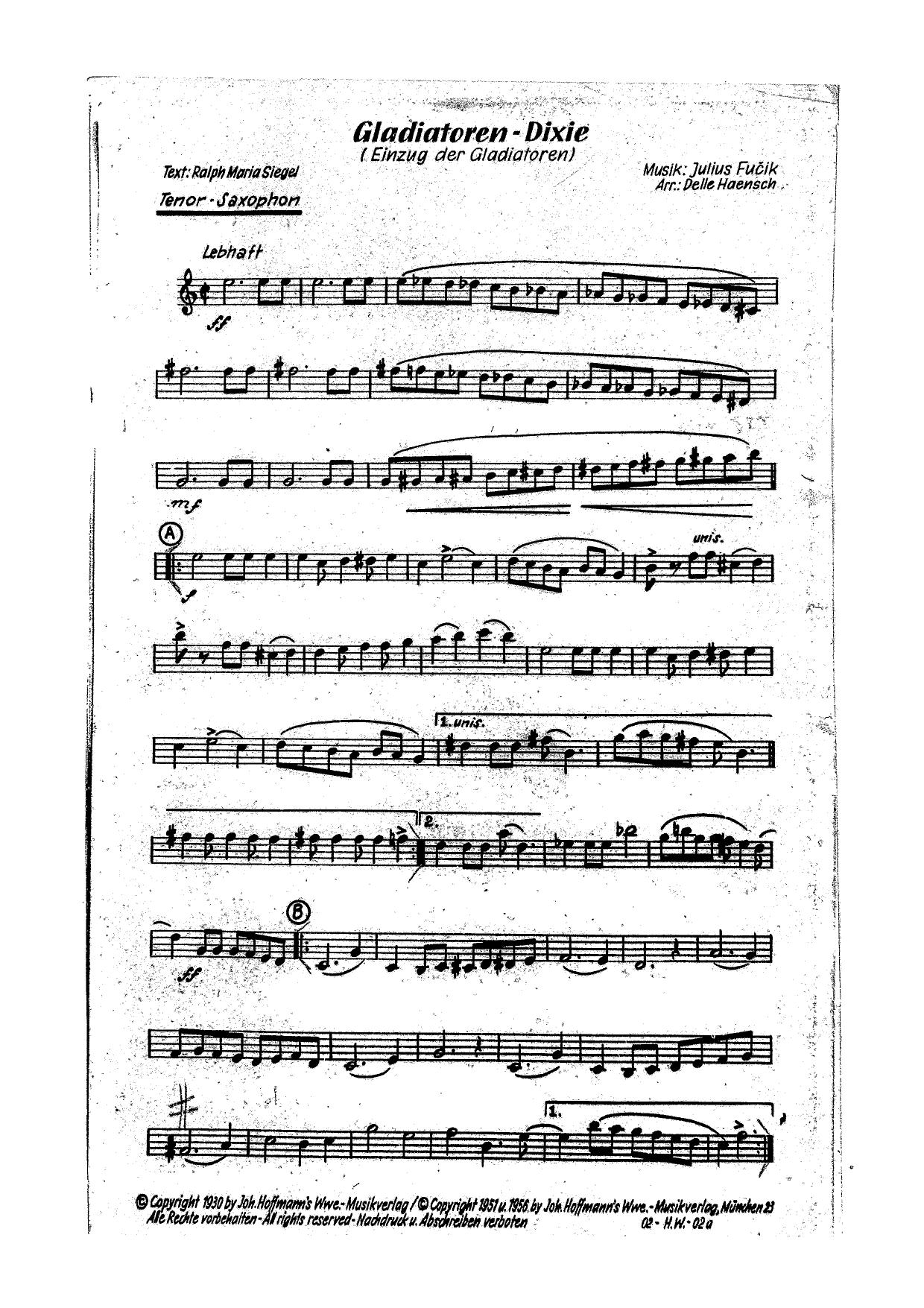
Gladiatoren-Dixie D.Haensch (D.Haensch)
Composed by Julius Fučik
Arranged by Delle Haensch
- Ensemble: Dixieland Band
- Style: Dixieland
- Pages: 15
- Instruments (8): Trompete (Melodie in B), Klarinette, C-Stimme (Dir.) Akkordeon, Bass, Schlagzeug, Gitarre od. Banjo, Tenor-Saxophon, Posaune
- Difficulty: easy
- Content: Individual Parts
- Format: PDF Download (Instant)
- Price: $18.99
Julius Fučik's iconic "Entry of the Gladiators," originally composed in 1897 as a military march, transcended its martial origins to become a global cultural phenomenon, most famously recognized as the quintessential "circus march." While not a jazz standard in its original form, its robust, memorable themes and inherent theatricality have long invited reinterpretation across diverse genres. Delle Haensch's "Gladiatoren-Dixie" masterfully re-imagines this classic through the vibrant, improvisational lens of Dixieland jazz, transporting its grandiosity from the big top to the bustling streets of early 20th-century New Orleans. This arrangement captures the joyful, polyphonic spirit of Dixieland, transforming Fučik's stately 6/8 march into a lively, driving 4/4 romp, typically performed at a bright, up-tempo feel, evoking a celebratory and energetic mood. Delle Haensch's distinctive arranging style for Dixieland is immediately evident in "Gladiatoren-Dixie." Rather than a mere transcription, Haensch has skillfully adapted the original melodic and harmonic contours to suit the unique instrumentation and improvisational interplay of a traditional Dixieland band. The arrangement features the melody prominently in the cornet/trumpet, often supported by clarinet counter-melodies and trombone tailgate lines, creating the characteristic thick, collective improvisation sound. Haensch employs clear, yet flexible, voicings that allow individual instruments to shine while maintaining the ensemble's cohesive sound. Expect a dynamic interplay between the front-line instruments, with opportunities for both unison statements of the main theme and interwoven melodic fragments. The arrangement likely incorporates traditional Dixieland elements such as stop-time breaks, call-and-response figures, and a driving rhythm section foundation that propels the piece forward with infectious energy. Performing "Gladiatoren-Dixie" is a rewarding experience that demands both precision and a sense of playful abandon. The primary melody, initially carried by the cornet, requires a strong, clear lead, while the clarinet part often features intricate, weaving counter-melodies that add harmonic and rhythmic interest. The trombone part provides the foundational "tailgate" slides and rhythmic punctuation essential to the Dixieland sound, requiring good breath support and a flexible embouchure. While specific solo sections are not explicitly dictated in all Dixieland arrangements, the structure inherently encourages improvised breaks or short, featured solos over the established harmonic progression, particularly for the clarinet and cornet. Technical challenges include maintaining a consistent, driving tempo, executing clean articulations in the fast passages, and blending effectively within the polyphonic texture. This arrangement is ideally suited for high school, college, or community Dixieland bands looking to expand their repertoire with a familiar, yet freshly interpreted, classic that is guaranteed to engage both performers and audiences. Its inherent familiarity, coupled with the energetic Dixieland treatment, makes it a highly accessible and enjoyable piece. "Gladiatoren-Dixie" should be approached with a bright, up-tempo feel, typically in the range of quarter note = 180-200 BPM, maintaining a consistent, driving 4/4 swing. The key technical challenge lies in the collective improvisation sections; encourage musicians to listen intently to each other, allowing their parts to interweave without clashing. The cornet/trumpet should lead with confidence, while the clarinet provides agile, flowing counter-melodies. Trombone players should embrace the characteristic "tailgate" slides and glissandi, using them tastefully to punctuate phrases. Articulation should be crisp and light, avoiding heavy accents that can weigh down the Dixieland feel. Rehearsal should focus on establishing a solid rhythmic foundation from the rhythm section, ensuring the bass and banjo/piano provide a steady pulse. Practice the ensemble sections for clarity and balance, then allow space for individual players to experiment with their improvised lines, emphasizing stylistic authenticity and melodic invention within the harmonic framework. Q: What instruments are included in the "Gladiatoren-Dixie D.Haensch" arrangement? A: This arrangement is scored for a standard Dixieland band, typically including Cornet/Trumpet, Clarinet, Trombone, Banjo/Piano, Bass (Tuba or String Bass), and Drums. Specific parts for each of these instruments are provided. Q: What is the difficulty level of this arrangement? A: "Gladiatoren-Dixie D.Haensch" is considered an intermediate-level arrangement. It requires proficient instrumental technique, a solid understanding of Dixieland style, and the ability to contribute to collective improvisation, making it suitable for high school, college, or community Dixieland ensembles. Q: What is the musical style and historical context of this piece? A: This arrangement transforms Julius Fučik's late 19th-century military march "Entry of the Gladiators" into an energetic Dixieland jazz piece. It captures the early 20th-century New Orleans jazz style, characterized by polyphonic collective improvisation and a driving, celebratory feel. Q: What makes Delle Haensch's arrangement of "Gladiatoren-Dixie" unique? A: Delle Haensch's arrangement uniquely reinterprets a classical march as a vibrant Dixieland number, skillfully adapting the original themes for the instrumentation and improvisational nature of the genre. It maintains the recognizable melody while infusing it with authentic Dixieland voicings, rhythmic drive, and opportunities for stylistic interplay. Q: What is the typical performance duration and tempo for this arrangement? A: The typical performance duration for "Gladiatoren-Dixie D.Haensch" is approximately 2-3 minutes, depending on any improvised sections. It is designed to be played at a bright, up-tempo 4/4 swing, generally in the range of quarter note = 180-200 BPM.
Questions and answers
- What is included in the Gladiatoren-Dixie D.Haensch (D.Haensch) PDF?
- The verified current file contains individual parts across 15 pages.
- How many instruments or parts are listed for Gladiatoren-Dixie D.Haensch (D.Haensch)?
- The verified instrumentation list contains 8 entries for this Dixieland Band arrangement.
- Who is credited for Gladiatoren-Dixie D.Haensch (D.Haensch)?
- Composer: Julius Fučik. Arranger: Delle Haensch.
- What difficulty is listed for Gladiatoren-Dixie D.Haensch (D.Haensch)?
- The verified difficulty level is easy.
- What style is listed for Gladiatoren-Dixie D.Haensch (D.Haensch)?
- The catalog lists the style as Dixieland.
- Can I preview Gladiatoren-Dixie D.Haensch (D.Haensch) before buying?
- Yes. The product page provides a preview generated from the current PDF file.
- How is Gladiatoren-Dixie D.Haensch (D.Haensch) delivered?
- After successful payment, the digital PDF is made available for download. The displayed price is $18.99.
Musicians Also Search For
Gladiatoren-Dixie D.Haensch Delle Haensch PDF • Gladiatoren-Dixie D.Haensch Delle Haensch sheet music • Gladiatoren-Dixie D.Haensch arranged by Delle Haensch • Delle Haensch dixieland band charts • Delle Haensch jazz arrangements PDF • Gladiatoren-Dixie D.Haensch Julius Fučik sheet music • Gladiatoren-Dixie D.Haensch Julius Fučik dixieland band arrangements • Julius Fučik dixieland band charts • Gladiatoren-Dixie D.Haensch dixieland band arrangements • Gladiatoren-Dixie D.Haensch dixieland band PDF download • Gladiatoren-Dixie D.Haensch jazz sheet music • dixieland band sheet music download • Gladiatoren-Dixie D.Haensch individual parts download • Gladiatoren-Dixie D.Haensch sheet music PDF • Gladiatoren-Dixie D.Haensch Dixieland charts • Dixieland dixieland band arrangements • buy Gladiatoren-Dixie D.Haensch sheet music • download Gladiatoren-Dixie D.Haensch PDF • Gladiatoren-Dixie D.Haensch jazz charts • best Delle Haensch dixieland band arrangements • Julius Fučik arranged by Delle Haensch • Gladiatoren-Dixie D.Haensch printable sheet music • dixieland band repertoire PDF