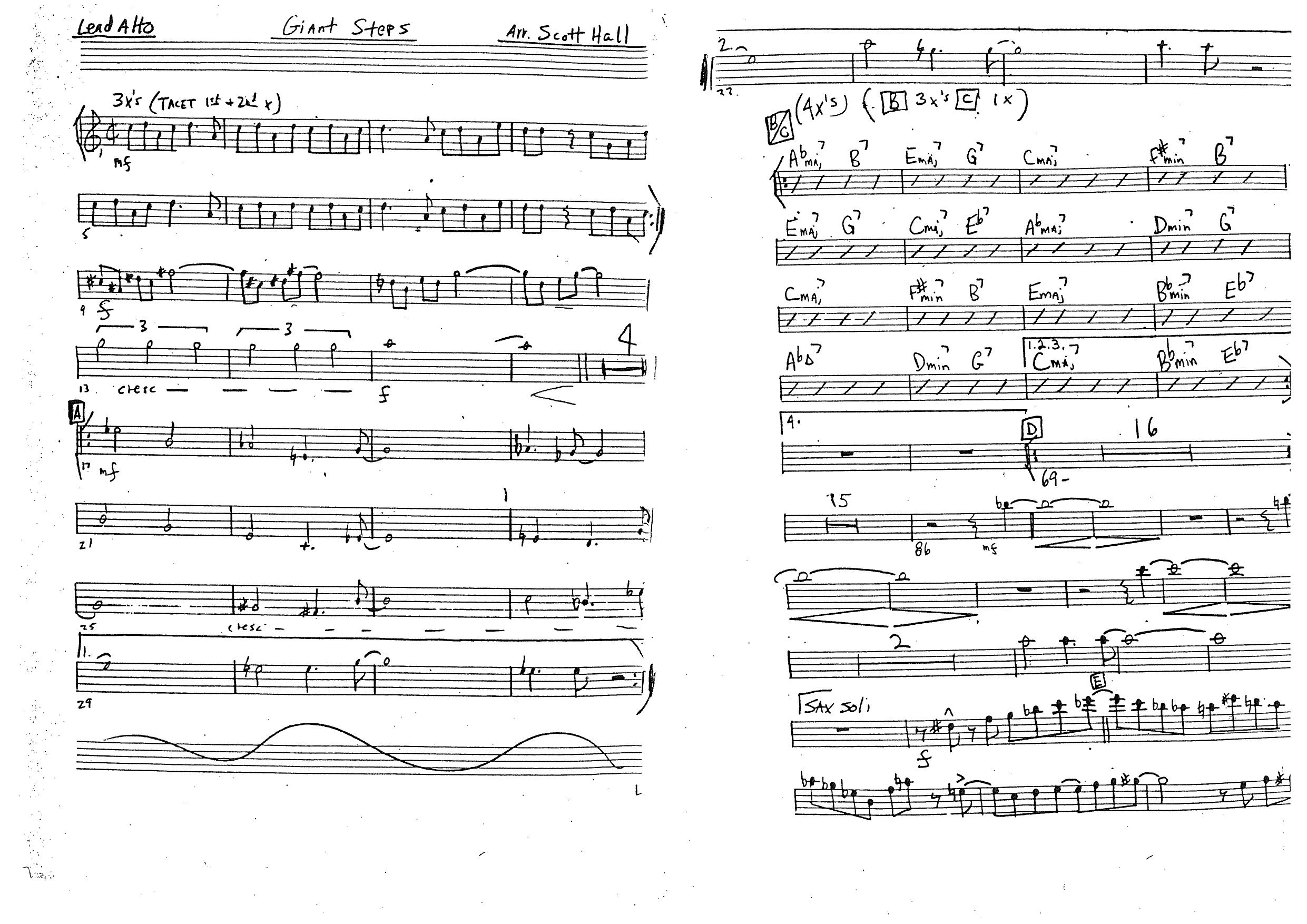
Giant Steps (S.Hall) sheet music preview

Giant Steps (S.Hall)

Composed by John Coltrane

Arranged by S.Hall

  • Ensemble: Big Band
  • Style: Jazz Standard
  • Pages: 34
  • Instruments (17): Lead Alto Saxophone, 2nd Alto Saxophone, Lead Tenor Saxophone, 2nd Tenor Saxophone, Baritone Saxophone, Trumpet 1, Trumpet 2, Trumpet 3, Trumpet 4, Lead Trombone, 2nd Trombone, 3rd Trombone, Bass Trombone, Drums, Bass, Piano, Guitar
  • Difficulty: medium
  • Content: Individual Parts
  • Format: PDF Download (Instant)
  • Price: $24.99

John Coltrane's "Giant Steps," first recorded in 1959 and released in 1960, stands as a monumental achievement in jazz history, marking a pivotal moment in the evolution of harmonic complexity. This iconic composition, featured on Coltrane's debut album as a leader for Atlantic Records, is celebrated for its groundbreaking "Coltrane changes"—a relentless, rapid-fire harmonic progression that navigates through three distantly related major keys (B major, G major, and E♭ major) connected by major third intervals. Often described as an "harmonic obstacle course," its intricate structure and blistering tempo have made it a rite of passage for improvisers and a benchmark for technical virtuosity in jazz. The piece encapsulates the innovative spirit of late 1950s bebop and hard bop, pushing the boundaries of improvisation and composition beyond traditional diatonicism. Its influence is so profound that it was added to the Library of Congress's National Recording Registry in 2004. S. Hall’s big band arrangement of "Giant Steps" reimagines this challenging standard for a full 16-instrument ensemble, delivering an electrifying up-tempo bebop experience. The arrangement maintains the original's frantic energy and harmonic density, presenting it within a rich, orchestral framework. Hall's distinctive approach often involves sophisticated voicings that enhance the inherent tension and release of Coltrane's changes, utilizing extended harmonies to color the rapid modulations. Expect intricate soli sections for the saxophones and brass, demanding precision and blend from all players. The musical character is one of exhilarating intensity, a high-stakes journey through a labyrinth of sound that evokes both intellectual fascination and visceral excitement. The arrangement is primarily in a fast swing feel, propelling the listener through Coltrane's revolutionary harmonic landscape. This arrangement features the melody initially carried by the lead alto saxophone, with subsequent statements woven throughout the ensemble, often in tight, powerful unison or harmonized lines. Featured solos are typically designated for tenor saxophone and trumpet, providing ample opportunity for advanced improvisers to navigate the demanding "Coltrane changes" within a big band context. Technical challenges abound, including rapid scale passages, complex rhythmic figures, and the sheer speed at which harmonic shifts occur. The rewarding aspect of performing this piece lies in the collective achievement of mastering its intricacies and delivering a cohesive, high-energy performance that honors the original's groundbreaking spirit. Specific musical moments that stand out include the tightly orchestrated shout choruses, where the full power of the big band is unleashed, and the clever reharmonizations that add a fresh dimension to a familiar, yet formidable, classic. Given its technical demands and harmonic complexity, this arrangement is most suitable for advanced high school, collegiate, community, and professional big bands. Bands with a strong rhythm section, experienced lead players, and improvisers comfortable with advanced harmonic concepts will find this piece both challenging and incredibly rewarding. It serves as an excellent vehicle for developing ensemble precision, advanced sight-reading skills, and individual improvisational prowess over one of jazz's most iconic and demanding forms. Approaching S. Hall's "Giant Steps" requires meticulous attention to detail and a commitment to rhythmic precision. The primary technical challenge lies in navigating the rapid "Coltrane changes" at an up-tempo bebop swing feel, often exceeding quarter note = 260 BPM. Conductors should emphasize clear articulation, particularly in the brass and saxophone soli sections, to ensure harmonic clarity amidst the dense voicings. Rehearsal tips include isolating challenging harmonic progressions for individual sections, using slower tempos for initial practice, and gradually increasing speed. Soloists must be proficient in improvising over "Coltrane changes," focusing on arpeggios and scale fragments that outline the rapidly shifting tonal centers. There are no special techniques like plunger mutes or doits explicitly required, but dynamic contrasts and precise cut-offs are crucial for shaping the energetic flow of the piece. Encourage the rhythm section to provide a driving, yet flexible, foundation, particularly the drummer in maintaining a consistent, propulsive swing pattern. Q: What instruments and parts are included in this arrangement? A: This big band arrangement includes parts for 16 instruments: Lead Alto Saxophone, 2nd Alto Saxophone, Lead Tenor Saxophone, 2nd Tenor Saxophone, Baritone Saxophone, 4 Trumpets, 4 Trombones, Piano, Bass, Drums, and Guitar. Q: What is the difficulty level of this arrangement? A: This arrangement is considered advanced, suitable for experienced high school, collegiate, community, and professional big bands due to its demanding harmonic progressions, rapid tempo, and intricate ensemble passages. Q: What is the musical style and historical context of "Giant Steps"? A: "Giant Steps" is a jazz standard composed by John Coltrane in 1959, representing the hard bop era. It is famous for its "Coltrane changes," a revolutionary harmonic progression that rapidly modulates through distantly related keys. Q: What makes S. Hall's arrangement of "Giant Steps" unique? A: S. Hall's arrangement provides a full big band treatment of Coltrane's challenging composition, featuring sophisticated voicings, intricate soli sections, and powerful shout choruses that reimagine the original's harmonic complexity within an orchestral jazz setting. Q: What is the typical performance duration and tempo for this arrangement? A: The typical performance duration for this arrangement is approximately 4-6 minutes, maintaining an up-tempo bebop swing feel, often around quarter note = 260 BPM, consistent with the original recording's energetic pace.

Questions and answers

What is included in the Giant Steps (S.Hall) PDF?
The verified current file contains individual parts across 34 pages.
How many instruments or parts are listed for Giant Steps (S.Hall)?
The verified instrumentation list contains 17 entries for this Big Band arrangement.
Who is credited for Giant Steps (S.Hall)?
Composer: John Coltrane. Arranger: S.Hall.
What difficulty is listed for Giant Steps (S.Hall)?
The verified difficulty level is medium.
What style is listed for Giant Steps (S.Hall)?
The catalog lists the style as Jazz Standard.
Can I preview Giant Steps (S.Hall) before buying?
Yes. The product page provides a preview generated from the current PDF file.
How is Giant Steps (S.Hall) delivered?
After successful payment, the digital PDF is made available for download. The displayed price is $24.99.

Musicians Also Search For

Giant Steps S.Hall PDFGiant Steps S.Hall sheet musicGiant Steps arranged by S.HallS.Hall big band chartsS.Hall jazz arrangements PDFGiant Steps John Coltrane sheet musicGiant Steps John Coltrane big band arrangementsJohn Coltrane big band chartsGiant Steps big band arrangementsGiant Steps big band PDF downloadGiant Steps jazz sheet musicbig band sheet music downloadGiant Steps individual parts downloadGiant Steps sheet music PDFGiant Steps Jazz Standard chartsJazz Standard big band arrangementsbuy Giant Steps sheet musicdownload Giant Steps PDFGiant Steps jazz chartsbest S.Hall big band arrangementsJohn Coltrane arranged by S.HallGiant Steps printable sheet musicbig band repertoire PDF

All arrangements by S.Hall All John Coltrane sheet music