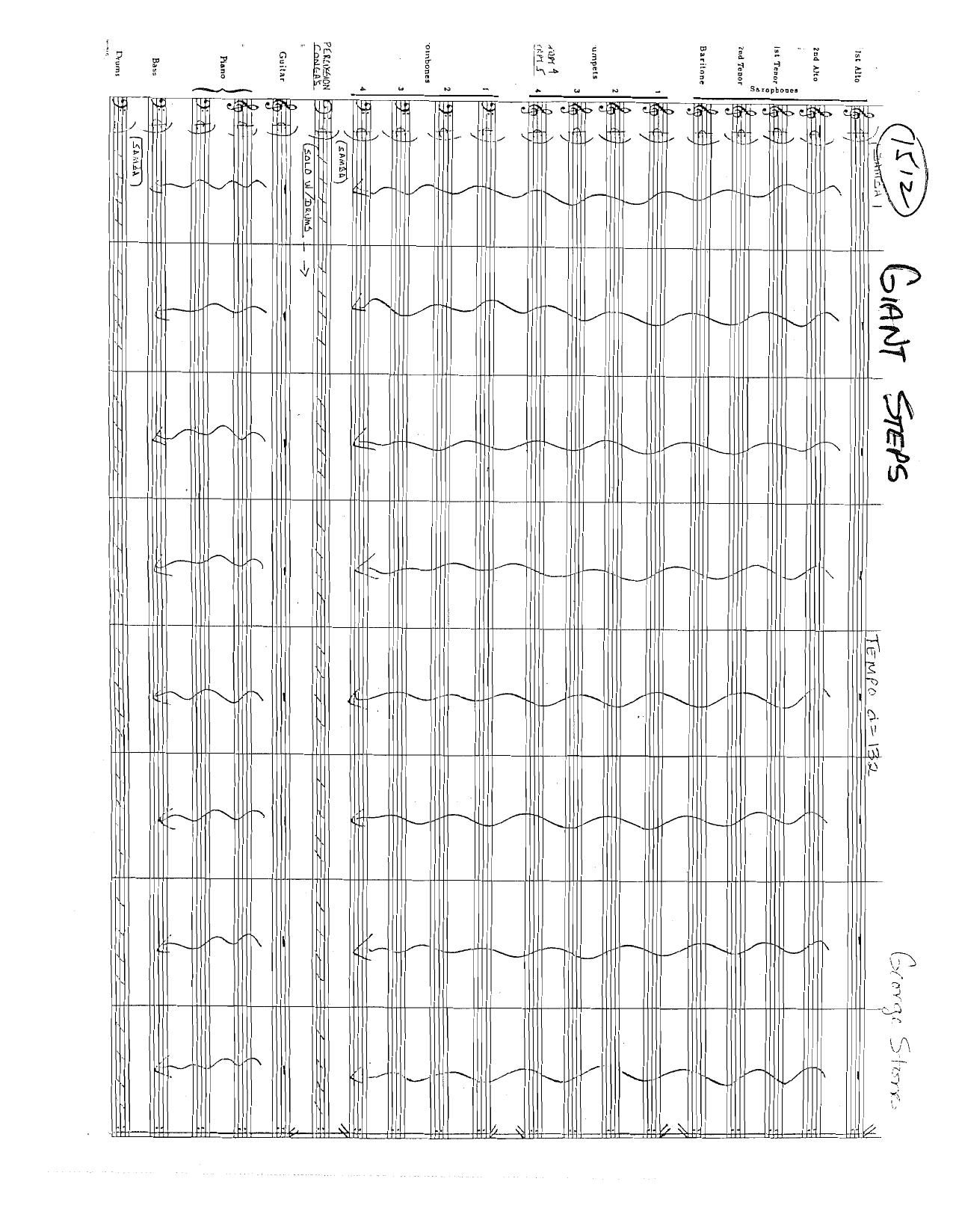
Giant Steps (G.Stone)
Composed by John Coltrane
Arranged by George Stone
- Ensemble: Big Band
- Pages: 100
- Instruments (19): 1st Alto Sax, 2nd Alto Sax, 1st Tenor Sax, 2nd Tenor Sax, Baritone Sax, 1st Trumpet, 2nd Trumpet, 3rd Trumpet, 4th Trumpet, 5th Trumpet, 1st Trombone, 2nd Trombone, 3rd Trombone, 4th Trombone, Guitar, Piano, Bass, Drums, Percussion
- Difficulty: advanced
- Content: Individual Parts
- Format: PDF Download (Instant)
- Price: $24.99
John Coltrane permanently altered the landscape of modern jazz with the 1960 release of "Giant Steps," the title track from his landmark Atlantic Records album. Representing the pinnacle of hard bop and the genesis of modal and advanced harmonic exploration, the composition is universally celebrated for its relentless, rapidly shifting chord progressions—colloquially known as "Coltrane changes." This iconic blueprint forces improvisers to navigate three distinct tonal centers moving in major thirds around the circle of fifths, establishing it as one of the ultimate rite-of-passage compositions in the jazz canon. Master arranger George Stone takes this notoriously labyrinthine harmonic obstacle course and reimagines it as an adrenaline-fueled, high-octane big band tour de force. Blasting off at a relentless up-tempo swing feel, the arrangement trades Coltrane’s original modal-leaning linear focus for dense, kaleidoscopic brass voicings and intricate woodwind counterpoint. The mood is exhilarating, urgent, and fiercely driving, evoking the electric atmosphere of a late-night modal workout pushed to its absolute technical limit. Stone constructs an intricate architecture of sound where tension and release are magnified exponentially through the sheer mass of a 19-piece ensemble. Rather than treating the melody as a mere unison head, Stone distributes the iconic motif across interlocking saxophone and brass sections, creating a cascading texture that highlights the cyclical nature of the changes. The arrangement features sweeping soli passages that demand absolute rhythmic precision and articulation discipline from the entire reed section. A monumental shout chorus serves as the structural climax, building layer upon layer of complex, extended harmonies before resolving into a high-velocity trading sequence. Featured solo space allows advanced improvisers to stretch out over the form, making the chart an incredible showcase for a fearless tenor saxophone or trumpet soloist. Advanced collegiate, professional, and elite top-tier community big bands will find this chart an exhilarating addition to their repertoire. Because of the blistering tempo and the sheer cognitive load required to execute Stone's sophisticated re-harmonizations and counterlines, the ensemble must possess superior sight-reading capabilities, impeccable internal time, and deep familiarity with fast-swing phrasing. Performing this arrangement offers an unmatched reward: it transforms a notoriously intimidating harmonic puzzle into a visceral, collective triumph of modern orchestral jazz execution. Navigating George Stone's arrangement of "Giant Steps" demands exceptional technical facility and acute collective listening from the entire ensemble. The primary challenge lies in maintaining a rock-solid, driving up-tempo swing feel without allowing the tempo to rush during the rapid harmonic modulations. Conductors should ensure the rhythm section—particularly the ride cymbal and walking bass—maintains an unyielding pulse that anchors the dense brass and reed textures. The woodwind section must approach the intricate soli lines with light, articulate tongue strokes, ensuring that every rapid-fire accidental speaks clearly. Brass players should practice their upper-register punches with controlled volume, avoiding brute force so the complex extended chords remain transparent and balanced. Rehearsals should initially be broken down at a fraction of the performance tempo, isolating the shifting tonal centers measure by measure until the ensemble’s collective ear adjusts to Stone’s radical harmonic trajectory. Pay careful attention to dynamic markings; contrasting the whisper-quiet backgrounds with explosive ensemble tuttis is the key to making this complex chart swing with undeniable authority. Q: What instruments and parts are included in this publication? A: This 100-page publication includes a full conductor score and complete parts for a standard 19-instrument big band lineup, consisting of 5 saxophones (2 altos, 2 tenors, 1 baritone), 4 trumpets, 4 trombones, and a 4-piece rhythm section (piano, bass, drums, guitar). Q: What is the difficulty level of this specific arrangement? A: This arrangement is graded as advanced/professional, making it best suited for elite university jazz orchestras, professional big bands, and top-tier community ensembles with highly skilled improvisers and rhythm section players. Q: How does this arrangement fit into the historical context of jazz? A: It takes John Coltrane's legendary 1960 hard bop composition—famous for introducing "Coltrane changes"—and translates its notoriously complex harmonic structure into a massive, contemporary big band format. Q: What makes George Stone's arrangement unique? A: Stone brilliantly reimagines a small-group masterpiece by utilizing dense, kaleidoscopic brass voicings, intricate woodwind counterpoint, and a monumental shout chorus that modernizes the original harmonic framework for a 19-piece ensemble. Q: What is the performance tempo and duration of the piece? A: Designed for an up-tempo, driving swing feel, the piece moves at a blistering pace typical of advanced bebop performance, resulting in a standard concert duration of approximately 5 to 6 minutes depending on soloist extensions.
Questions and answers
- What is included in the Giant Steps (G.Stone) PDF?
- The verified current file contains a conductor score and individual parts across 100 pages.
- How many instruments or parts are listed for Giant Steps (G.Stone)?
- The verified instrumentation list contains 19 entries for this Big Band arrangement.
- Who is credited for Giant Steps (G.Stone)?
- Composer: John Coltrane. Arranger: George Stone.
- What difficulty is listed for Giant Steps (G.Stone)?
- The verified difficulty level is advanced.
- Can I preview Giant Steps (G.Stone) before buying?
- Yes. The product page provides a preview generated from the current PDF file.
- How is Giant Steps (G.Stone) delivered?
- After successful payment, the digital PDF is made available for download. The displayed price is $24.99.
Musicians Also Search For
Giant Steps George Stone PDF • Giant Steps George Stone sheet music • Giant Steps arranged by George Stone • George Stone big band charts • George Stone jazz arrangements PDF • Giant Steps John Coltrane sheet music • Giant Steps John Coltrane big band arrangements • John Coltrane big band charts • Giant Steps big band arrangements • Giant Steps big band PDF download • Giant Steps jazz sheet music • big band sheet music download • Giant Steps conductor score PDF • Giant Steps individual parts download • Giant Steps sheet music PDF • buy Giant Steps sheet music • download Giant Steps PDF • Giant Steps jazz charts • best George Stone big band arrangements • John Coltrane arranged by George Stone • Giant Steps printable sheet music • big band repertoire PDF