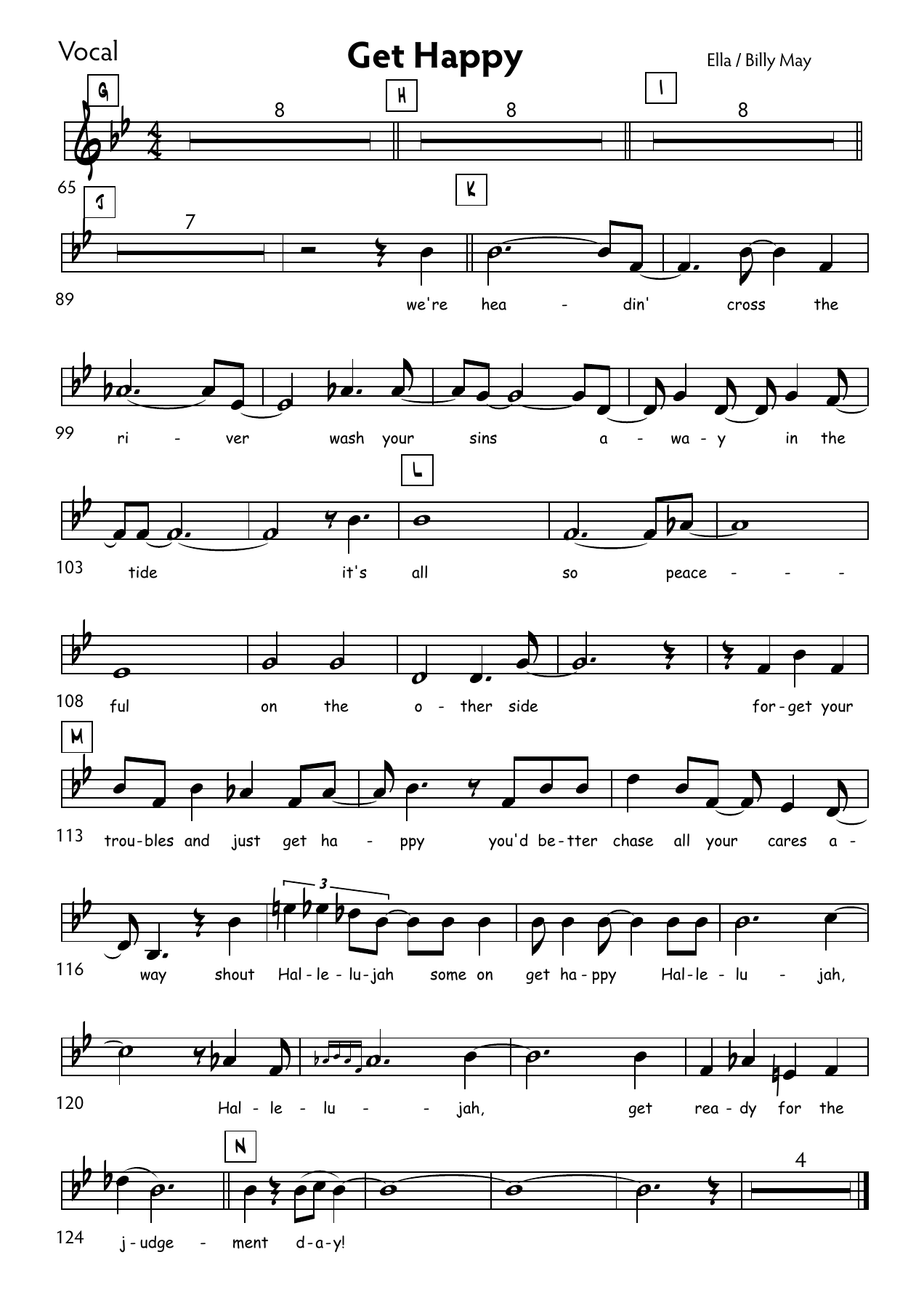
Get Happy (B.May -M.Collins) sheet music preview

Get Happy (B.May -M.Collins)

Composed by Harold Arlen

Arranged by B.May -M.Collins

  • Ensemble: Big Band
  • Style: Jazz Standard
  • Pages: 67
  • Instruments (18): Vocal, Alto Saxophone 1, Alto Saxophone 2, Tenor Saxophone 1, Tenor Saxophone 2, Baritone Saxophone, Trumpet 1, Trumpet 2, Trumpet 3, Trumpet 4, Trombone 1, Trombone 2, Trombone 3, Trombone 4, Guitar, Piano, Bass, Drum Set
  • Difficulty: advanced
  • Content: Individual Parts
  • Format: PDF Download (Instant)
  • Price: $24.99

Harold Arlen and Ted Koehler’s timeless composition, "Get Happy," first enchanted audiences in 1930 as part of the musical revue *The Nine-Fifteen Revue*. While initially a stage number, it was Judy Garland's iconic, spirited rendition in the 1950 film *Summer Stock* that cemented its status as an enduring American standard. This piece represents the vibrant, optimistic spirit of the American Songbook, evolving from its Broadway roots into a beloved jazz vehicle. Its memorable melody and uplifting harmonic progression have made it a staple for countless vocalists and instrumentalists, embodying a classic swing era feel while offering ample room for improvisation and reinterpretation. This big band arrangement by B.May and M.Collins transforms "Get Happy" into a dynamic, up-tempo swing showcase, set firmly in the key of F Major. The overall mood is exhilarating and celebratory, designed to inject high energy into any performance. From the initial crisp ensemble figures, the arrangement establishes a driving, medium-fast swing feel (around 180-200 BPM) that propels the piece forward with relentless enthusiasm. The orchestrators have skillfully woven together the familiar melodic contours with sophisticated big band textures, ensuring that the piece retains its classic appeal while offering fresh, contemporary voicings. B.May and M.Collins approach this standard with a keen understanding of both traditional big band aesthetics and modern harmonic sensibilities. Their signature techniques are evident in the tight, often intricate soli sections for the saxophones, which feature close voicings that demand precision and blend. The brass sections are given powerful, punctuated figures, building tension and excitement, particularly leading into the climactic shout chorus. The arrangement strategically places the melody, initially presented by the full ensemble, then handed off to a featured trumpet soloist for a lyrical, yet energetic, interpretation. This leads into an open solo section over the standard changes, providing ample space for improvisation for both tenor saxophone and trumpet, allowing soloists to stretch out over the familiar harmonic landscape. Performing this arrangement is a rewarding experience for a well-rehearsed ensemble. Technical challenges include the rapid articulation required in the saxophone soli passages and the precise rhythmic drive needed from the entire rhythm section to maintain the energetic tempo. The powerful brass hits in the shout chorus demand strong breath support and confident attacks. A particularly standout musical moment is the dynamic interplay between the brass and saxophones during the final ensemble chorus, culminating in a powerful, definitive ending. This arrangement is ideally suited for college-level jazz ensembles, advanced community big bands, and professional groups seeking a vibrant, well-crafted swing chart that pays homage to a classic while offering a fresh, exciting performance experience. This arrangement demands a consistent, driving medium-fast swing feel, ideally between 180-200 BPM. The rhythm section must establish a strong, unwavering pulse from the outset. Key technical challenges include the precise articulation and blend required in the saxophone soli passages; encourage saxophones to practice these sections slowly to ensure rhythmic accuracy and unified phrasing. Brass players should focus on clear attacks and releases, particularly in the punctuated ensemble figures and the powerful shout chorus, ensuring excellent intonation on sustained chords. Soloists (Tenor Saxophone, Trumpet) should approach their improvisations with a balance of melodic invention and rhythmic drive, maintaining the overall energetic character. Rehearsal time should be dedicated to balancing the dynamic contrasts, from the initial ensemble statements to the powerful full-band climaxes, using dynamics to shape the narrative of the piece. Q: What instruments and parts are included in this arrangement? A: This big band arrangement includes parts for 17 instruments: Alto Saxophone 1, Alto Saxophone 2, Tenor Saxophone 1, Tenor Saxophone 2, Baritone Saxophone, Trumpet 1, Trumpet 2, Trumpet 3, Trumpet 4, Trombone 1, Trombone 2, Trombone 3, Bass Trombone, Piano, Bass, Drums, and Guitar. Q: What is the difficulty level of this arrangement? A: This arrangement is rated as advanced intermediate to advanced, making it suitable for college-level jazz ensembles, advanced community big bands, and professional groups due to its demanding soli sections, energetic tempo, and intricate ensemble writing. Q: What musical style and historical context does this arrangement represent? A: This arrangement is an up-tempo big band jazz standard, based on Harold Arlen's iconic 1930 composition. It embodies the vibrant, optimistic swing era feel, reimagined with contemporary big band voicings and arrangements by B.May and M.Collins. Q: What makes this specific arrangement of "Get Happy" unique? A: B.May and M.Collins' arrangement stands out for its sophisticated saxophone soli voicings, powerful brass sections, and dynamic shout chorus. It features a compelling interplay between ensemble sections and open solo opportunities for both tenor saxophone and trumpet, offering a fresh take on a beloved classic. Q: What is the typical performance duration and recommended tempo for this piece? A: The typical performance duration for this arrangement is approximately 3-4 minutes, depending on the length of the improvised solos. It is designed to be performed at a medium-fast swing tempo, ideally between 180-200 BPM, to capture its intended energetic and celebratory mood.

Musicians Also Search For

Get Happy B.May -M.Collins PDFGet Happy B.May -M.Collins sheet musicGet Happy arranged by B.May -M.CollinsB.May -M.Collins big band chartsB.May -M.Collins jazz arrangements PDFGet Happy Harold Arlen sheet musicGet Happy Harold Arlen big band arrangementHarold Arlen big band chartsGet Happy big band arrangementGet Happy big band PDF downloadGet Happy jazz ensemble sheet musicbig band sheet music instant downloadGet Happy conductor score PDFGet Happy individual parts downloadGet Happy sheet music with partsGet Happy Jazz Standard chartJazz Standard big band arrangementsbuy Get Happy sheet music onlinedownload Get Happy PDFGet Happy jazz chartbest B.May -M.Collins big band arrangementsHarold Arlen songs arranged by B.May -M.CollinsGet Happy printable sheet musicbig band repertoire PDF

All arrangements by B.May -M.Collins All Harold Arlen sheet music