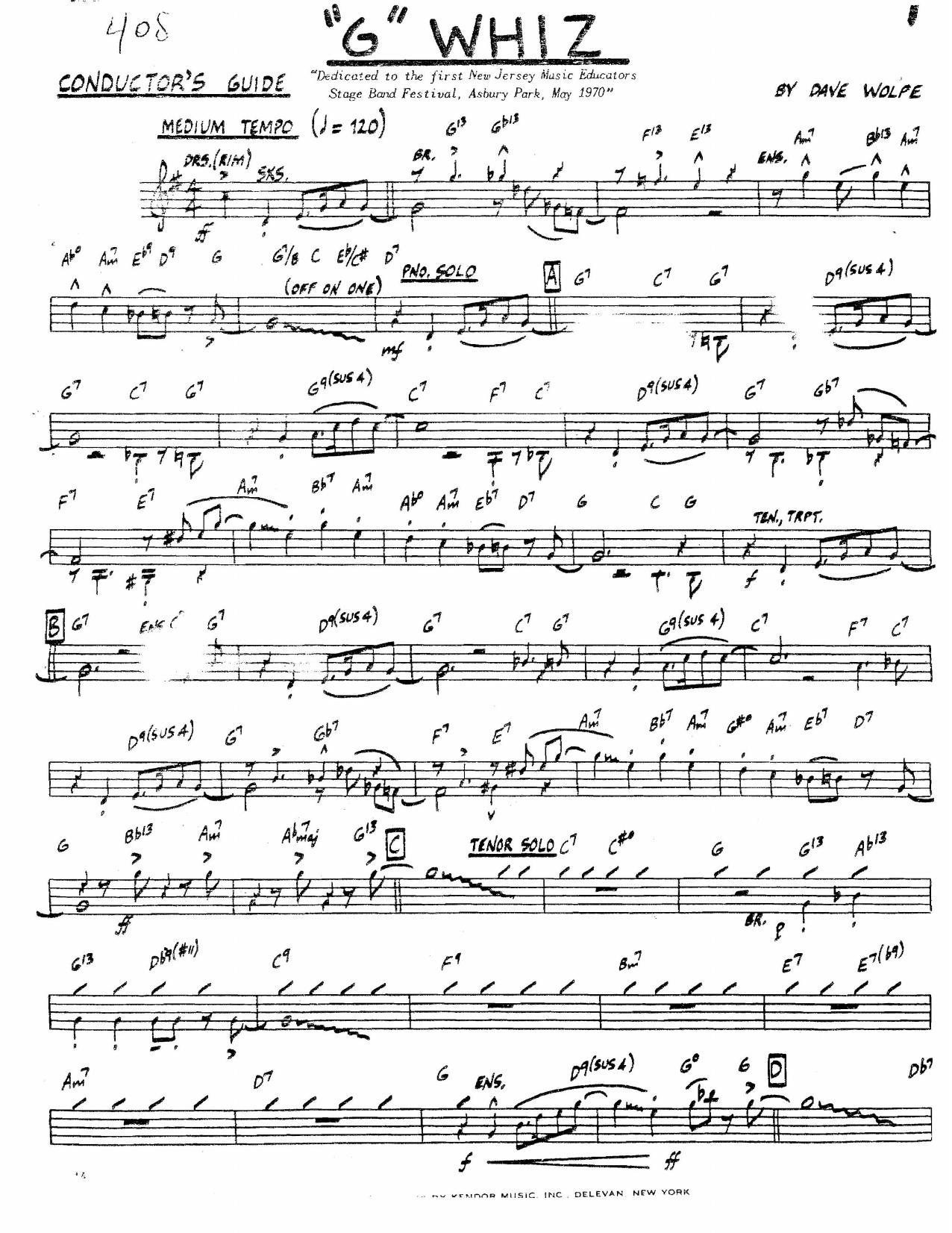
G Whiz (D.Wolpe)
Composed by Dave Wolpe
Arranged by Dave Wolpe
- Ensemble: Big Band
- Pages: 34
- Instruments (17): 1st Eb Alto Saxophone, 3rd Eb Alto Saxophone, 2nd Bb Tenor Saxophone, 4th Bb Tenor Saxophone, 5th Eb Baritone Saxophone, 1st Bb Trumpet, 2nd Bb Trumpet, 3rd Bb Trumpet, 4th Bb Trumpet, 1st Trombone, 2nd Trombone, 3rd Trombone, 4th Trombone, Piano, Bass, Drums, Guitar
- Difficulty: medium
- Content: Individual Parts
- Format: PDF Download (Instant)
- Price: $24.99
"G Whiz," composed and arranged by the prolific jazz educator and writer Dave Wolpe, stands as a quintessential showcase of modern big band writing rooted in the swinging tradition of the mid-20th century. Written during an era when contemporary big band charts sought to balance accessible pedagogical value with authentic, driving swing vernacular, Wolpe’s original composition captures the buoyant, high-octane energy of classic Count Basie and Buddy Rich style charts. It represents a vital bridge between traditional swing-era arrangement techniques and the polished demands of modern educational and professional jazz ensembles, offering a masterclass in dynamic contrast, rhythmic drive, and economical yet rich harmonic scoring. From the opening downbeat, the chart establishes an infectious, medium-up swing groove characterized by crisp articulation, tightly wound brass punches, and a relentless walking bass line feel. The harmonic language is built upon a sturdy blues-infused framework laced with sophisticated extended dominant chords, secondary dominants, and clever chromatic passing tones that keep both the performers and listeners engaged. Wolpe’s arrangement style is celebrated for its clarity; rather than muddying the texture with over-orchestration, he utilizes the full 18-piece big band apparatus with surgical precision. The saxophone section enjoys lush, harmonized solis that echo the classic traditions of the Bebop and post-Swing eras, while the brass section alternates between warm, muted pads and razor-sharp, high-energy shout choruses that drive the momentum forward. Throughout the arrangement, the melodic weight is shared democratically across the ensemble, though the woodwinds frequently carry the initial thematic statements before handing off the energy to the brasses. Featured solo space allows instrumentalists to stretch out over standard changes, fostering genuine improvisational growth within a structured, high-impact framework. Technically, the chart demands precise ensemble phasing, nimble fingerwork in the woodwind section for rapid bebop-inflected lines, and dependable range control for the lead trumpet and trombone players. The payoff is an exhilarating performance vehicle that builds inexorably toward a thrilling, full-ensemble climax. Advanced high school, collegiate, and community big bands will find "G Whiz" to be an ideal centerpiece for festival programs or seasonal concert sets. It offers enough technical and stylistic rigor to challenge developing musicians while rewarding advanced groups with ample room for interpretive nuance, stylistic authenticity, and unbridled swing execution. Achieving an authentic performance of "G Whiz" requires strict adherence to traditional swing articulation: eighth notes must be swung unevenly, with an intentional emphasis on the upbeats, particularly in tempos hovering around medium-up. Conductors should ensure that the rhythm section locks in immediately; the drummer's ride cymbal and the bassist's quarter-note pulse form the engine of the chart, and dragging must be actively avoided during transitional dynamic shifts. Pay close attention to the dynamic markings leading into the shout chorus—subtle underplaying in the mezzo-piano sections will maximize the impact of the final fortissimo peaks. Section leaders should unify their phrasing, ensuring that all stylistic devices, such as short accents, falls, and doits, are executed with identical length and placement across the entire section. Rehearsal time is best spent isolating the rhythm section to cement the groove before introducing the horn lines, allowing the ensemble to internalize the infectious forward momentum unique to Wolpe’s writing style. Q: What instruments and parts are included in this arrangement? A: This complete 18-instrument big band arrangement includes a full Conductor's Score, standard rhythm section parts (piano, bass, drum set, guitar), five saxophones (Alto 1, Alto 3, Tenor 2, Tenor 4, plus baritone or alternate configurations), four trumpets, and four trombones, spanning 34 pages of comprehensive scoring. Q: What is the difficulty level of this arrangement? A: "G Whiz" is graded as an advanced-intermediate to advanced chart, making it exceptionally well-suited for top-tier high school jazz ensembles, university bands, and professional community big bands looking for a substantive swing challenge. Q: What is the musical style and historical context of the piece? A: Written by Dave Wolpe, the piece is styled in the classic medium-up swing tradition, heavily influenced by the powerhouse big band writing of the Basie and Buddy Rich libraries while maintaining a modern educational framework. Q: What makes this Dave Wolpe arrangement unique? A: The arrangement is distinguished by Wolpe's signature transparent orchestration, which balances dense, harmonized saxophone solis with razor-sharp brass shout choruses without ever cluttering the texture or muddying the groove. Q: What is the performance tempo and approximate duration? A: "G Whiz" is designed to be performed at a bright, driving medium-up swing tempo (approximately quarter note = 160–172 BPM), yielding an energetic performance duration of roughly 3 to 4 minutes depending on solo rotations.
Questions and answers
- What is included in the G Whiz (D.Wolpe) PDF?
- The verified current file contains a conductor score and individual parts across 34 pages.
- How many instruments or parts are listed for G Whiz (D.Wolpe)?
- The verified instrumentation list contains 17 entries for this Big Band arrangement.
- Who is credited for G Whiz (D.Wolpe)?
- Composer: Dave Wolpe. Arranger: Dave Wolpe.
- What difficulty is listed for G Whiz (D.Wolpe)?
- The verified difficulty level is medium.
- Can I preview G Whiz (D.Wolpe) before buying?
- Yes. The product page provides a preview generated from the current PDF file.
- How is G Whiz (D.Wolpe) delivered?
- After successful payment, the digital PDF is made available for download. The displayed price is $24.99.
Musicians Also Search For
G Whiz Dave Wolpe PDF • G Whiz Dave Wolpe sheet music • G Whiz arranged by Dave Wolpe • Dave Wolpe big band charts • Dave Wolpe jazz arrangements PDF • G Whiz Dave Wolpe big band arrangements • G Whiz big band arrangements • G Whiz big band PDF download • G Whiz jazz sheet music • big band sheet music download • G Whiz conductor score PDF • G Whiz individual parts download • G Whiz sheet music PDF • buy G Whiz sheet music • download G Whiz PDF • G Whiz jazz charts • best Dave Wolpe big band arrangements • G Whiz printable sheet music • big band repertoire PDF