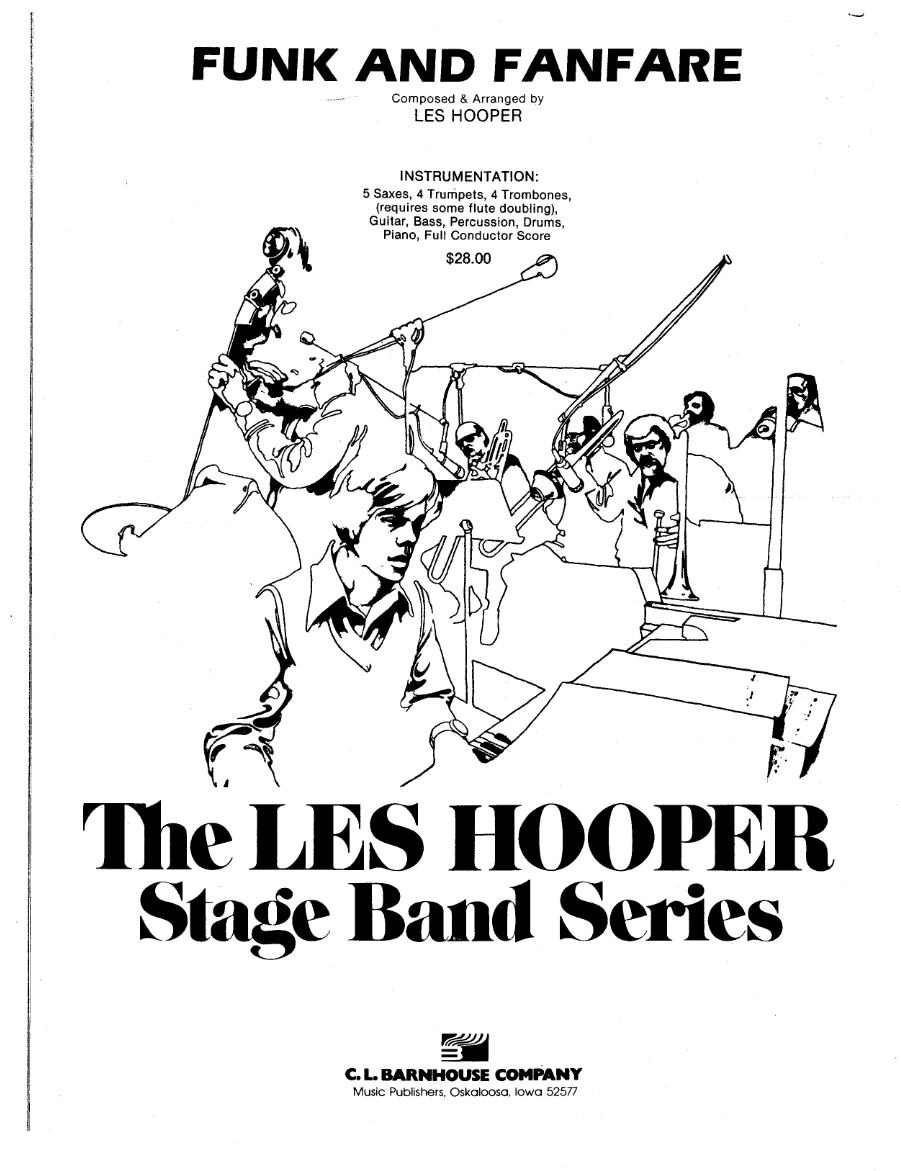
Funk And Fanfare (L.Hooper) sheet music preview

Funk And Fanfare (L.Hooper)

Composed by Les Hooper

Arranged by Les Hooper

  • Ensemble: Big Band
  • Pages: 63
  • Instruments (18): 1st Eb Alto Saxophone (doubles Flute), 2nd Eb Alto Saxophone (doubles Flute), 1st Bb Tenor Saxophone, 2nd Bb Tenor Saxophone, Eb Baritone Saxophone, 1st Bb Trumpet, 2nd Bb Trumpet, 3rd Bb Trumpet, 4th Bb Trumpet, 1st Trombone, 2nd Trombone, 3rd Trombone, 4th Trombone, Guitar, Piano, Bass, Drums, Percussion
  • Difficulty: advanced
  • Content: Individual Parts
  • Format: PDF Download (Instant)
  • Price: $24.99

Master composer and arranger Les Hooper carved out an unmistakable niche in modern big band jazz by fusing intricate, contemporary harmonies with infectious, high-energy grooves. Emerging from the vibrant studio and jazz education scenes of the late 20th century, Hooper’s writing style bridges the gap between sophisticated, West Coast-influenced compositional depth and the driving, visceral pulse of funk and fusion. "Funk And Fanfare" stands as a premier example of this stylistic synthesis, originally crafted to showcase the precision, dynamic range, and rhythmic agility of elite contemporary big bands. Rather than relying on standard blues forms, Hooper constructs a sophisticated architectural landscape where majestic, brass-heavy fanfare statements collide head-on with driving, syncopated funk ostinatos. Musically, the work operates on a canvas of high contrast and electrifying energy. Driven by an assertive, punchy groove in 4/4 time, the piece opens with regal, heraldic brass declarations before abruptly pivoting into a relentless, funk-infused rhythmic vamp. The harmonic language is rich with extended and altered chords—featuring sharp-9s, flat-13s, and stacked quartal voicings—that create a dense, modern soundscape. The mood shifts fluidly between triumphant, widescreen grandeur and gritty, street-level intensity. This duality keeps both the performers and the audience on edge, evoking a sense of cinematic propulsion that rarely lets up from the downbeat of the first chart to the final suspended chord. Hooper’s signature arranging hand is instantly recognizable in the meticulous craftsmanship of the ensemble writing. The chart features tightly interlocked woodwind solis, blistering brass counterlines, and a thoroughly developed shout chorus that systematically builds tension through rhythmic displacement and dynamic swelling. Rather than treating the rhythm section as mere accompaniment, Hooper weaves the bass and drum patterns into the core thematic material, demanding absolute telepathic cohesion between the rhythm players and the horns. Featured solo space allows improvisers to stretch out over modern modal and altered chord changes, providing a vital showcase for advanced soloists who thrive in fusion and contemporary jazz contexts. Advanced college ensembles, top-tier high school bands, and professional repertory jazz orchestras will find this expansive 63-page, 9-instrument arrangement to be an exhilarating vehicle. The technical demands are significant, requiring stellar sight-reading capabilities, immaculate section articulation, and a mature grasp of modern rhythmic subdivision. Horn players must navigate rapid-fire unison lines and wide dynamic shifts, while the rhythm section must anchor the groove with unwavering authority. Performing "Funk And Fanfare" rewards the ensemble with a masterclass in dynamic contrast, collective precision, and contemporary big band bravura, making it a show-stopping centerpiece for any ambitious concert program. Conductors approaching "Funk And Fanfare" must prioritize ultra-precise articulation and rhythmic lockdown, particularly within the rhythm section. The groove must remain relentless yet relaxed; avoid rushing the syncopated figures by ensuring the sixteenth-note subdivisions are felt internally. Brass players should treat the opening fanfare statements with a regal, open tone, contrasting sharply with the tight, clipped, and aggressive articulation required during the funk vamp sections. Pay close attention to dynamic markings—subito pianos and sudden crescendos are essential to selling Hooper’s cinematic tension-and-release design. Saxophones must blend meticulously during the intricate soli passages, ensuring that internal voice leadings remain audible beneath the lead alto. Rehearsals should begin slowly at a reduced tempo to lock in complex ensemble figures and odd-meter accents before ramping up to the performance tempo. Encourage the rhythm section to experiment with dynamic accompaniment textures behind the soloists while maintaining the unyielding funk pulse. Q: What instruments and parts are included in this 63-page arrangement? A: This arrangement is scored for a 9-instrument ensemble configuration, specifically featuring parts for Alto Saxophone, Tenor Saxophone, Baritone Saxophone, Trumpet, and Trombone, alongside a comprehensive rhythm section score. Q: What is the difficulty level of "Funk And Fanfare"? A: This piece is graded as advanced, making it best suited for college jazz orchestras, advanced high school bands, and professional ensembles capable of handling complex modern harmonies and rapid syncopation. Q: What are the primary musical style and historical roots of this composition? A: Composed by Les Hooper, the piece blends contemporary big band jazz with high-energy funk and fusion grooves, representing the sophisticated, studio-driven writing style characteristic of late 20th-century progressive jazz. Q: What makes this Les Hooper arrangement unique compared to standard big band charts? A: It uniquely juxtaposes regal, heraldic brass fanfares with gritty, syncopated funk ostinatos, utilizing extended jazz harmonies, dense quartal voicings, and tightly interlocked horn solis. Q: What is the approximate performance duration and tempo feel of the piece? A: While performance time can vary based on solo lengths, the arrangement is built around an energetic, driving up-tempo funk groove in 4/4 time designed to sustain high momentum from start to finish.

Questions and answers

What is included in the Funk And Fanfare (L.Hooper) PDF?
The verified current file contains a conductor score and individual parts across 63 pages.
How many instruments or parts are listed for Funk And Fanfare (L.Hooper)?
The verified instrumentation list contains 18 entries for this Big Band arrangement.
Who is credited for Funk And Fanfare (L.Hooper)?
Composer: Les Hooper. Arranger: Les Hooper.
What difficulty is listed for Funk And Fanfare (L.Hooper)?
The verified difficulty level is advanced.
Can I preview Funk And Fanfare (L.Hooper) before buying?
Yes. The product page provides a preview generated from the current PDF file.
How is Funk And Fanfare (L.Hooper) delivered?
After successful payment, the digital PDF is made available for download. The displayed price is $24.99.

Musicians Also Search For

Funk And Fanfare Les Hooper PDFFunk And Fanfare Les Hooper sheet musicFunk And Fanfare arranged by Les HooperLes Hooper big band chartsLes Hooper jazz arrangements PDFFunk And Fanfare Les Hooper big band arrangementsFunk And Fanfare big band arrangementsFunk And Fanfare big band PDF downloadFunk And Fanfare jazz sheet musicbig band sheet music downloadFunk And Fanfare conductor score PDFFunk And Fanfare individual parts downloadFunk And Fanfare sheet music PDFbuy Funk And Fanfare sheet musicdownload Funk And Fanfare PDFFunk And Fanfare jazz chartsbest Les Hooper big band arrangementsFunk And Fanfare printable sheet musicbig band repertoire PDF

All arrangements by Les Hooper All Les Hooper sheet music