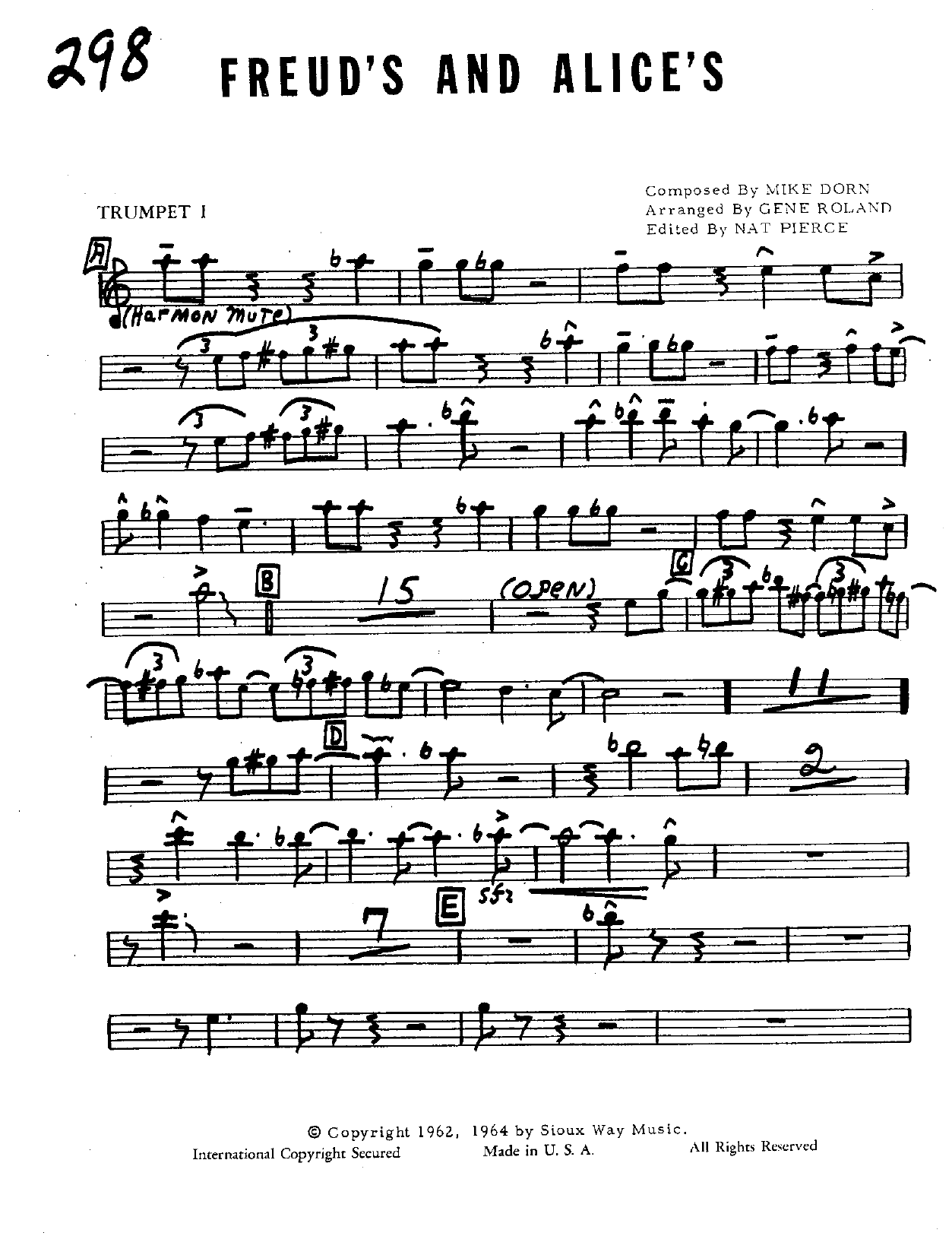
Freud's And Alices (G.Roland)
Composed by Gene Roland
Arranged by G.Roland
- Ensemble: Big Band
- Pages: 36
- Instruments (17): Trumpet I, Trumpet II, Trumpet III, Trumpet IV, Trumpet V, Tenor Sax I, Tenor Sax II, Tenor Sax III, Baritone, Trombone I, Trombone II, Trombone III, Trombone IV, Guitar, Drums, Piano, Bass
- Difficulty: medium
- Content: individual parts only
- Format: PDF Download (Instant)
- Price: $24.99
Rooted in the rich tapestry of modal exploration and avant-garde jazz sensibilities, "Freud's And Alices" reimagines traditional melodic motifs through a sophisticated, contemporary big band lens. While the underlying thematic material draws from timeless folk idioms, arranger G.Roland transforms these familiar contours into a labyrinthine psychological journey—echoing the surrealist dreamscapes implied by the title. Emerging from the post-bop and contemporary European jazz traditions, this composition bridges the gap between structured harmonic rigor and uninhibited improvisational expression, making it a captivating departure from standard swing-era repertoire. Stylistically, the arrangement thrives on an unpredictable medium-up groove that fluctuates between driving straight-eighth modal vamps and loose, organic swing feels. The harmonic language is dense and iridescent, characterized by extended chord structures, polychords, and shifting metric pulses that create an atmosphere of intellectual curiosity and restless energy. G.Roland utilizes the 17-piece big band not merely as a block-voicing machine, but as a textural palette; shimmering muted trumpet textures contrast sharply with low-register trombone clusters and cascading woodwind counterlines. The emotional arc moves from an initial state of calculated introspection to a cathartic, high-octane shout chorus that demands absolute precision and rhythmic agility from every section. G.Roland’s signature approach is immediately evident in the intricate interplay between the rhythm section and the horn tiers, avoiding predictable call-and-response in favor of overlapping melodic layers. The chart opens with a moody, rubato preamble before settling into a persistent, hypnotic ostinato carried by the rhythm section. Throughout the 36-page score, the lead trumpet navigates demanding upper-register lines, while the saxophones are treated to a dense, harmonically labyrinthine soli section that recalls the sophistication of modern jazz composition masters. Featured open solo spaces are provided for tenor saxophone and piano, allowing soloists to stretch out over challenging modal changes that reward both linear bop vocabulary and outside-the-changes exploration. Advanced college ensembles, top-tier high school jazz orchestras, and professional big bands will find "Freud's And Alices" to be a deeply rewarding centerpiece for festival programs or contemporary concert sets. The technical demands—ranging from complex syncopated figures and wide dynamic shifts to intricate ensemble unisons—require a mature rhythm section and strong section leaders who can anchor shifting metric modulations. Directors seeking to push their band's stylistic boundaries beyond standard blues and rhythm changes will discover that G.Roland's masterful orchestration provides an unforgettable vehicle for advanced musical growth. Navigating G.Roland’s "Freud's And Alices" requires meticulous attention to articulation, balance, and rhythmic exactitude. The primary technical hurdle lies in the execution of asymmetrical phrase lengths and rapid shifting between straight-eighth and swung subdivisions; conductors should insist that the rhythm section maintains an unwavering anchor during metric transitions. At a recommended tempo of around quarter note = 184, the brass must approach high-register passages with controlled resonance rather than brute force, ensuring that complex extended voicings remain transparent. Trumpets should utilize cup and harmon mutes precisely as indicated to achieve the requisite modern textural contrast, paying close attention to intonation on altered dominant chords. Rehearsals should begin section by section, isolating the dense woodwind counter-melodies and ensuring the low brass and bass trombone lock in tightly with the drum set's ride cymbal and displaced accents. Balance is critical during the climactic shout chorus; horns must dynamically support the lead voices while maintaining a clean, aggressive articulation on staccato figures. Q: What instruments and parts are included in this big band arrangement? A: The 36-page score and parts package is scored for a standard 17-instrument big band lineup, featuring 5 trumpets, 4 trombones, 5 saxophones (with standard double woodwind or doubling specifications where applicable), and a full rhythm section comprising piano, guitar, bass, and drums. Q: What is the difficulty level of "Freud's And Alices"? A: This arrangement is graded as advanced (Level 4.5/5), making it best suited for accomplished university ensembles, advanced youth jazz orchestras, and professional big bands capable of handling complex harmonies and shifting metric feels. Q: What is the musical style and historical context of the piece? A: The arrangement is set in a contemporary post-bop and modal jazz style, composed and arranged by G.Roland to bridge traditional folk thematic material with modern avant-garde big band orchestration techniques. Q: What makes G.Roland's arrangement unique compared to standard big band charts? A: It stands out through its psychological, dreamlike narrative structure, utilizing dense extended harmonies, shifting rhythmic feels, sophisticated saxophone solis, and non-traditional texture pairings that avoid predictable swing-era clichés. Q: What is the approximate performance duration and tempo of the piece? A: The arrangement runs for approximately 6 to 7 minutes and is anchored around a driving medium-up tempo of quarter note = 184, complete with rubato introductory sections and open solo spaces.
Questions and answers
- What is included in the Freud's And Alices (G.Roland) PDF?
- The verified current file contains individual parts across 36 pages.
- How many instruments or parts are listed for Freud's And Alices (G.Roland)?
- The verified instrumentation list contains 17 entries for this Big Band arrangement.
- Who is credited for Freud's And Alices (G.Roland)?
- Composer: Gene Roland. Arranger: G.Roland.
- What difficulty is listed for Freud's And Alices (G.Roland)?
- The verified difficulty level is medium.
- Can I preview Freud's And Alices (G.Roland) before buying?
- Yes. The product page provides a preview generated from the current PDF file.
- How is Freud's And Alices (G.Roland) delivered?
- After successful payment, the digital PDF is made available for download. The displayed price is $24.99.
Musicians Also Search For
Freud's And Alices G.Roland PDF • Freud's And Alices G.Roland sheet music • Freud's And Alices arranged by G.Roland • G.Roland big band charts • G.Roland jazz arrangements PDF • Freud's And Alices Gene Roland sheet music • Freud's And Alices Gene Roland big band arrangements • Gene Roland big band charts • Freud's And Alices big band arrangements • Freud's And Alices big band PDF download • Freud's And Alices jazz sheet music • big band sheet music download • Freud's And Alices individual parts download • Freud's And Alices sheet music PDF • buy Freud's And Alices sheet music • download Freud's And Alices PDF • Freud's And Alices jazz charts • best G.Roland big band arrangements • Gene Roland arranged by G.Roland • Freud's And Alices printable sheet music • big band repertoire PDF