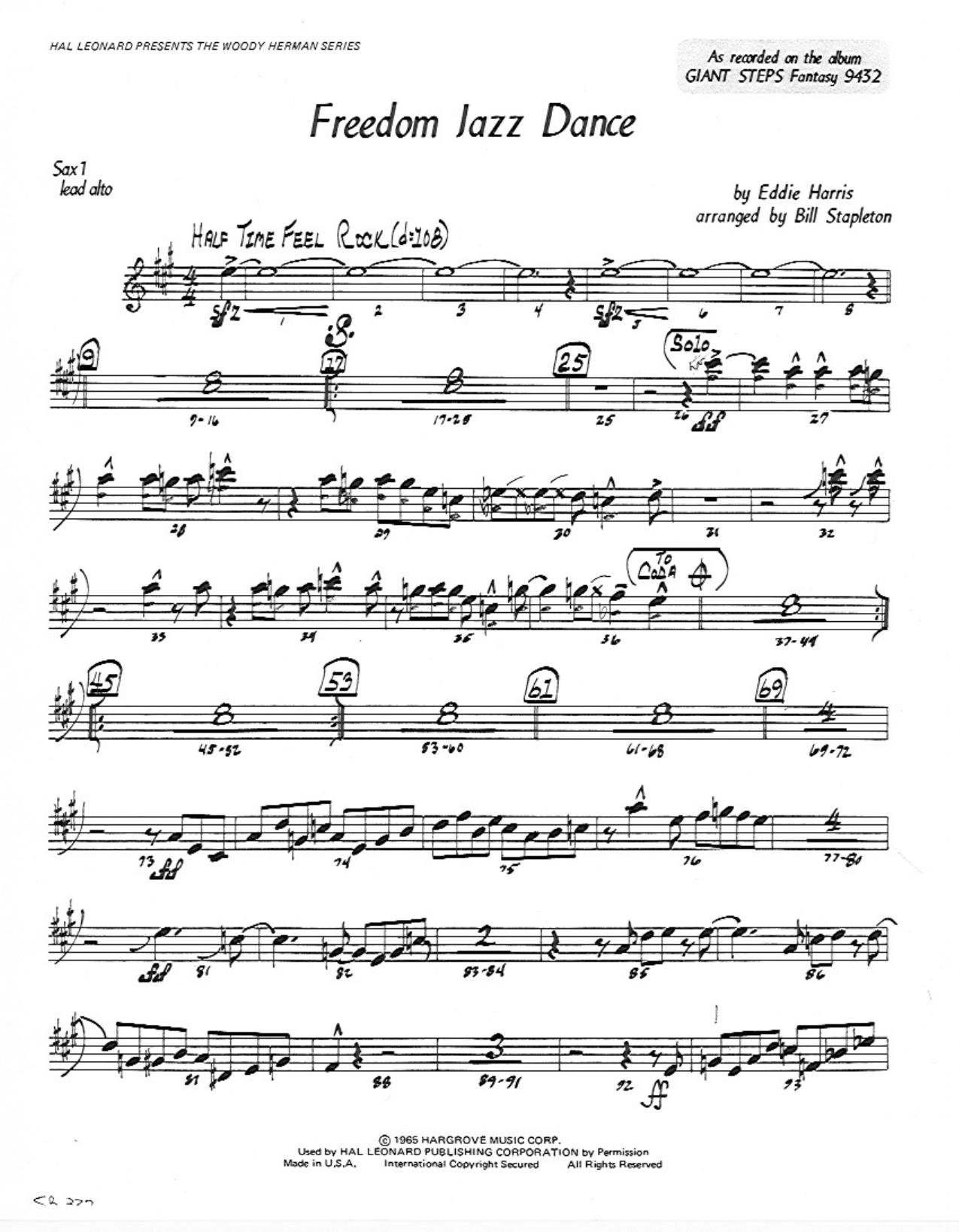
Freedom Jazz Dance (B.Stapleton) sheet music preview

Freedom Jazz Dance (B.Stapleton)

Composed by Eddie Harris

Arranged by Woody Herman

  • Ensemble: Big Band
  • Pages: 49
  • Instruments (19): Sax 1 lead alto, Sax 2 lead tenor, Sax 3 opt. alto, Sax 3 tenor, Sax 4 tenor, Sax 5 baritone, Trumpet 1, Trumpet 2, Trumpet 3, Trumpet 4, Trumpet 5, Trombone 1, Trombone 2, Trombone 3, Trombone 4 (Opt.), Bass, Drums, Guitar, Piano
  • Difficulty: medium
  • Content: Individual Parts
  • Format: PDF Download (Instant)
  • Price: $24.99

Eddie Harris originally composed "Freedom Jazz Dance" in 1965, recording it for his landmark album *The In Sound* before it was famously canonized by the Miles Davis Quintet on their 1966 release *Miles Smiles*. This modal jazz masterpiece quickly evolved from a quirky, harmonically ambiguous head into an essential modern jazz standard, celebrated for its infectious, asymmetrical 10-bar form and driving, blues-infused chromaticism. The tune bridges the gap between hard bop and the avant-garde leanings of the late sixties, offering a masterclass in tension and release. Woody Herman’s powerhouse big band adaptation supercharges Harris's original modal framework with high-octane swing, transforming a cool quartet exploration into a roaring, brass-heavy tour de force. Driven by an urgent, pulsing rhythm section feel, the arrangement explodes right out of the gate with aggressive ensemble hits and blistering sax solis. The emotional landscape shifts dynamically from cool, calculating modal vamps to explosive, high-energy shout choruses that demand absolute precision. The mood is relentlessly driving, sophisticated, and unmistakably theatrical, capturing the swagger of Herman’s legendary "Thundering Herd" era. Herman’s chart leverages the full 19-piece big band instrumentation to create massive sonic walls of sound, utilizing dense, extended post-bop harmonies in the brass contrasted with fleet-fingered woodwind counterpoint. The sax section—featuring a robust lineup of dual altos and multiple tenors—functions as a cohesive, nimble unit, executing intricate unison lines that double the iconic thematic material before breaking into harmonized block-chord solis. The arrangement wastes no time modulating and shifting textures, keeping both the ensemble and the listener on edge. A standout structural feature is the way the rhythm section locks into an unyielding, modal groove underneath shifting brass stabs, creating a rhythmic push-and-pull that heightens the overall excitement. Melodic duties are shared dynamically across the entire ensemble, though the woodwinds and trumpets frequently handle the primary thematic weight. Solo opportunities are carved out centrally, providing space for standout improvisers to stretch out over the modal changes. Technically, the chart demands agile double-tonguing from the trumpets, immense endurance and upper-register security from the lead chair, and a rhythm section capable of maintaining a relentless, driving pulse while remaining elastic. Advanced high school bands with strong section leaders, collegiate ensembles, and professional freelance big bands will find this chart immensely rewarding. It serves as an ideal vehicle for showcasing a tight rhythm section, powerful brass, and confident soloists capable of navigating modern modal territory with fierce swing authority. Navigating "Freedom Jazz Dance" requires acute rhythmic precision and stamina from all sections. The tempo must remain relentlessly steady; resist the urge to drag during the modal vamps or rush during the high-energy shout choruses. The primary technical challenge lies in executing the asymmetrical 10-bar phrasing cleanly. Horn players should practice the rapid, chromatic lines slowly with a metronome, ensuring that articulation markings (staccatos and accents) match uniformly across the entire section, particularly in the multi-tenor passages. Conductors should pay close attention to the dynamic contrast between the understated rhythm-section vamps and the sudden, explosive brass stabs. Ensure the lead trumpet maintains a bright, projecting tone without forcing the upper register. Saxophones should focus on a dry, articulate tone to cut through the heavy brass voicings. Encourage the rhythm section to treat the groove with a forward-leaning, aggressive edge rather than a laid-back swing feel. Q: What instruments and parts are included in this big band arrangement? A: This 49-page arrangement is scored for a standard 19-instrument big band lineup, featuring Alto Saxophone 1, Tenor Saxophone 2, Alto Saxophone 3, Tenor Saxophone 3, Tenor Saxophone 4, alongside standard brass and rhythm sections. Q: What is the difficulty level of this Woody Herman chart? A: This arrangement is best suited for advanced high school, collegiate, and professional big bands due to its intricate modal harmonies, fast-paced technical passages, and high-register endurance demands for the brass. Q: What is the musical style and historical background of "Freedom Jazz Dance"? A: Originally composed by Eddie Harris in 1965 and famously adapted by Miles Davis, this piece is a classic modal jazz standard built on an unconventional 10-bar form, which Woody Herman reimagined for his powerhouse big band. Q: What makes this specific arrangement by Woody Herman unique? A: Herman’s treatment transforms a small-group modal tune into a high-octane big band showcase, utilizing dense post-bop harmonies, aggressive brass stabs, and intricate woodwind lines that maximize the color of a 19-piece ensemble. Q: What is the expected performance duration and tempo feel of this arrangement? A: While performance time can vary based on the number of open solo choruses taken, the chart operates at a brisk, driving tempo with an urgent swing and modal groove feel that keeps momentum high from start to finish.

Questions and answers

What is included in the Freedom Jazz Dance (B.Stapleton) PDF?
The verified current file contains individual parts across 49 pages.
How many instruments or parts are listed for Freedom Jazz Dance (B.Stapleton)?
The verified instrumentation list contains 19 entries for this Big Band arrangement.
Who is credited for Freedom Jazz Dance (B.Stapleton)?
Composer: Eddie Harris. Arranger: Woody Herman.
What difficulty is listed for Freedom Jazz Dance (B.Stapleton)?
The verified difficulty level is medium.
Can I preview Freedom Jazz Dance (B.Stapleton) before buying?
Yes. The product page provides a preview generated from the current PDF file.
How is Freedom Jazz Dance (B.Stapleton) delivered?
After successful payment, the digital PDF is made available for download. The displayed price is $24.99.

Musicians Also Search For

Freedom Jazz Dance Woody Herman PDFFreedom Jazz Dance Woody Herman sheet musicFreedom Jazz Dance arranged by Woody HermanWoody Herman big band chartsWoody Herman jazz arrangements PDFFreedom Jazz Dance Eddie Harris sheet musicFreedom Jazz Dance Eddie Harris big band arrangementsEddie Harris big band chartsFreedom Jazz Dance big band arrangementsFreedom Jazz Dance big band PDF downloadFreedom Jazz Dance jazz sheet musicbig band sheet music downloadFreedom Jazz Dance individual parts downloadFreedom Jazz Dance sheet music PDFbuy Freedom Jazz Dance sheet musicdownload Freedom Jazz Dance PDFFreedom Jazz Dance jazz chartsbest Woody Herman big band arrangementsEddie Harris arranged by Woody HermanFreedom Jazz Dance printable sheet musicbig band repertoire PDF

All arrangements by Woody Herman All Eddie Harris sheet music