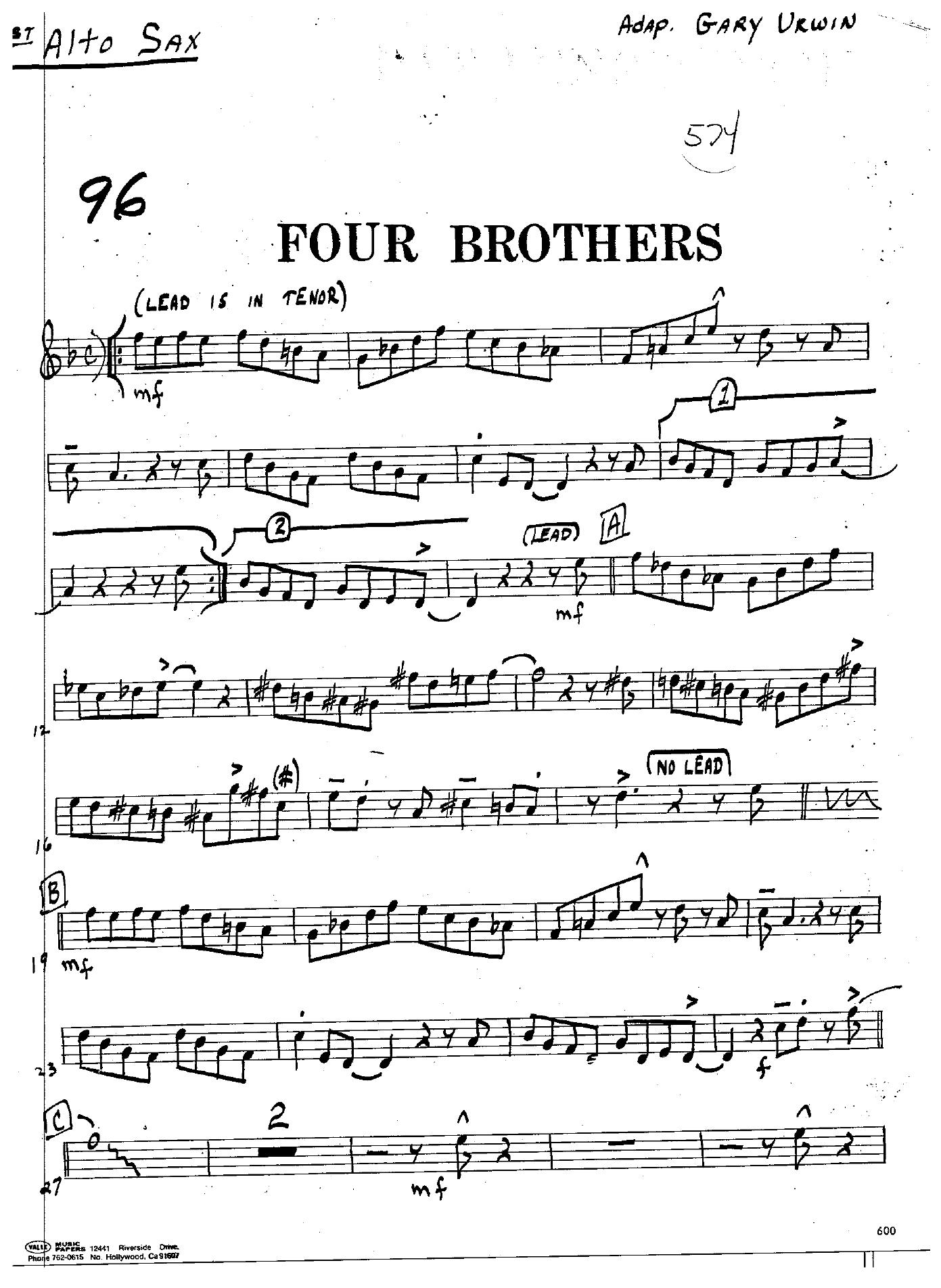
Four Brothers (G.Urwin)
Composed by Jimmy Giuffre
Arranged by Gary Urwin
- Ensemble: Big Band
- Pages: 61
- Instruments (18): 1st Alto Sax, 2nd Alto Sax, 1st Tenor Sax, 2nd Tenor Sax, Baritone Sax, 1st Trumpet, 2nd Trumpet, 3rd Trumpet, 4th Trumpet, 5th Trumpet (Optional), 1st Trombone, 2nd Trombone, 3rd Trombone (Optional), Bass Trombone, Piano, Bass, Drums, Guitar
- Difficulty: advanced
- Content: Individual Parts
- Format: PDF Download (Instant)
- Price: $24.99
Jimmy Giuffre’s immortal "Four Brothers" stands as a monumental pillar of West Coast jazz and Cool School writing, originally penned for the groundbreaking Second Herman Herd led by Woody Herman in 1947. Immortalized by the legendary "Four Brothers" saxophone section—featuring Zoot Sims, Stan Getz, Herbie Steward, and Serge Chaloff—this composition redefined the sonic palette of the big band by weaponizing three tenors and one baritone saxophone to create a rich, homogenized harmony that cut through the ensemble with a buttery, lightweight density. It quickly transcended its origins to become an essential bebop-infused jazz standard, celebrated for its infectious circular momentum, clever sequential writing, and driving counterpoint. Gary Urwin’s masterful modern big band treatment breathes exhilarating new life into this classic blueprint, driving forward with a brisk, high-energy medium-up swing tempo that demands precision and agility. The chart opens with an unmistakable, bubbling bop energy, capturing a breezy yet intensely sophisticated mood that evokes the smoky, cool sophistication of late-1940s Hollywood jazz clubs while maintaining a crisp, contemporary punch. Urwin captures the essence of the original three-tenor saxophone concept while expanding the voicing textures across a full 17-piece modern jazz orchestra instrumentation, weaving intricate harmonic extensions that balance traditional bebop chromaticism with lush, modern chord clusters. At the heart of Urwin’s arrangement is a breathtaking interplay between the brass and the full reed section, featuring meticulously crafted soli passages that mirror the intricate counterpoint of Giuffre's original writing while pushing the technical boundaries of the contemporary big band. The saxophone section takes center stage for several passages, requiring absolute unanimity of articulation, light-tongued sixteenth-note runs, and seamless blend across registers. Featured solo spaces allow standout improvisers in the band to stretch out over standard changes, supported by crisp, driving background figures from the brass that build organic dramatic tension leading into a roaring, harmonically adventurous shout chorus. Advanced high school ensembles with strong section players, college jazz orchestras, and professional big bands will find this 61-page score to be an immensely rewarding challenge. While the harmonic vocabulary is accessible to players well-versed in mainstream jazz idioms, the sheer velocity of the lines and the requirement for feather-light articulation demand mature ensemble discipline. Directors will appreciate how naturally the chart lies under the fingers once sectional balance is locked in, making it a show-stopping opener or festival chart that guarantees an enthusiastic response from any audience. Navigating Gary Urwin's dynamic adaptation of "Four Brothers" requires meticulous attention to articulation, balance, and stylistic consistency. Set at a brisk, driving medium-up swing tempo (around quarter note = 208–216), the primary technical hurdle lies in maintaining a light, horizontal "cool" articulation even at high velocities; avoid heavy, accented tongue strokes that can bog down the bop-infused lines. The rhythm section should anchor the groove with an unforced, driving ride-cymbal-led pulse, keeping the hi-hat crisp on beats two and four without overplaying. Brass players must exercise extreme dynamic control during background figures, ensuring they never mask the moving lines in the saxophones. Rehearsals should begin section by section at a reduced tempo, isolating the intricate counterpoint and ensuring that internal voice-leading is audible before integrating the full ensemble. Pay special attention to dynamic contrast leading into the shout chorus, where subtle crescendos will maximize the explosive impact of Urwin's reharmonizations. Q: What instrumentation and parts are included in this arrangement? A: This chart is scored for a standard 17-piece big band configuration, comprising 2 alto saxophones, 2 tenor saxophones, 1 baritone saxophone, 4 trumpets, 4 trombones, piano, guitar, bass, and drums, spanning a total of 61 pages of full score and parts. Q: What is the difficulty level of this arrangement? A: It is graded as advanced, making it ideal for skilled college jazz orchestras, top-tier high school bands, and professional community big bands that possess strong section reading skills and experienced soloists. Q: What is the stylistic background of this piece? A: Rooted in the West Coast cool jazz movement, this arrangement honors Jimmy Giuffre's legendary 1947 composition for Woody Herman while filtering the iconic swinging aesthetic through Gary Urwin's contemporary big band arranging lens. Q: What makes Gary Urwin's arrangement unique compared to other versions? A: Urwin expands upon the historic three-tenor/baritone saxophone concept by incorporating lush modern harmonic extensions, clever counter-melodies, and a powerhouse shout chorus that updates the classic bop vehicle for modern big bands. Q: What is the recommended performance duration and tempo? A: The arrangement runs approximately 4 to 5 minutes when performed at the recommended medium-up swing tempo of around quarter note = 210.
Questions and answers
- What is included in the Four Brothers (G.Urwin) PDF?
- The verified current file contains individual parts across 61 pages.
- How many instruments or parts are listed for Four Brothers (G.Urwin)?
- The verified instrumentation list contains 18 entries for this Big Band arrangement.
- Who is credited for Four Brothers (G.Urwin)?
- Composer: Jimmy Giuffre. Arranger: Gary Urwin.
- What difficulty is listed for Four Brothers (G.Urwin)?
- The verified difficulty level is advanced.
- Can I preview Four Brothers (G.Urwin) before buying?
- Yes. The product page provides a preview generated from the current PDF file.
- How is Four Brothers (G.Urwin) delivered?
- After successful payment, the digital PDF is made available for download. The displayed price is $24.99.
Musicians Also Search For
Four Brothers Gary Urwin PDF • Four Brothers Gary Urwin sheet music • Four Brothers arranged by Gary Urwin • Gary Urwin big band charts • Gary Urwin jazz arrangements PDF • Four Brothers Jimmy Giuffre sheet music • Four Brothers Jimmy Giuffre big band arrangements • Jimmy Giuffre big band charts • Four Brothers big band arrangements • Four Brothers big band PDF download • Four Brothers jazz sheet music • big band sheet music download • Four Brothers individual parts download • Four Brothers sheet music PDF • buy Four Brothers sheet music • download Four Brothers PDF • Four Brothers jazz charts • best Gary Urwin big band arrangements • Jimmy Giuffre arranged by Gary Urwin • Four Brothers printable sheet music • big band repertoire PDF