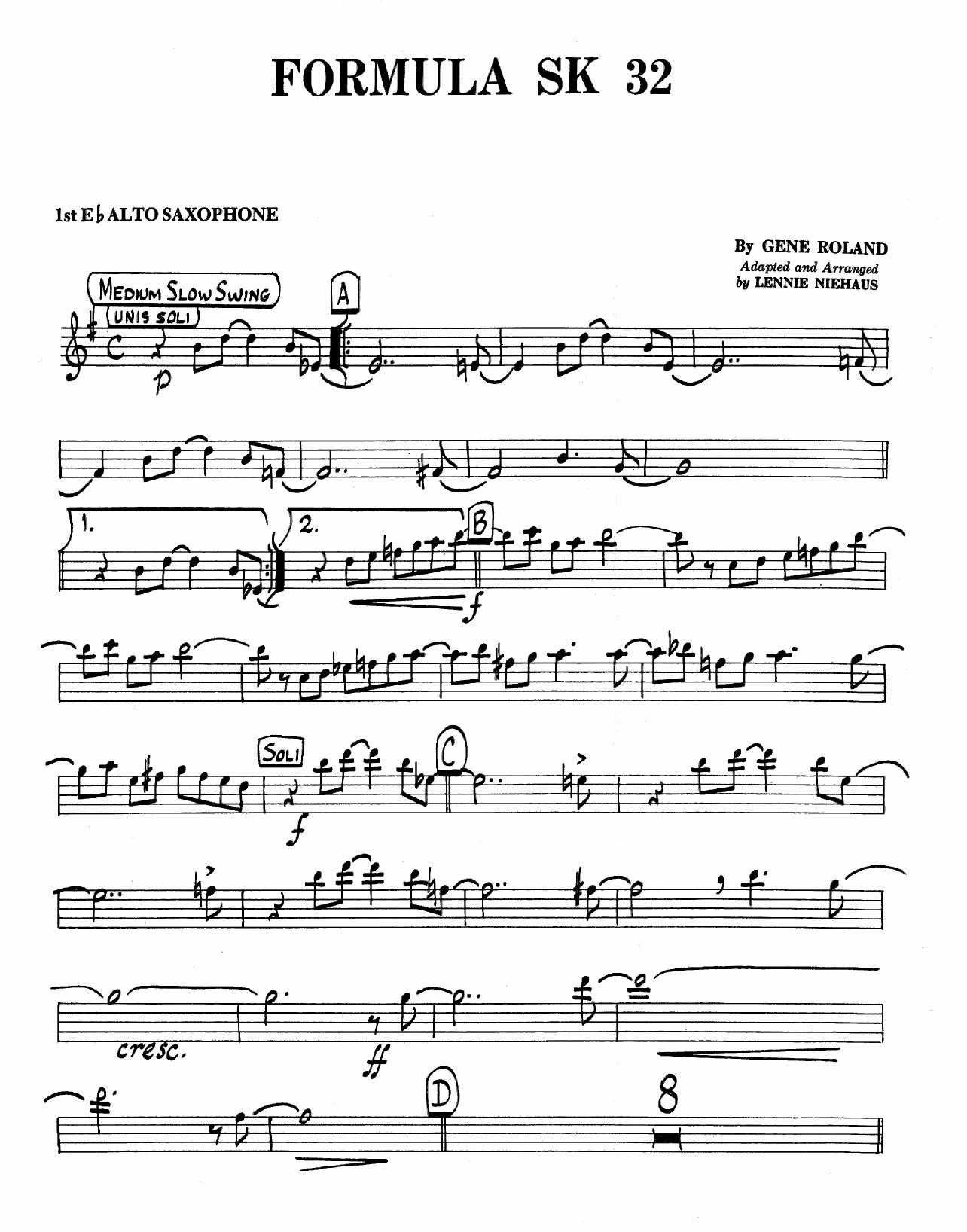
Formula SK 32 (L.Niehaus)
Composed by Lennie Niehaus
Arranged by Lennie Niehaus
- Ensemble: Big Band
- Pages: 35
- Instruments (17): 1st Eb Alto Saxophone, 2nd Eb Alto Saxophone, 1st Bb Tenor Saxophone, 2nd Bb Tenor Saxophone, Eb Baritone Saxophone, 1st Bb Trumpet, 2nd Bb Trumpet, 3rd Bb Trumpet, 4th Bb Trumpet, 1st Trombone, 2nd Trombone, 3rd Trombone, 4th Trombone, Piano, Guitar, Bass, Drums
- Difficulty: medium
- Content: Individual Parts
- Format: PDF Download (Instant)
- Price: $24.99
Bebop and West Coast cool jazz converged masterfully through the prolific pen of Lennie Niehaus, a foundational figure whose writing for big band remains a benchmark for crisp articulation, intricate counterpoint, and swinging modernism. "Formula SK 32" encapsulates the sophisticated yet deeply swinging ethos that Niehaus refined during his tenure with the Stan Kenton Orchestra and his subsequent extensive output for educational and professional jazz ensembles. Composed and arranged during an era when modern jazz arrangers were pushing big band writing toward tighter, linear configurations and harmonically adventurous textures, this chart bridges the gap between classic swing propulsion and bebop-infused harmonic sophistication. Driving with an infectious, medium-up swing tempo, "Formula SK 32" opens with an energetic statement that immediately establishes a bright, forward-moving character. The harmonic language is rich with altered dominants, chromatic voice-leading, and signature Niehaus parallel block chords that demand immaculate intonation and rhythmic unity from the brass and reed sections. The mood is sharp, intellectual, and relentlessly driving, evoking the cool sophistication of West Coast modernism while retaining the high-octane energy of a traditional powerhouse big band. The emotional trajectory builds steadily from a taut, driving head into soaring ensemble passages that push the rhythm section to maintain a relentless, buoyant pulse. Niehaus treats the 16-piece big band as a finely calibrated machine, utilizing the saxophones (two altos, two tenors, and baritone) as a tightly knit, highly agile choir that frequently handles complex bebop lines in unison or rich harmonic parallelisms. The brass section is deployed with precision, punctuating the texture with crisp, articulate staccato bursts and well-placed background figures that never muddy the sonic space. Solo opportunities are integrated seamlessly into the form, allowing featured improvisers to stretch out over changes that favor modal explorations and bebop vocabulary. The shout chorus serves as a structural high point, brilliantly recycling motivic material introduced earlier in the chart while ratcheting up the dynamic intensity through clever cross-section counterpoint and rhythmic displacement. Advanced high school, collegiate, and professional jazz ensembles will find "Formula SK 32" to be an exceptionally rewarding vehicle for developing ensemble reading skills, stylistic uniformity, and swing-eighth-note integrity. Because Niehaus writes idiomatically for each horn, players accustomed to standard arrangement tropes will appreciate how every part maintains genuine melodic and rhythmic interest. Performing this arrangement successfully requires an ensemble that excels at light, articulate swing phrasing, precise section balance, and maintaining a transparent texture where intricate inner voices can cut through the ensemble framework. Achieving an authentic realization of "Formula SK 32" requires meticulous attention to articulation, particularly the crisp execution of short, accented notes and the proper placement of late-eighth-note swing feels. The conductor should establish a comfortable, driving medium-up swing tempo where the ride cymbal dictates the pulsing momentum without rushing. Rehearsal should begin by isolating the saxophone section to master the rapid bebop lines without tongue-slapping; uniform articulation across both alto and tenor voices is critical for the soli sections to sound cohesive. Brass players must avoid overblowing on high register accents, prioritizing a bright, focused tone that blends rather than dominates the chordal texture. The rhythm section functions as the engine: the drummer should keep the time crisp and uncrowded, utilizing light hi-hat chokes on beats two and four, while the bassist walks a steady, quarter-note line that locks tightly with the piano's comping rhythms. Pay close attention to dynamic contrast between background figures and featured soloists to ensure clarity throughout every section. Q: What specific instruments and parts are included in the 16-instrument instrumentation for "Formula SK 32"? A: The arrangement is scored for a standard 16-piece big band featuring Alto Saxophone 1, Alto Saxophone 2, Tenor Saxophone 1, Tenor Saxophone 2, Baritone Saxophone, four trumpets, four trombones, piano, bass, and drums. Q: What is the designated difficulty level for this Lennie Niehaus arrangement? A: This chart is best suited for advanced high school, collegiate, and professional jazz ensembles due to its demanding bebop-inflected lines, intricate section unisons, and required facility with fast swing tempos. Q: What stylistic era does "Formula SK 32" represent within the jazz canon? A: It represents the modern West Coast cool and bebop-influenced big band era, blending sophisticated linear counterpoint with the swinging drive characteristic of Lennie Niehaus’s celebrated writing style. Q: What makes this specific arrangement unique compared to standard big band charts? A: Its uniqueness lies in Niehaus’s signature use of intricate saxophone block voicings, transparent cross-section counterpoint, and rhythmically inventive shout choruses that treat every section as an equal melodic voice. Q: What is the general tempo feel and performance duration of the piece? A: The arrangement is set in a brisk, driving medium-up swing feel (4/4 time) designed to showcase an ensemble's rhythmic precision and stamina over a standard multi-chorus big band form.
Questions and answers
- What is included in the Formula SK 32 (L.Niehaus) PDF?
- The verified current file contains individual parts across 35 pages.
- How many instruments or parts are listed for Formula SK 32 (L.Niehaus)?
- The verified instrumentation list contains 17 entries for this Big Band arrangement.
- Who is credited for Formula SK 32 (L.Niehaus)?
- Composer: Lennie Niehaus. Arranger: Lennie Niehaus.
- What difficulty is listed for Formula SK 32 (L.Niehaus)?
- The verified difficulty level is medium.
- Can I preview Formula SK 32 (L.Niehaus) before buying?
- Yes. The product page provides a preview generated from the current PDF file.
- How is Formula SK 32 (L.Niehaus) delivered?
- After successful payment, the digital PDF is made available for download. The displayed price is $24.99.
Musicians Also Search For
Formula SK 32 Lennie Niehaus PDF • Formula SK 32 Lennie Niehaus sheet music • Formula SK 32 arranged by Lennie Niehaus • Lennie Niehaus big band charts • Lennie Niehaus jazz arrangements PDF • Formula SK 32 Lennie Niehaus big band arrangements • Formula SK 32 big band arrangements • Formula SK 32 big band PDF download • Formula SK 32 jazz sheet music • big band sheet music download • Formula SK 32 individual parts download • Formula SK 32 sheet music PDF • buy Formula SK 32 sheet music • download Formula SK 32 PDF • Formula SK 32 jazz charts • best Lennie Niehaus big band arrangements • Formula SK 32 printable sheet music • big band repertoire PDF