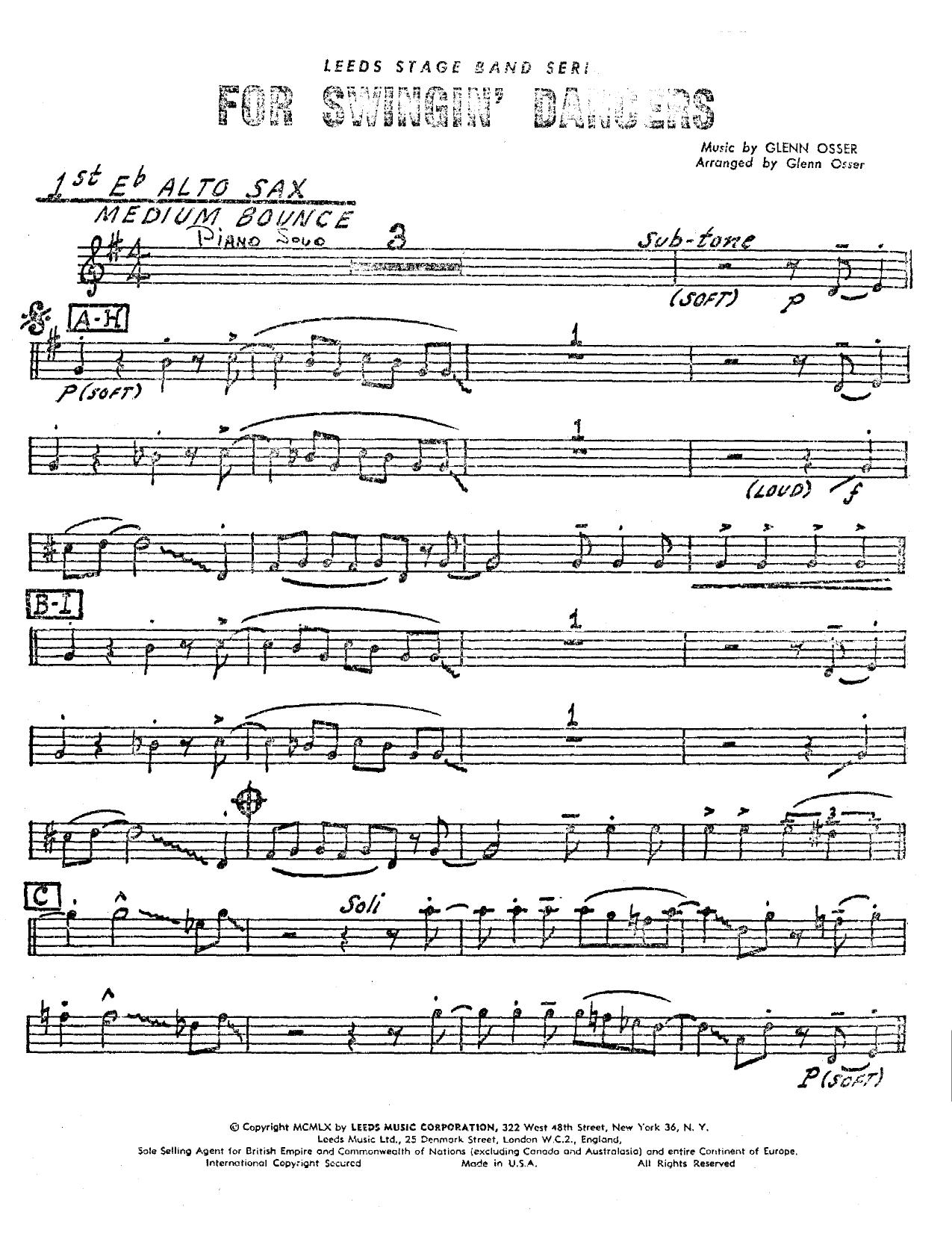
For Swingin' Dancers (G.Osser)
Composed by Glenn Osser
Arranged by Glenn Osser
- Ensemble: Big Band
- Pages: 36
- Instruments (17): 1st Eb Alto Sax, 2nd Bb Tenor Sax, 3rd Eb Alto Sax, 4th Bb Tenor Sax, 5th Eb Baritone Sax, 1st Bb Trumpet, 2nd Bb Trumpet, 3rd Bb Trumpet, 4th Bb Trumpet, 1st Trombone, 2nd Trombone, 3rd Trombone, 4th Trombone, Guitar, Piano (Accordion), String Bass, Drums
- Difficulty: medium
- Content: Individual Parts
- Format: PDF Download (Instant)
- Price: $24.99
Mid-century American bandstands and radio broadcasts bore witness to the golden age of polished, high-energy dance arrangements, a golden era brilliantly captured by composer and arranger Glenn Osser. Writing under his own name as well as his prominent pseudonym "Spike Jones' arranger" or his extensive work for television and light-concert orchestras, Osser mastered the art of combining sophisticated harmonic movement with an irresistible, foot-tapping pulse. "For Swingin' Dancers" stands as a quintessential artifact of this vibrant post-war big band movement, designed from the ground up to fill ballrooms with kinetic energy while offering musicians a masterclass in crisp articulation, buoyant swing styling, and transparent, swinging ensemble writing. Driving forward with an infectious, bright medium-up swing feel in 4/4 time, the chart exudes an atmosphere of effortless cool and unbridled optimism. From the opening brass punch to the final cymbal crash, the mood is jubilant, sophisticated, and tailor-made for movement. Osser structures the arrangement with meticulous craftsmanship, utilizing tight, interlocking horn voicings that recall the classic radio studio orchestras of the 1950s. The melodic weight is shared fluidly across the compact eight-instrument ensemble—featuring a punchy three-piece sax section (alto, tenor, baritone) alongside trumpet, trombone, and rhythm support—ensuring that every player maintains a vital role in the contrapuntal texture. Rather than relying on massive wall-of-sound orchestration, Osser achieves transparency and punch through brilliant voice-leading, clever dynamic shifts, and snappy syncopated figures that make the ensemble sound twice its size. Navigating this 36-page score requires precision, clean articulation, and a strong collective sense of time. The primary technical challenges lie in the ensemble phrasing; short, clipped notes must be executed with identical weight across the reed and brass sections to achieve that signature radio-band sheen. The woodwind voices weave agile counter-lines beneath declarative brass statements, demanding independent confidence from every player on the stage. Dynamic contrasts are sharp and sudden, requiring disciplined control over peaks and valleys, particularly during the crisp transition into the primary shout chorus. Advanced high school ensembles, collegiate studio bands, and professional community big bands will find this arrangement to be an exceptionally rewarding addition to their repertoire. Because of its scaled-down 8-instrument configuration, it provides a unique pedagogical and performance opportunity: it forces individual accountability while delivering the rich, authentic harmonic language of a full big band. Conductor and players alike will appreciate how efficiently Osser's writing translates on stage, offering a masterclass in swing era style that never fails to electrify an audience. Achieving an authentic mid-century broadcast sound on "For Swingin' Dancers" demands strict adherence to style-specific articulation and dynamic discipline. Establish a confident, driving medium-up swing tempo right from the downbeat, ensuring the rhythm section locks into a steady, unhurried pulse that encourages the horns to swing rather than rush. The primary technical hurdle involves the execution of short, accented quarter notes and articulated eighth-note lines; all players must match tongue attacks, particularly on the syncopated ensemble hits. Brass players should use a clean, bright tone without overblowing, keeping plunger or cup-mute effects (where applied) crisp and controlled. Rehearsal should initially isolate the interplay between the saxophone soli and the punctuating brass riffs, ensuring the dynamic balance favors whichever section carries the thematic material. Pay close attention to the dynamic hairpins leading into sectional unisons to maximize the dramatic impact of Osser's clever harmonic shifts. Q: What instruments and parts are included in this arrangement? A: This arrangement is scored for an 8-instrument ensemble, comprising Alto Saxophone, Tenor Saxophone, Baritone Saxophone, Trumpet, Trombone, and a complete rhythm section, across a comprehensive 36-page score and parts set. Q: What is the difficulty level of this piece? A: It is well-suited for advanced high school, collegiate, and professional small-ensemble or reduced big band configurations, requiring solid reading skills and precise ensemble articulation. Q: What musical style and historical era does this arrangement represent? A: Written by Glenn Osser, it represents the polished, radio-friendly swing and dance band era of the mid-20th century, combining sophisticated harmonic voicings with a high-energy dance groove. Q: What makes this particular arrangement unique? A: Its unique strength lies in Glenn Osser's ability to capture the expansive, punchy sound of a full big band within a streamlined 8-instrument texture through brilliant voice-leading and transparent counterpoint. Q: What is the recommended performance tempo and duration? A: The piece is set in a bright, driving 4/4 swing feel with a performance duration of approximately 3 to 4 minutes, depending on the chosen tempo and soloist extensions.
Questions and answers
- What is included in the For Swingin' Dancers (G.Osser) PDF?
- The verified current file contains individual parts across 36 pages.
- How many instruments or parts are listed for For Swingin' Dancers (G.Osser)?
- The verified instrumentation list contains 17 entries for this Big Band arrangement.
- Who is credited for For Swingin' Dancers (G.Osser)?
- Composer: Glenn Osser. Arranger: Glenn Osser.
- What difficulty is listed for For Swingin' Dancers (G.Osser)?
- The verified difficulty level is medium.
- Can I preview For Swingin' Dancers (G.Osser) before buying?
- Yes. The product page provides a preview generated from the current PDF file.
- How is For Swingin' Dancers (G.Osser) delivered?
- After successful payment, the digital PDF is made available for download. The displayed price is $24.99.
Musicians Also Search For
For Swingin' Dancers Glenn Osser PDF • For Swingin' Dancers Glenn Osser sheet music • For Swingin' Dancers arranged by Glenn Osser • Glenn Osser big band charts • Glenn Osser jazz arrangements PDF • For Swingin' Dancers Glenn Osser big band arrangements • For Swingin' Dancers big band arrangements • For Swingin' Dancers big band PDF download • For Swingin' Dancers jazz sheet music • big band sheet music download • For Swingin' Dancers individual parts download • For Swingin' Dancers sheet music PDF • buy For Swingin' Dancers sheet music • download For Swingin' Dancers PDF • For Swingin' Dancers jazz charts • best Glenn Osser big band arrangements • For Swingin' Dancers printable sheet music • big band repertoire PDF