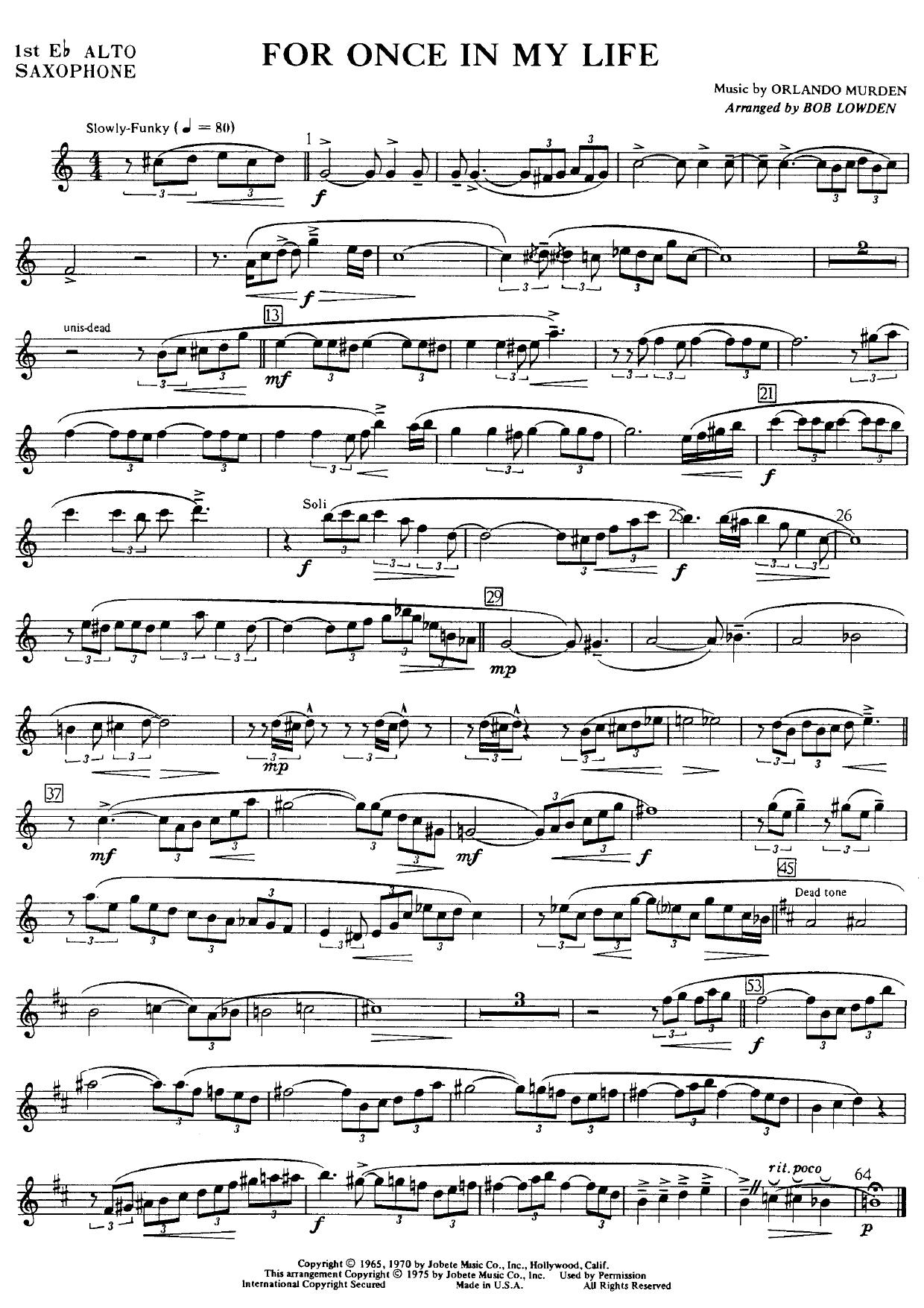
For Once In My Life (B.Lowden) sheet music preview

For Once In My Life (B.Lowden)

Composed by Stevie Wonder

Arranged by Bob Lowden

  • Ensemble: Big Band
  • Pages: 23
  • Instruments (19): 1st Eb Alto Saxophone, 2nd Eb Alto Saxophone, 1st Bb Tenor Saxophone, 2nd Bb Tenor Saxophone, Eb Baritone Saxophone, 1st Bb Trumpet, 2nd Bb Trumpet, 3rd Bb Trumpet, 4th Bb Trumpet, 5th Bb Trumpet (Optional), 1st Trombone, 2nd Trombone, 3rd Trombone, 4th Trombone, 5th Trombone (Optional) / Tuba, Piano, Bass, Drums, Guitar
  • Difficulty: medium
  • Content: Individual Parts
  • Format: PDF Download (Instant)
  • Price: $24.99

Originally recorded by Stevie Wonder in 1968 for Tamla (Motown), "For Once In My Life" stands as an enduring masterpiece of soul and pop-inflected jazz, capturing the vibrant energy and optimistic spirit of late-1960s popular music. Written by Ron Miller and Orlando Murden, the song was initially cut as a slow ballad before Wonder transformed it into an ecstatic, uptempo celebration of love that exploded onto the international charts. Over the decades, it has transcended its Motown roots to become a staple of the Great American Songbook and a favorite vehicle for jazz instrumentalists, most notably interpreted by artists like Tony Bennett, Ella Fitzgerald, and various big bands seeking to bridge the gap between soulful groove and straight-ahead jazz sophistication. Bob Lowden’s masterwork big band arrangement infuses this iconic tune with a driving, infectious swing feel that balances high-octane ensemble energy with clever, intricate horn writing. Set in a bright, forward-moving tempo, the arrangement opens with a recognizable rhythmic hook before opening up into rich, cascading harmonic structures. Lowden utilizes the full 19-instrument big band palette with exceptional dexterity, employing lush sax soli passages and dynamic brass counter-melodies that give every section a chance to shine. The mood is persistently euphoric and uplifting, driven by a pulsating rhythm section groove that demands precision and stamina from both the drummer and bassist, while maintaining the bright, brassy warmth characteristic of classic mid-century big band charts. Throughout the chart, melody duties are shared dynamically across sections, preventing textural monotony and creating an engaging dialogue between the saxophones, trumpets, and trombones. Lowden builds structural tension effectively through clever modulation and a powerful shout chorus that serves as the emotional and sonic peak of the arrangement. While there are opportunities to spotlight featured soloists, the primary strength of this chart lies in its ensemble cohesion; the interplay between the rhythm section and the horn blocks requires tight articulation and an acute awareness of swing subdivisions. The harmonic language expands upon the original chord progression with tasteful extensions, making the transitions between lyrical melody statements and punchy, accented ensemble hits sound seamless and sophisticated. Advanced high school ensembles, collegiate jazz bands, and professional community big bands will find this chart to be an exceptionally rewarding addition to their repertoire. It strikes an ideal balance between audience accessibility and musical substance, providing enough technical challenge to refine a band's section playing, dynamic control, and articulation without introducing unmanageable avant-garde hurdles. Conductors will appreciate how naturally the arrangement lays on the instruments, allowing groups to focus on stylistic nuance, stylistic uniformity, and high-energy delivery that leaves a lasting impression on listeners. Achieving the right pocket is essential; the tempo must maintain a driving, energetic medium-up swing feel without rushing. Section leaders should ensure that all eighth notes are properly swung, avoiding an overly stiff or too-triplet-heavy interpretation. The brass section must pay close attention to dynamic markings during the shout chorus, keeping a lid on the volume early to allow room for a natural, blazing crescendo. Articulation is the primary technical challenge—short notes must be clipped and uniform across the sax and brass sections, while accented lines require a warm, vocal quality. Rehearsal should begin with the rhythm section isolating the groove and hi-hat crispness before integrating the horns. Encourage the lead trumpeter to project confidently over the ensemble without forcing tone quality, and ensure the bass player locks in tightly with the ride cymbal to anchor the dynamic tempo changes throughout the form. Q: What instrumentation and parts are included in this arrangement? A: This arrangement is scored for a standard 19-instrument big band, which includes Alto Saxophone 1, Alto Saxophone 2, Tenor Saxophone 1, Tenor Saxophone 2, Baritone Saxophone, 4 Trumpets, 4 Trombones, Piano, Guitar, Bass, Drums, and a comprehensive conductor score. Q: What is the difficulty level of this Bob Lowden arrangement? A: This chart is graded as medium-advanced, making it ideal for accomplished high school ensembles, college jazz bands, and professional community big bands looking for a crowd-pleasing yet musically substantial chart. Q: What is the historical context and musical style of this piece? A: Based on Stevie Wonder's 1968 Motown classic, this arrangement reimagines the soulful pop standard through a high-energy, swinging big band jazz lens that honors both the era of its origin and traditional jazz arranging idioms. Q: What makes this specific arrangement by Bob Lowden unique? A: Lowden’s treatment stands out for its brilliant distribution of melody across multiple sections, clever harmonic expansions, and a powerhouse shout chorus that maximizes the dynamic range of a full 19-piece big band. Q: What is the performance duration and tempo feel of the piece? A: The arrangement is designed to be performed at a bright, driving medium-up swing tempo (approximately quarter note = 152-160 BPM), resulting in a performance duration of roughly 3 to 4 minutes depending on solo extensions.

Questions and answers

What is included in the For Once In My Life (B.Lowden) PDF?
The verified current file contains a conductor score and individual parts across 23 pages.
How many instruments or parts are listed for For Once In My Life (B.Lowden)?
The verified instrumentation list contains 19 entries for this Big Band arrangement.
Who is credited for For Once In My Life (B.Lowden)?
Composer: Stevie Wonder. Arranger: Bob Lowden.
What difficulty is listed for For Once In My Life (B.Lowden)?
The verified difficulty level is medium.
Can I preview For Once In My Life (B.Lowden) before buying?
Yes. The product page provides a preview generated from the current PDF file.
How is For Once In My Life (B.Lowden) delivered?
After successful payment, the digital PDF is made available for download. The displayed price is $24.99.

Musicians Also Search For

For Once In My Life Bob Lowden PDFFor Once In My Life Bob Lowden sheet musicFor Once In My Life arranged by Bob LowdenBob Lowden big band chartsBob Lowden jazz arrangements PDFFor Once In My Life Stevie Wonder sheet musicFor Once In My Life Stevie Wonder big band arrangementsStevie Wonder big band chartsFor Once In My Life big band arrangementsFor Once In My Life big band PDF downloadFor Once In My Life jazz sheet musicbig band sheet music downloadFor Once In My Life conductor score PDFFor Once In My Life individual parts downloadFor Once In My Life sheet music PDFbuy For Once In My Life sheet musicdownload For Once In My Life PDFFor Once In My Life jazz chartsbest Bob Lowden big band arrangementsStevie Wonder arranged by Bob LowdenFor Once In My Life printable sheet musicbig band repertoire PDF

All arrangements by Bob Lowden All Stevie Wonder sheet music